16th Finance Commission and the Future of Fiscal Federalism
#GS-2 #Indian Polity & Constitution #Federalism #Constitutional Bodies #GS-3 #Economy #Taxation #Fiscal Federalism #Centre-State Relations #Current Events #National
Key takeaways
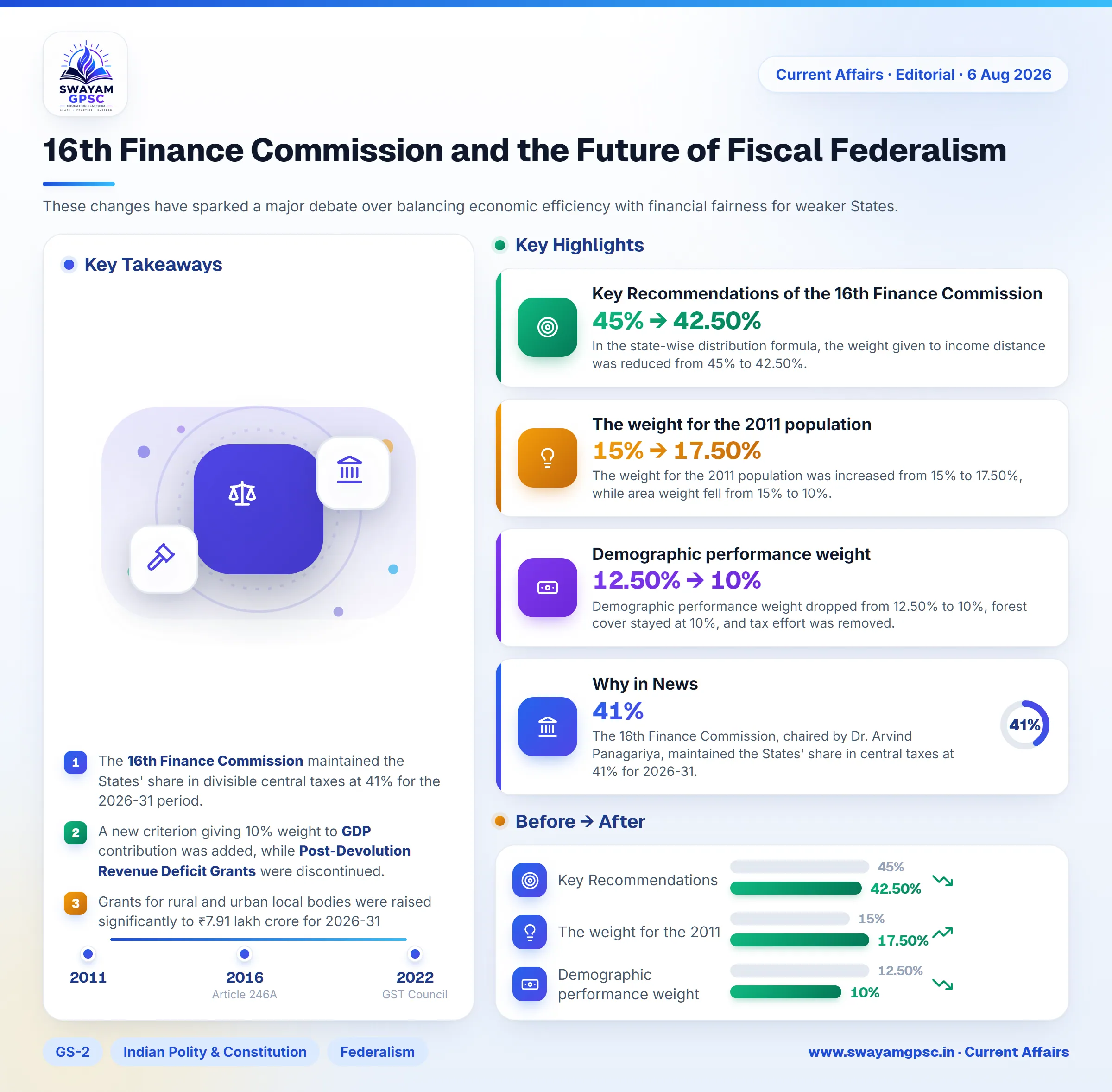
- The 16th Finance Commission maintained the States' share in divisible central taxes at 41% for the 2026-31 period.
- A new criterion giving 10% weight to GDP contribution was added, while Post-Devolution Revenue Deficit Grants were discontinued.
- Grants for rural and urban local bodies were raised significantly to ₹7.91 lakh crore for 2026-31, up from ₹4.36 lakh crore under the previous commission.
- The shareable central tax pool shrank from 89.1% in 2014-15 to 74-80% during 2020-24 due to higher Union cesses and surcharges.
- The report targets a reduction in combined Centre-State public debt from 77.3% of GDP in 2026-27 down to 73.1% by 2030-31.
Why in News
- The 16th Finance Commission, chaired by Dr. Arvind Panagariya, maintained the States' share in central taxes at 41% for 2026-31.
- The Commission introduced major changes to how tax revenue is distributed among individual States across India.
- It completely stopped Post-Devolution Revenue Deficit Grants, sector-specific grants, and State-specific grants.
- The formula now includes a 10% weight for a State's contribution to GDP alongside higher transfers for local governments.
- These changes have sparked a major debate over balancing economic efficiency with financial fairness for weaker States.
Understanding Fiscal Federalism
- Fiscal federalism defines how taxing powers, spending duties, borrowing rights, and grants are divided among different levels of government.
- India's fiscal setup aims to balance three main financial inequalities across the country.
- Vertical fiscal imbalance occurs because the Union government collects major taxes while States handle heavy expenses like health and education.
- Horizontal fiscal imbalance exists because States vary greatly in income, natural resources, geography, and tax-raising ability.
- For example, Bihar cannot provide the same quality of public services as a high-income State using the same tax rates.
- Third-tier imbalance means Panchayats and Municipalities face large local duties but have very few direct revenue sources.
- Article 246 and the 7th Schedule divide legislative and taxing authority between the Union and States through three lists.
- Article 246A, added by the 101st Constitutional Amendment Act, 2016, established joint powers over Goods and Services Tax (GST).
- Article 270 creates the central divisible pool of taxes, but it excludes Union surcharges under Article 271 and cesses.
- Article 275 allows Parliament to provide financial grants from the Consolidated Fund of India to States in need.
- Under Article 280, the President sets up a Finance Commission every 5 years to recommend tax sharing rules.
- Article 282 enables central or state grants for public purposes, serving as the basis for Centrally Sponsored Schemes.
- Articles 243-I and 243-Y order States to set up State Finance Commissions every 5 years to help local bodies.
- Article 293 regulates state loans and requires central consent if a State owes money to the Union government.
- Article 279A created the GST Council to enable joint Centre-State decisions on indirect tax rules.
Key Recommendations of the 16th Finance Commission
- The 16th Finance Commission kept the States' share in divisible central taxes at 41%, matching the 15th Finance Commission.
- In the state-wise distribution formula, the weight given to income distance was reduced from 45% to 42.50%.
- The weight for the 2011 population was increased from 15% to 17.50%, while area weight fell from 15% to 10%.
- Demographic performance weight dropped from 12.50% to 10%, forest cover stayed at 10%, and tax effort was removed.
- A new 10% weight was introduced for a State's contribution to GDP, calculated using the square root of State GSDP.
- This new rule rewards productive economies while moderating the raw advantage of the largest State economies.
- The Commission completely ended Post-Devolution Revenue Deficit Grants, along with sector-specific and State-specific grants.
- This shift encourages States to collect more revenue and manage spending instead of relying on gap-filling grants.
- Local government grants were increased to ₹7.91 lakh crore for 2026-31, up from ₹4.36 lakh crore under the previous commission.
- Basic and performance local grants follow an 80:20 ratio, with half of basic grants untied and half tied to sanitation and water.
- The report added ₹56,100 crore as Special Infrastructure Grants for urban wastewater and a ₹10,000-crore Urbanisation Premium.
- For disaster management, the total outlay is ₹2,04,401 crore, with the Union contributing ₹1,55,916 crore.
- The central sharing ratio is set at 90:10 for northeastern and Himalayan States and 75:25 for all other States.
- States must limit fiscal deficits to 3% of GSDP, while the Union must lower its deficit to 3.5% by 2030-31.
- The Commission called for stopping off-budget borrowing and projected total debt to drop from 77.3% in 2026-27 to 73.1% by 2030-31.
Challenges
- A total of 18 States requested a higher tax devolution share of 50%, showing dissatisfaction with retaining the 41% level.
- Union cesses and surcharges shrank the shareable tax pool from 89.1% in 2014-15 to 74-80% during 2020-24.
- Stopping deficit grants removes an important safety net for hill States like Himachal Pradesh and Punjab.
- Giving 10% weight to GDP might favor developed coastal States that already benefit from strong industrial infrastructure.
- Ending State-specific grants leaves States without targeted help for local crises like floods in Assam or droughts in Rajasthan.
- Weak and delayed State Finance Commissions leave Panchayats and Municipalities reliant on central grants.
- The GST system combined major taxing powers into the GST Council, reducing independent state fiscal powers.
- In Union of India v. Mohit Minerals (2022), the Supreme Court noted that GST Council decisions are persuasive, highlighting federal contestation.
Global Best Practices on Fiscal Federalism
- Australia uses its Commonwealth Grants Commission to distribute GST revenue so all states can offer equal public service levels.
- Canada provides unconditional federal equalisation grants to provinces with lower tax capacity to support local service needs.
Way Forward
- India should maintain a transparent equalisation grant based on clear fiscal capacity and public spending needs.
- The Union and States must review long-standing cesses and surcharges to combine permanent ones into the main tax pool.
- Economic performance indicators should support equalisation by rewarding human development and tax collection improvements.
- States must set up State Finance Commissions on schedule and implement their reports with technical support.
- The Centre needs to simplify overlapping Centrally Sponsored Schemes and grant States more flexibility in spending.
- Both Union and State governments must fully disclose off-budget liabilities and subsidy promises for clear accounting.
- Future Finance Commissions should include indicators for climate exposure, disaster risk, and mountainous terrain costs.
- Regular Centre-State fiscal discussions should continue through the GST Council, Inter-State Council, and NITI Aayog.
Conclusion
- The 16th Finance Commission focuses on economic growth and discipline, but removing deficit grants creates financial pressure for weaker States.
- India needs a balanced fiscal policy that blends economic competition with fair support for less developed regions.