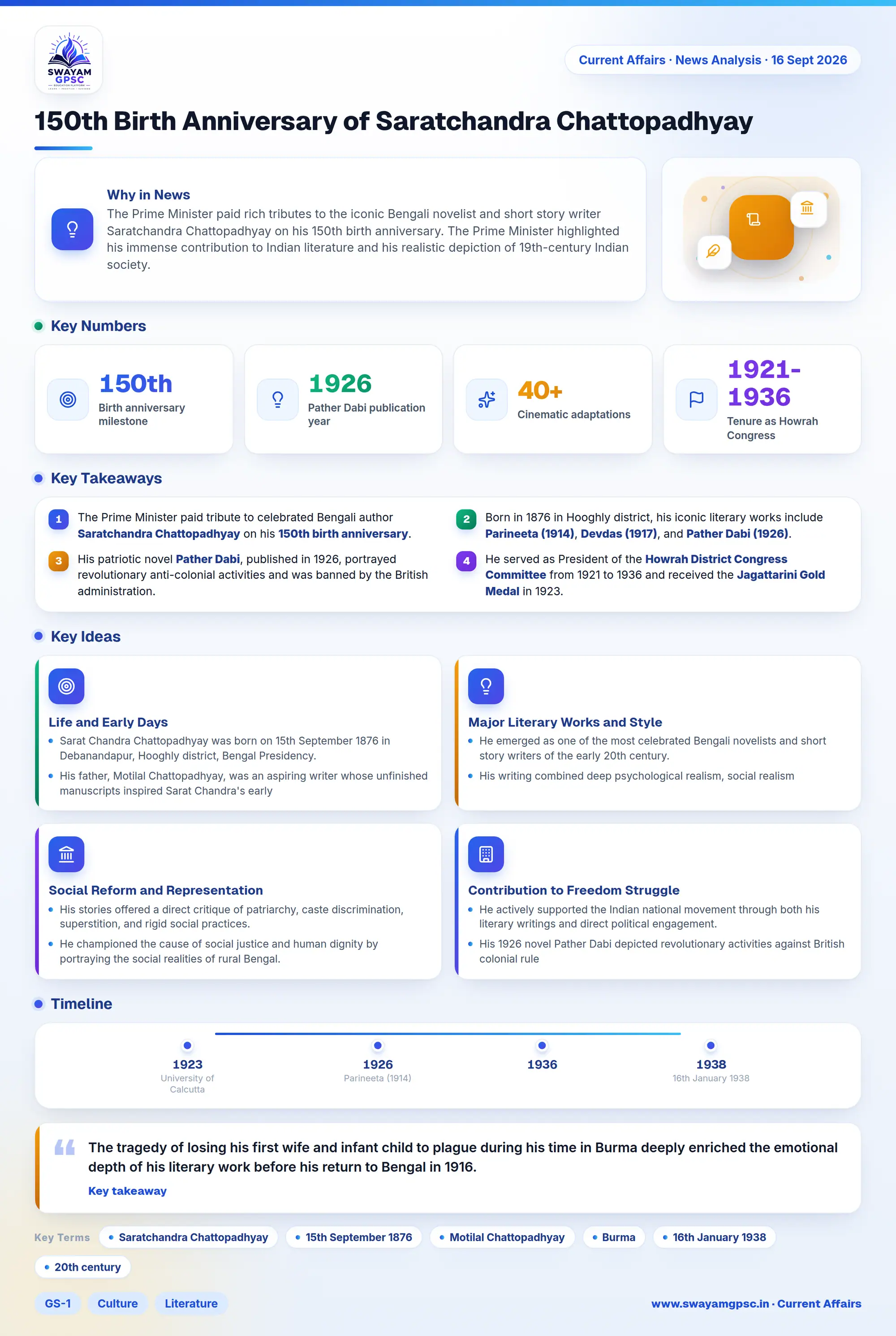
150th Birth Anniversary of Saratchandra Chattopadhyay
#GS-1 #Culture #Literature #History #Freedom Struggle #Current Events #National #Saratchandra Chattopadhyay
Key takeaways
- The Prime Minister paid tribute to celebrated Bengali author Saratchandra Chattopadhyay on his 150th birth anniversary.
- Born in 1876 in Hooghly district, his iconic literary works include Parineeta (1914), Devdas (1917), and Pather Dabi (1926).
- His patriotic novel Pather Dabi, published in 1926, portrayed revolutionary anti-colonial activities and was banned by the British administration.
- He served as President of the Howrah District Congress Committee from 1921 to 1936 and received the Jagattarini Gold Medal in 1923.
- His writings inspired over 40 cinematic adaptations and were translated into numerous Indian and foreign languages.
Why in News
- The Prime Minister paid rich tributes to the iconic Bengali novelist and short story writer Saratchandra Chattopadhyay on his 150th birth anniversary.
- The Prime Minister highlighted his immense contribution to Indian literature and his realistic depiction of 19th-century Indian society.
Life and Early Days
- Sarat Chandra Chattopadhyay was born on 15th September 1876 in Debanandapur, Hooghly district, Bengal Presidency.
- His father, Motilal Chattopadhyay, was an aspiring writer whose unfinished manuscripts inspired Sarat Chandra's early creative imagination.
- He moved to Burma in 1903 to work in Rangoon and spent nearly a decade there.
- The tragedy of losing his first wife and infant child to plague during his time in Burma deeply enriched the emotional depth of his literary work before his return to Bengal in 1916.
- He passed away on 16th January 1938 in Kolkata at the age of 61, leaving behind an enduring legacy in literature.
Major Literary Works and Style
- He emerged as one of the most celebrated Bengali novelists and short story writers of the early 20th century.
- His writing combined deep psychological realism, social realism, and remarkable empathy for the marginalized sections of society.
- His notable literary creations include Parineeta (1914), Devdas (1917), Charitraheen (1917), Srikanta (1917-1933), Pather Dabi (1926), Nishkriti, Biraj Bou, and Sesh Prashna.
- Translators published his literary works in almost all major Indian and foreign languages, inspiring more than 40 cinematic adaptations.
Social Reform and Representation of Women
- His stories offered a direct critique of patriarchy, caste discrimination, superstition, and rigid social practices.
- He championed the cause of social justice and human dignity by portraying the social realities of rural Bengal.
- He crafted powerful female characters, including widows, courtesans, and self-reliant women, portraying them with dignity and individual agency.
- His stories highlighted the distinct struggles and aspirations of women living under colonial rule.
Contribution to Freedom Struggle and Political Role
- He actively supported the Indian national movement through both his literary writings and direct political engagement.
- His 1926 novel Pather Dabi depicted revolutionary activities against British colonial rule, which led to a government ban on the book.
- He served as the President of the Howrah District Congress Committee from 1921 to 1936.
- He actively participated in the Non-Cooperation Movement and worked to build grassroots political support.
Recognition and Later Years
- The University of Calcutta awarded him the Jagattarini Gold Medal in 1923 for his outstanding literary contributions.
- The University of Dacca conferred an honorary D.Litt. degree upon him in 1936.
- He spent his final years engaged in literary writing and philanthropic work in Samtaber and Kolkata.