World Tourism Day 2026 and India's Tourism Sector Transformation
#GS-2 #GS-3 #Government Policies & Interventions #Economy #Infrastructure #Good Governance #Current Events #National #International
Key takeaways
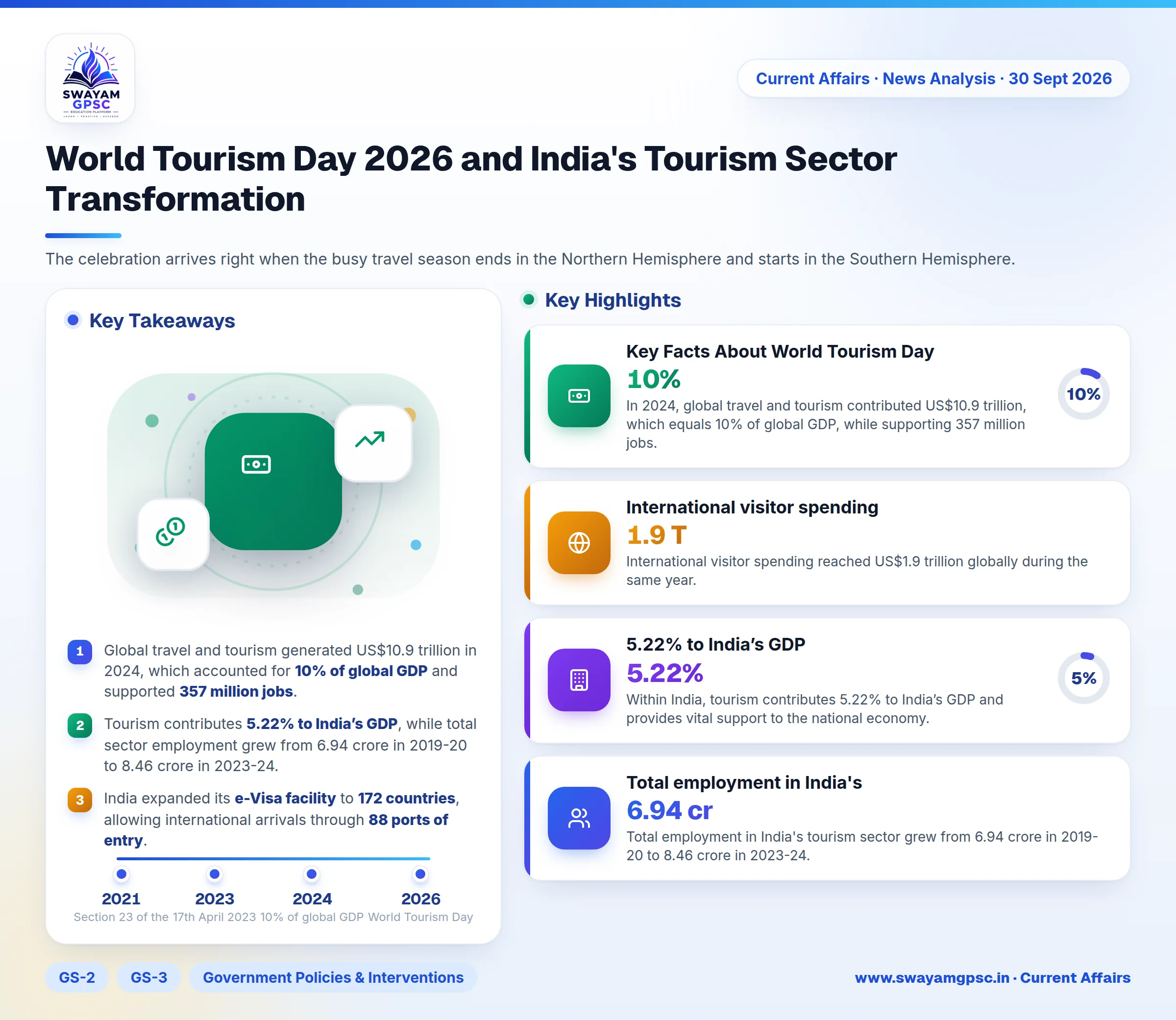
- Global travel and tourism generated US$10.9 trillion in 2024, which accounted for 10% of global GDP and supported 357 million jobs.
- Tourism contributes 5.22% to India’s GDP, while total sector employment grew from 6.94 crore in 2019-20 to 8.46 crore in 2023-24.
- India expanded its e-Visa facility to 172 countries, allowing international arrivals through 88 ports of entry.
- The revised UDAN scheme received an outlay of ₹28,840 crore to develop 100 airports and 200 modern helipads across the country.
Why in News
- Global communities observed World Tourism Day on 27th September 2026 to discuss new ways to grow the travel industry.
- Organisers chose the theme “Digital Agenda and Artificial Intelligence to Redesign Tourism” to show how modern tools can shape the future of travel.
Key Facts About World Tourism Day
- The United Nations World Tourism Organisation (UNWTO) started World Tourism Day to show how travel helps economies grow and brings cultures closer while supporting Sustainable Development Goals (SDGs).
- Member nations selected 27 September because the UNWTO Statutes were adopted on this date back in 1970.
- The celebration arrives right when the busy travel season ends in the Northern Hemisphere and starts in the Southern Hemisphere.
- The Ministry of Tourism introduced the National Digital Tourism Stack as an open digital platform to make travel options easier to find and trust.
- The government relaunched Dekho Apna Desh 2.0 to encourage travellers to visit less famous locations and prevent overcrowding at popular spots.
- The Ministry signed agreements with industry partners under the Incredible India umbrella to improve digital outreach and community involvement.
- In 2024, global travel and tourism contributed US$10.9 trillion, which equals 10% of global GDP, while supporting 357 million jobs.
- International visitor spending reached US$1.9 trillion globally during the same year.
- Within India, tourism contributes 5.22% to India’s GDP and provides vital support to the national economy.
- Total employment in India's tourism sector grew from 6.94 crore in 2019-20 to 8.46 crore in 2023-24.
- Both domestic and foreign visitor numbers increased significantly alongside higher foreign exchange earnings.
- Artificial Intelligence (AI) is now helping travel planners make better decisions and give visitors a smarter experience.
Digital Transformation of Tourism
- Travellers now prefer digital planning tools over traditional methods to personalise their holiday journeys.
- India launched the e-Visa facility in 2014 for travellers from 43 countries, and the service now covers 172 countries.
- Travellers can enter India through 88 international ports, which include 37 airports, 38 seaports, and 13 land ports.
- The revamped Incredible India Digital Platform offers virtual tours of heritage sites, wellness hubs, and rural tourism spots.
- AI features on the platform give real-time weather updates and local travel assistance.
- The portal connects visitors directly with Online Travel Agents (OTAs) to book flights, hotels, and monument tickets easily.
- The National Integrated Database of Hospitality Industry (NIDHI+) gives hotel owners a single digital window for registration and approvals.
Technology Partnerships and Tourism Innovation
- The Ministry of Tourism partnered with Google India in June 2026 to use AI and data analytics for better promotion.
- Official data from 17th April 2023 shows that India had 1,497 DPIIT-recognised startups working in travel and tourism across 262 districts.
- These tourism startups created 13,919 jobs, with 58% of them operating in smaller Tier II and Tier III cities.
Tourist Support Services
- The Ministry runs a 24×7 toll-free multilingual Tourist Helpline through 1800111363 and the short code 1363.
- Support agents help travellers in 12 international languages, including French, German, Japanese, and Spanish.
Key Features of India's Diverse Tourism Landscape
- Spiritual tourism draws pilgrims to holy sites connected with Hinduism, Buddhism, Jainism, and Sikhism.
- Famous destinations like Ayodhya, Kashi, Bodh Gaya, Amritsar, Tirupati and Puri attract millions of devotees.
- Schemes like PRASHAD and Swadesh Darshan build better public facilities at these religious centres.
- Buddhist circuits link India with followers across Asia by highlighting historical locations like Bodh Gaya, Sarnath and Kushinagar.
- Heritage tourism showcases ancient forts, palaces, temples, archaeological sites, museums and historic cities.
- India promotes wellness through Yoga and Ayurveda alongside modern hospitals for medical tourists.
- Eco-tourism projects protect national parks, tiger reserves, wetlands, mangroves, and Himalayan landscapes.
- Rural tourism encourages village homestays and local crafts to boost village incomes.
- Cruise passenger traffic jumped from 1.08 lakh in 2014-15 to 4.62 lakh in 2025-26, marking a 328% growth.
- Authorities upgraded international cruise terminals in Visakhapatnam, Mumbai and Chennai while expanding the East Coast Cruise Circuit to Puducherry.
- Lighthouses are turning into tourist spots under Section 23 of the Marine Aids to Navigation Act, 2021.
- Lighthouse museums are now open in Chennai, Mahabalipuram, Alappuzha, Kannur, Muttom, Dwarka and Gopnath alongside facilities at 75 lighthouses.
- The government promotes business events through the National Strategy and Roadmap for the MICE Industry.
- Large venues like Bharat Mandapam, Yashobhoomi in Delhi and Jio World Centre in Mumbai host major international conferences.
- During its BRICS Chairship in 2026, India hosted the BRICS Tourism Ministers’ Meeting in Jaipur and adopted the Jaipur Declaration.
- India's G20 Presidency featured more than 200 meetings across 60 cities to showcase local culture and hospitality.
Government Initiatives to Boost Tourism in India
- The Regional Connectivity Scheme ( RCS- UDAN ) launched 687 routes connecting 95 airports to improve travel access.
- The updated UDAN scheme for 2026-27 to 2035-36 has a budget of ₹28,840 crore to build 100 airports and 200 modern helipads.
- The Swadesh Darshan Scheme started in 2014-15 and has sanctioned 76 projects worth over ₹5,295.24 crore across 15 thematic circuits.
- The upgraded Swadesh Darshan 2.0 approved 53 projects worth ₹2,207.08 crore for better visitor experiences.
- The Challenge Based Destination Development sub-scheme has funded 37 projects worth ₹687.99 crore.
- The PRASHAD Scheme launched in 2014-15 has sanctioned 54 projects worth ₹1,726.18 crore for pilgrimage infrastructure.
- The Special Assistance to States for Capital Investment (SASCI) allocated ₹3,295.76 crore in FY 2024-25 with 100% Central funding.
- The government also released ₹250 crore each to Nagaland, Mizoram and Himachal Pradesh for tourism projects in FY 2025-26.
- The Capacity Building for Service Providers (CBSP) scheme trains local youth and service workers in professional hospitality.
- The Paryatan Mitra/Paryatan Didi Initiative started in 2024 and has trained 4,382 candidates, including local guides and homestay owners.