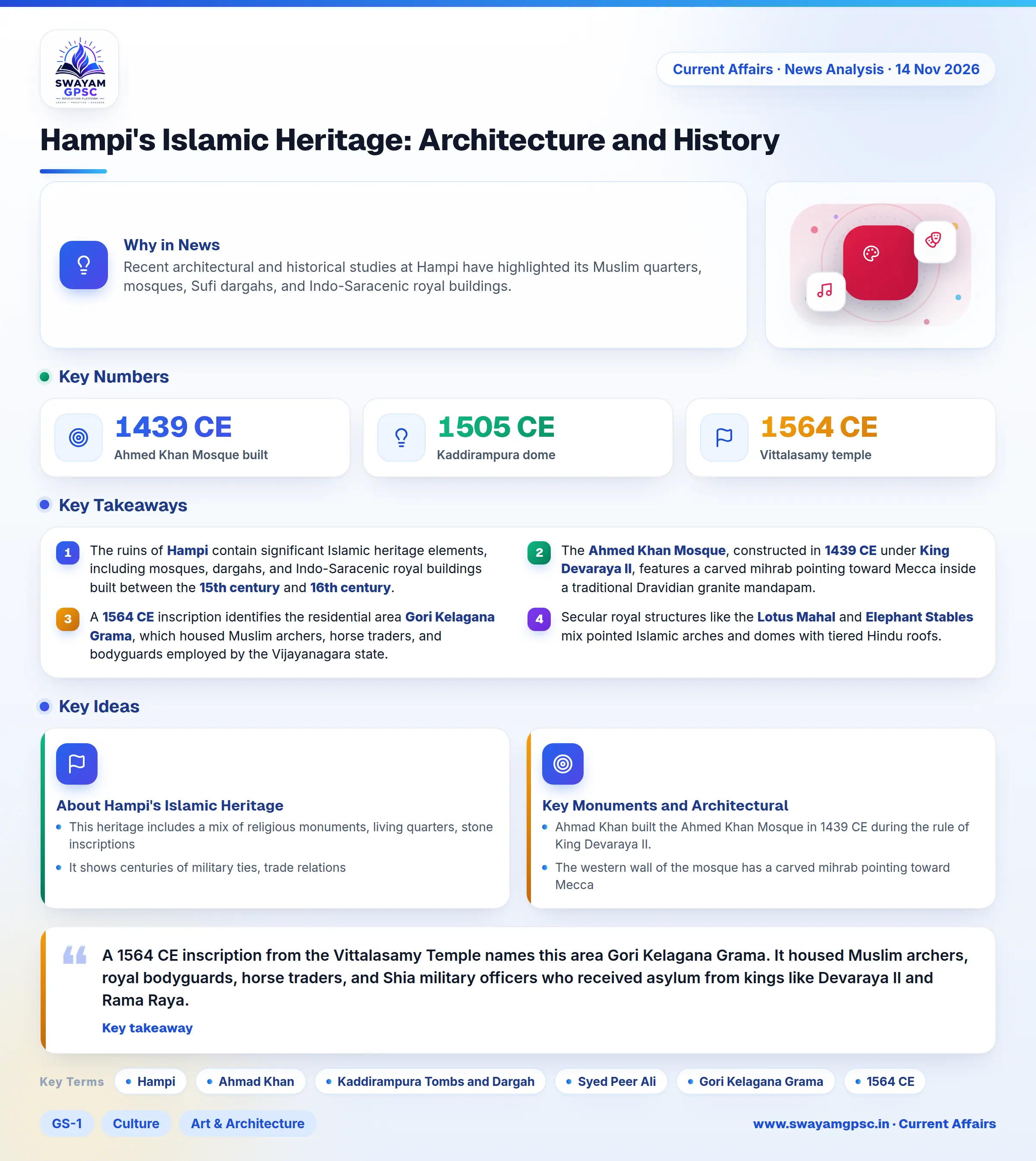
Hampi's Islamic Heritage: Architecture and History
#GS-1 #Culture #Art & Architecture #Heritage #Current Events #National #Hampi #Vijayanagara Empire #Indo-Saracenic Architecture
Key takeaways
- The ruins of Hampi contain significant Islamic heritage elements, including mosques, dargahs, and Indo-Saracenic royal buildings built between the 15th century and 16th century.
- The Ahmed Khan Mosque, constructed in 1439 CE under King Devaraya II, features a carved mihrab pointing toward Mecca inside a traditional Dravidian granite mandapam.
- A 1564 CE inscription identifies the residential area Gori Kelagana Grama, which housed Muslim archers, horse traders, and bodyguards employed by the Vijayanagara state.
- Secular royal structures like the Lotus Mahal and Elephant Stables mix pointed Islamic arches and domes with tiered Hindu roofs.
Why in News
- Recent architectural and historical studies at Hampi have highlighted its Muslim quarters, mosques, Sufi dargahs, and Indo-Saracenic royal buildings.
About Hampi's Islamic Heritage
- This heritage includes a mix of religious monuments, living quarters, stone inscriptions, and hybrid Indo-Islamic royal buildings inside the Vijayanagara heartland.
- It shows centuries of military ties, trade relations, and social integration between Vijayanagara kings and their Muslim subjects and neighboring rulers.
Key Monuments and Architectural Features
- Ahmad Khan built the Ahmed Khan Mosque in 1439 CE during the rule of King Devaraya II. It blends local Dravidian granite mandapam design with Islamic needs.
- The western wall of the mosque has a carved mihrab pointing toward Mecca, combining local stone building methods with Islamic worship requirements.
- A Kannada stone inscription on the building confirms its construction date and proves official state support for different faiths.
- The Kaddirampura Tombs and Dargah complex sits east of the royal enclosure and contains two large domed tombs inside a walled compound.
- A Kannada inscription inside this tomb area shows that Syed Peer Ali built a dome here in 1505 CE under King Vira Narasimha.
- The Gori Kelagana Grama was a dedicated Muslim settlement located near the Ahmed Khan Mosque, containing ruins of tombs, stepwells, and houses.
- A 1564 CE inscription from the Vittalasamy Temple names this area Gori Kelagana Grama. It housed Muslim archers, royal bodyguards, horse traders, and Shia military officers who received asylum from kings like Devaraya II and Rama Raya.
- Royal structures like the Lotus Mahal, Elephant Stables, Guards' Quarters, Muhammadan Watch Tower, and Queen's Bath combine pointed Islamic arches and domes with traditional stepped Hindu roofs.
- These buildings show that diplomatic meetings and wars with the neighboring Deccani Sultanates added new ideas to Vijayanagara royal architecture.
- Stone carvings on the walls of the Hazara Rama Temple and the Mahanavami Dibba show Muslim horse traders, cavalry soldiers, and royal servants.
- Foreign travelers like Domingo Paes and Abdur Razzak, along with historian Ferishta, noted that kings like Devaraya II kept a copy of the Holy Quran near the throne so Muslim officers could bow respectfully according to their faith.