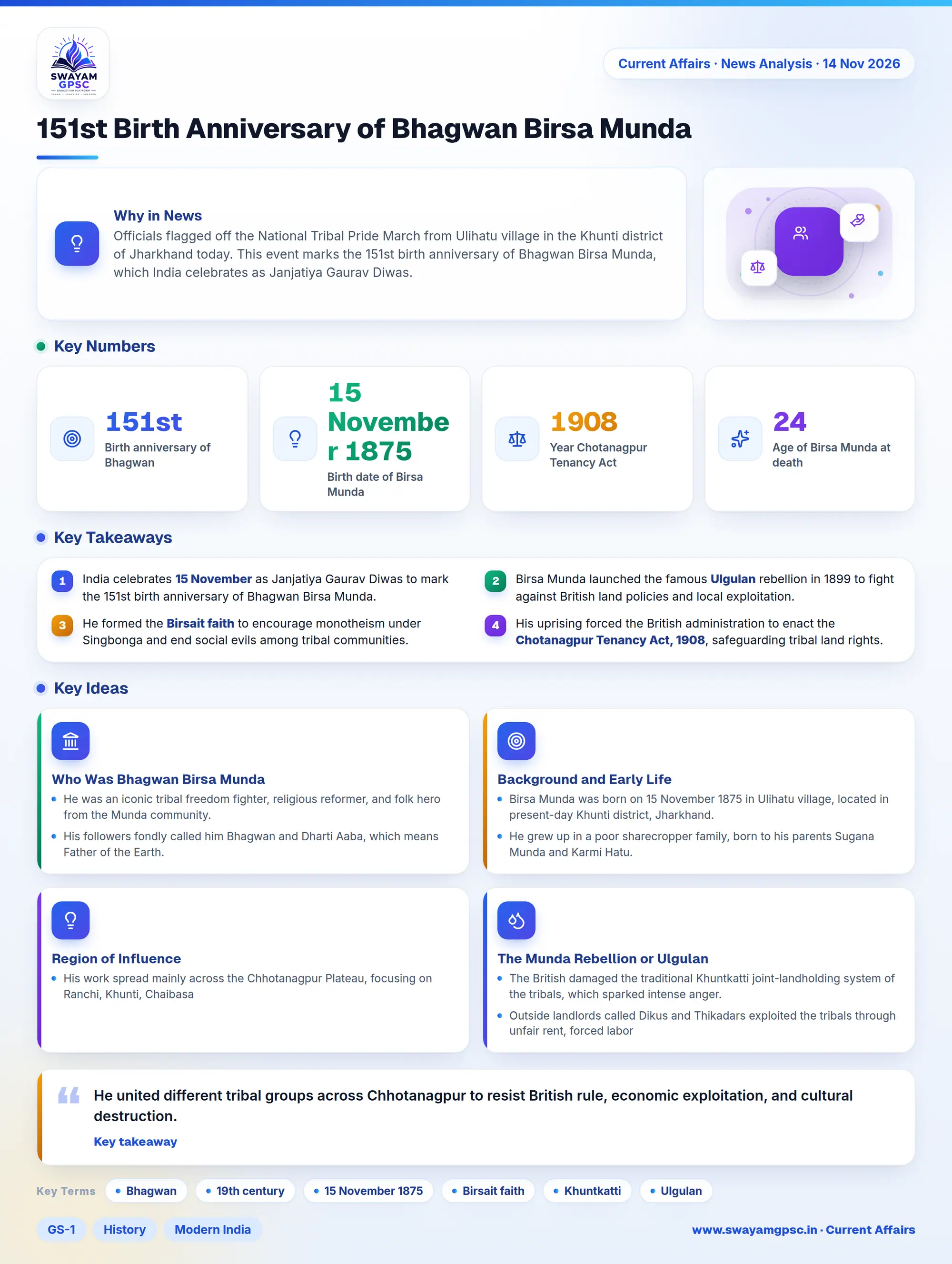
151st Birth Anniversary of Bhagwan Birsa Munda
#GS-1 #History #Modern India #Freedom Struggle #GS-2 #Governance & Social Justice #Vulnerable Sections #Tribal Uprisings #Birsa Munda #Ulgulan #Chotanagpur Tenancy Act 1908
Key takeaways
- India celebrates 15 November as Janjatiya Gaurav Diwas to mark the 151st birth anniversary of Bhagwan Birsa Munda.
- Birsa Munda launched the famous Ulgulan rebellion in 1899 to fight against British land policies and local exploitation.
- He formed the Birsait faith to encourage monotheism under Singbonga and end social evils among tribal communities.
- His uprising forced the British administration to enact the Chotanagpur Tenancy Act, 1908, safeguarding tribal land rights.
Why in News
- Officials flagged off the National Tribal Pride March from Ulihatu village in the Khunti district of Jharkhand today.
- This event marks the 151st birth anniversary of Bhagwan Birsa Munda, which India celebrates as Janjatiya Gaurav Diwas.
Who Was Bhagwan Birsa Munda
- He was an iconic tribal freedom fighter, religious reformer, and folk hero from the Munda community.
- His followers fondly called him Bhagwan and Dharti Aaba, which means Father of the Earth.
- He led a massive tribal and land-rights movement against British colonial rule in the late 19th century.
Background and Early Life
- Birsa Munda was born on 15 November 1875 in Ulihatu village, located in present-day Khunti district, Jharkhand.
- He grew up in a poor sharecropper family, born to his parents Sugana Munda and Karmi Hatu.
- He studied at a German Mission school in Chaibasa and briefly took the name Birsa David.
- He later gave up Christian missionary influence to fight against foreign rule and protect indigenous culture.
- He drew inspiration from Vaishnavite teachings and traditional tribal customs to create the Birsait faith.
- This faith urged people to worship one god, Singbonga, give up alcohol and superstition, and rebuild tribal pride.
Region of Influence
- His work spread mainly across the Chhotanagpur Plateau, focusing on Ranchi, Khunti, Chaibasa, and Singhbhum in modern Jharkhand.
The Munda Rebellion or Ulgulan
- The British damaged the traditional Khuntkatti joint-landholding system of the tribals, which sparked intense anger.
- Outside landlords called Dikus and Thikadars exploited the tribals through unfair rent, forced labor, and strict forest laws.
- After serving a prison sentence from 1895 to 1897, Birsa started the Ulgulan, which means The Great Tumult.
- He organized local tribes to fight British rule and reclaim their right to self-governance.
- In December 1899, Munda, Oraon, and Kharia fighters began using guerrilla tactics against British government posts.
- Major battles took place around Khunti and Dombari Hill in January 1900.
Contribution to the Freedom Movement
- He united different tribal groups across Chhotanagpur to resist British rule, economic exploitation, and cultural destruction.
- His revolt forced the colonial government to pass the Chotanagpur Tenancy Act, 1908.
- This law protected tribal land rights, restored the traditional Khuntkatti system, and banned forced labor.
Last Days and Legacy
- British soldiers caught Birsa Munda in the Jamkopai forest in Singhbhum on 3 February 1900.
- He passed away in Ranchi Central Jail on 9 June 1900 at the young age of 24.
- The authorities claimed he died of cholera, but many suspected bad treatment in prison.