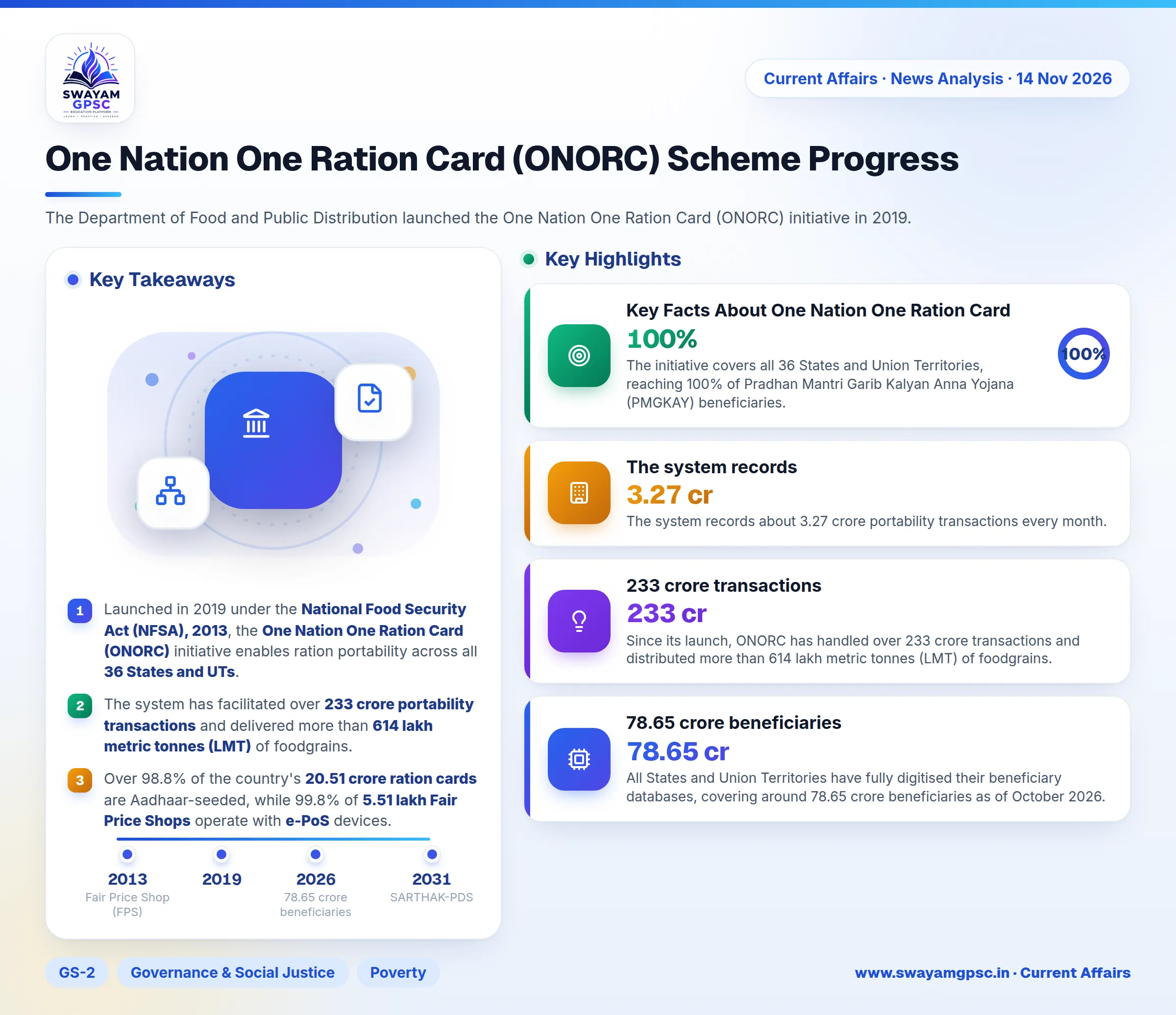
One Nation One Ration Card (ONORC) Scheme Progress
#GS-2 #Governance & Social Justice #Poverty #Hunger #Good Governance #E-Governance #GS-3 #Economy #Food Security #Public Distribution System (PDS) #Government Policies & Interventions #Quick Facts For Prelims
Key takeaways
- Launched in 2019 under the National Food Security Act (NFSA), 2013, the One Nation One Ration Card (ONORC) initiative enables ration portability across all 36 States and UTs.
- The system has facilitated over 233 crore portability transactions and delivered more than 614 lakh metric tonnes (LMT) of foodgrains.
- Over 98.8% of the country's 20.51 crore ration cards are Aadhaar-seeded, while 99.8% of 5.51 lakh Fair Price Shops operate with e-PoS devices.
- Data analytics under Rightful Targeting Version 1 helped identify 5.95 crore suspicious records, leading to the deletion of 2.58 crore fake entries.
- The central government approved the SARTHAK-PDS reform framework through 31st March 2031 with an outlay of Rs 25,530 crore.
Why in News
- The Ministry of Consumer Affairs, Food and Public Distribution recently shared updates on the progress of the One Nation One Ration Card (ONORC) scheme.
- The update highlights how digital integration and ration portability are strengthening national food security.
- This system improves the Public Distribution System (PDS) delivery to help migrant workers and vulnerable families across the country.
Key Facts About One Nation One Ration Card
- The Department of Food and Public Distribution launched the One Nation One Ration Card (ONORC) initiative in 2019.
- Beneficiaries under the National Food Security Act (NFSA), 2013 can collect foodgrains from any electronic Point of Sale (e-PoS) enabled Fair Price Shop (FPS) in India using their current ration card.
- The system allows both inter-State and intra-State ration portability, which provides immense relief to migrant workers.
- Under the split ration entitlement feature, migrant workers can claim their share of foodgrains at their work location.
- At the same time, family members staying back in their home State can draw the remaining share using the same ration card.
- The initiative covers all 36 States and Union Territories, reaching 100% of Pradhan Mantri Garib Kalyan Anna Yojana (PMGKAY) beneficiaries.
- The system records about 3.27 crore portability transactions every month.
- Since its launch, ONORC has handled over 233 crore transactions and distributed more than 614 lakh metric tonnes (LMT) of foodgrains.
- All States and Union Territories have fully digitised their beneficiary databases, covering around 78.65 crore beneficiaries as of October 2026.
- Out of 20.51 crore ration cards, 98.8% (or 20.27 crore) are linked with Aadhaar, covering 76.97 crore individual beneficiaries.
- By September 2026, authorities completed e-KYC verification for 71.52 crore beneficiaries, reaching a 91% completion rate.
- About 99.8% of India's 5.51 lakh Fair Price Shops (around 5.50 lakh FPSs) now operate with e-PoS devices to verify beneficiaries.
- All States have digitized online foodgrain allocation, and 31 States and Union Territories have computerised their end-to-end PDS supply chains.
- Online portals for resolving complaints and checking records have made the whole distribution process transparent.
- Aadhaar verification and data analytics help officials identify and remove duplicate or fake ration card holders.
- Under Rightful Targeting Version 1, officials flagged 5.95 crore suspicious records and removed 2.58 crore duplicate or ineligible entries after field checks.
- The SARTHAK-PDS scheme works as an overarching framework to drive technology reforms across the PDS network.
- The government extended SARTHAK-PDS until 31st March 2031 with a central financial allocation of Rs 25,530 crore.
- This budget helps fund state transport, grain handling, dealer margins, and digital hardware upgrades.
- The NIRMAL sub-scheme strengthens the core data architecture and analytics of the distribution system.
- The SAKSHAM sub-scheme provides real-time supply chain monitoring, including Vehicle Location Tracking Systems (VLTS) on grain trucks.
- The SMART-PDS initiative combines card management, food distribution, supply chain logistics, and grievance systems into one digital platform.
Key Features of Mera Ration App
- The government developed the Mera Ration mobile application under the ONORC initiative to help mobile beneficiaries access information easily.
- The app is available in 13 languages so that users across different states can navigate it comfortably.
- Beneficiaries can use the app to check their monthly foodgrain allowance and past transaction history.
- Users can verify their Aadhaar link status and check if they qualify for nationwide portability.
- The app provides a simple portal for voluntary ONORC registration when moving to new locations.
- Built-in GPS and map tools help beneficiaries locate the nearest Fair Price Shop (FPS) instantly.