Balancing Economic Growth and Air Quality in India
#GS-3 #Environment #Environmental Pollution & Degradation #Climate Change #Sustainable Development #GS-2 #Governance & Social Justice #Good Governance #Economy #Growth
Key takeaways
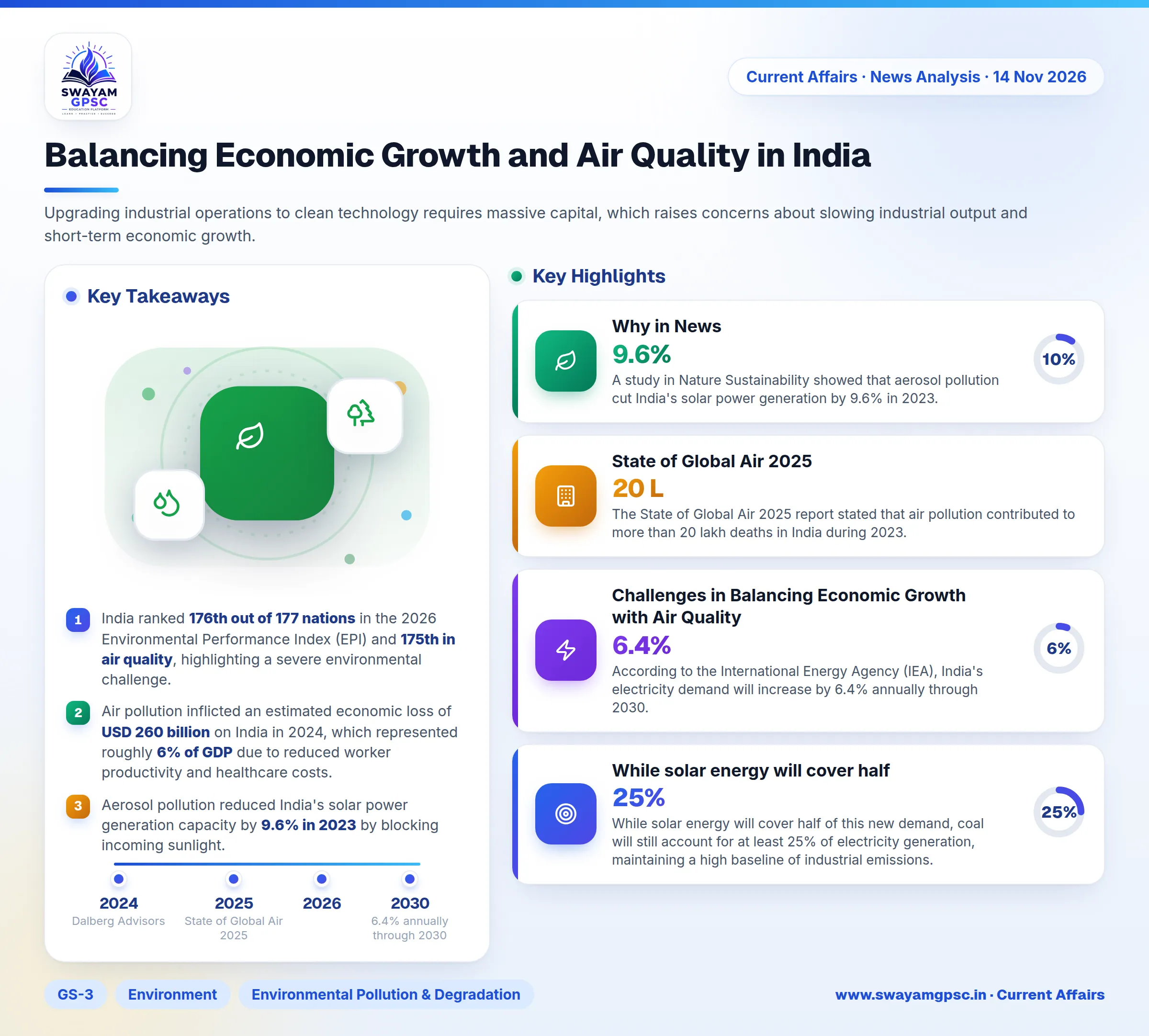
- India ranked 176th out of 177 nations in the 2026 Environmental Performance Index (EPI) and 175th in air quality, highlighting a severe environmental challenge.
- Air pollution inflicted an estimated economic loss of USD 260 billion on India in 2024, which represented roughly 6% of GDP due to reduced worker productivity and healthcare costs.
- Aerosol pollution reduced India's solar power generation capacity by 9.6% in 2023 by blocking incoming sunlight.
- Cutting PM2.5 levels by 20% could save India up to USD 85 billion in cumulative economic losses by 2030.
- Under IQAir's 2025 Report, New Delhi remained the world's most polluted capital with an average annual PM2.5 level of 82.2 µg/m³.
Why in News
- The debate on balancing economic growth with environmental protection gained focus after India performed poorly in the 2026 Environmental Performance Index (EPI).
- India ranked 176th out of 177 countries overall and 175th in air quality in the 2026 EPI.
- A study in Nature Sustainability showed that aerosol pollution cut India's solar power generation by 9.6% in 2023.
- The State of Global Air 2025 report stated that air pollution contributed to more than 20 lakh deaths in India during 2023.
Summary of the Core Dilemma
- India faces an urgent need to balance economic growth with air quality improvements because severe pollution damages public health, lowers worker productivity, reduces solar power generation, and harms long-term economic growth.
- The best way forward involves adopting clean technology, implementing airshed-based governance, enforcing stricter emission standards, delivering affordable clean energy, and shifting toward outcome-based pollution control to support sustainable development and Viksit Bharat @2047.
Challenges in Balancing Economic Growth with Air Quality
- Core economic activities driving development, such as heavy industries, coal-fired power plants, freight transport, and agriculture, act as the primary sources of air emissions.
- Upgrading industrial operations to clean technology requires massive capital, which raises concerns about slowing industrial output and short-term economic growth.
- According to the International Energy Agency (IEA), India's electricity demand will increase by 6.4% annually through 2030.
- While solar energy will cover half of this new demand, coal will still account for at least 25% of electricity generation, maintaining a high baseline of industrial emissions.
- Installing advanced pollution control systems like Flue Gas Desulfurization (FGD) requires substantial financial investment from power producers.
- In July 2025, the Union government relaxed mandatory Sulphur Dioxide (SO2) emission standards for several coal-fired power plants to keep electricity prices affordable and limit water consumption.
- Relaxing these rules creates serious health risks because SO2 serves as a primary precursor for toxic PM2.5 fine particulate matter.
- Providing clean infrastructure does not guarantee sustained adoption by households due to financial constraints.
- Under the Pradhan Mantri Ujjwala Yojana (PMUY), millions of rural families received LPG connections to replace traditional fuels.
- High LPG cylinder refill costs relative to rural household incomes force many families back to burning traditional biomass, continuing harmful indoor and outdoor air pollution.
- India's current administrative approach treats air pollution as a city-by-city issue rather than managing natural atmospheric regions.
- City-focused management fails to address cross-boundary pollution across shared meteorological zones like the Indo-Gangetic Plain.
- City-specific plans create collective-action failures where downwind cities suffer from pollution generated in neighbouring states through activities like stubble burning.
- Air pollution causes massive economic losses that offset short-term financial gains from unconstrained industrial output.
- Dense smog blocked solar radiation and reduced India's solar power output by 9.6% in 2023.
- A study by Dalberg Advisors and the Clean Air Fund estimated that air pollution cost India USD 260 billion in 2024, which equalled roughly 6% of GDP.
- Economic losses stem from high healthcare expenses, premature deaths, and reduced workplace productivity caused by employees working while ill, a phenomenon known as presenteeism.
- Aerosol pollution particles scatter sunlight and create a temporary localized cooling effect in the atmosphere.
- Removing aerosol particles rapidly without cutting greenhouse gas emissions could unmask hidden warming and cause sudden spikes in extreme heat.
- Current municipal initiatives focus heavily on lowering dust levels (PM10) while neglecting smaller, highly toxic particles (PM2.5).
- Fine PM2.5 particles form from industrial gases like SO2 and NOx, meaning that reducing PM10 does not automatically reduce PM2.5 pollution levels.
Current Air Quality Status in India
- According to IQAir's World Air Quality Report 2025, India's population-weighted annual average PM2.5 concentration fell by 3%, dropping from 50.6 µg/m³ in 2024 to 48.9 µg/m³ in 2025.
- This minor reduction improved India's global position from the 5th to the 6th most polluted country in 2025.
- New Delhi remained the most polluted capital city in the world with an annual average PM2.5 level of 82.2 µg/m³.
- Loni in Uttar Pradesh recorded the highest pollution among Indian cities with an annual average PM2.5 concentration of 112.5 µg/m³.
- The IQAir report highlighted weak enforcement of emission standards for vehicles and industries, alongside poor allocation of National Clean Air Programme (NCAP) funds toward industrial emissions control.
- A report by the Centre for Research on Energy and Clean Air (CREA) revealed that 261 out of 267 Indian cities exceeded the WHO daily PM2.5 limit of 15 µg/m³ in October 2026.
- The CREA report added that 38 Indian cities breached the national daily safety limit of 60 µg/m³ during the same month.
- The 2026 Environmental Performance Index (EPI) placed India 176th out of 177 countries, ranking it 175th in Air Quality but 88th in Air Pollution, showing a gap between emission metrics and health outcomes.
- Under the NCAP, 108 out of 130 non-attainment cities reported lower PM10 levels in FY 2025-26 compared to 2017-18, with 26 cities achieving reductions over 40%.
Way Forward: Measures to Balance Economic Growth and Air Quality
- Research by Dalberg Advisors and the Clean Air Fund shows that cutting PM2.5 levels by 20% could prevent USD 85 billion in cumulative economic losses by 2030.
- Policy interventions should target measures that deliver combined economic, public health, and environmental benefits.
- Enforce energy efficiency targets under the Perform, Achieve and Trade (PAT) Scheme and require thermal power plants to install Flue-Gas Desulphurisation (FGD) technology.
- Strengthen the Pradhan Mantri Ujjwala Yojana (PMUY) by offering targeted, income-linked LPG refill subsidies to prevent rural households from returning to biomass fuels.
- Use funds from Swachh Bharat Mission-Urban 2.0 and the GOBARdhan Scheme to construct biomethanation facilities that stop open waste burning.
- Establish regional airshed management frameworks across the Indo-Gangetic Plain to coordinate cross-state actions against crop residue burning and industrial smoke.
- Direct funding from the 16th Finance Commission and the MoEFCC toward verified reductions in PM2.5 levels rather than spending on equipment like smog towers or road sweepers.
- Implement integrated Heat and Health Action Plans (HHAPs) based on NDMA guidelines to prepare communities for localized temperature spikes caused by reduced aerosol masking.
- China expanded its economy between 2005 and 2010 while successfully reducing total SO2 emissions by 14%.
- Although China accounted for 54.9% of global aerosol-related solar energy losses in 2023, strict retrofitting of coal plants reduced its annual solar power losses by 1.4% each year between 2013 and 2023.
Conclusion
- Under Article 21 of the Indian Constitution, the Supreme Court has ruled that the Right to Life includes the fundamental right to live in a clean and unpolluted environment.
- Adopting targeted pollution controls, clean technologies, and outcome-based funding will help India meet its targets under SDG 3 (Good Health), SDG 7 (Affordable Clean Energy), SDG 8 (Decent Work), and SDG 13 (Climate Action).
- The true mark of Viksit Bharat will be reducing environmental pollution faster than the expansion rate of economic activities.
Frequently Asked Questions
- The National Clean Air Programme (NCAP) was launched in 2019 as a national mission to reduce particulate matter levels by up to 40% across 131 non-attainment cities.
- An airshed-based approach treats a geographic area sharing common atmospheric and wind patterns as a single unit to coordinate pollution controls across city and state borders.
- The Graded Response Action Plan (GRAP) is an emergency response system for Delhi-NCR that triggers anti-pollution controls based on real-time AQI levels.
- Climate masking occurs when aerosol particles reflect incoming sunlight to create a temporary cooling effect, which can hide the full impact of greenhouse gas warming.
- The Supreme Court interprets Article 21 (Right to Life) as guaranteeing citizens a clean environment, making pollution control a constitutional obligation.