World Mental Health Day 2026: Challenges and Reforms
#GS-2 #Governance & Social Justice #Health #Poverty #Current Events #National
Key takeaways
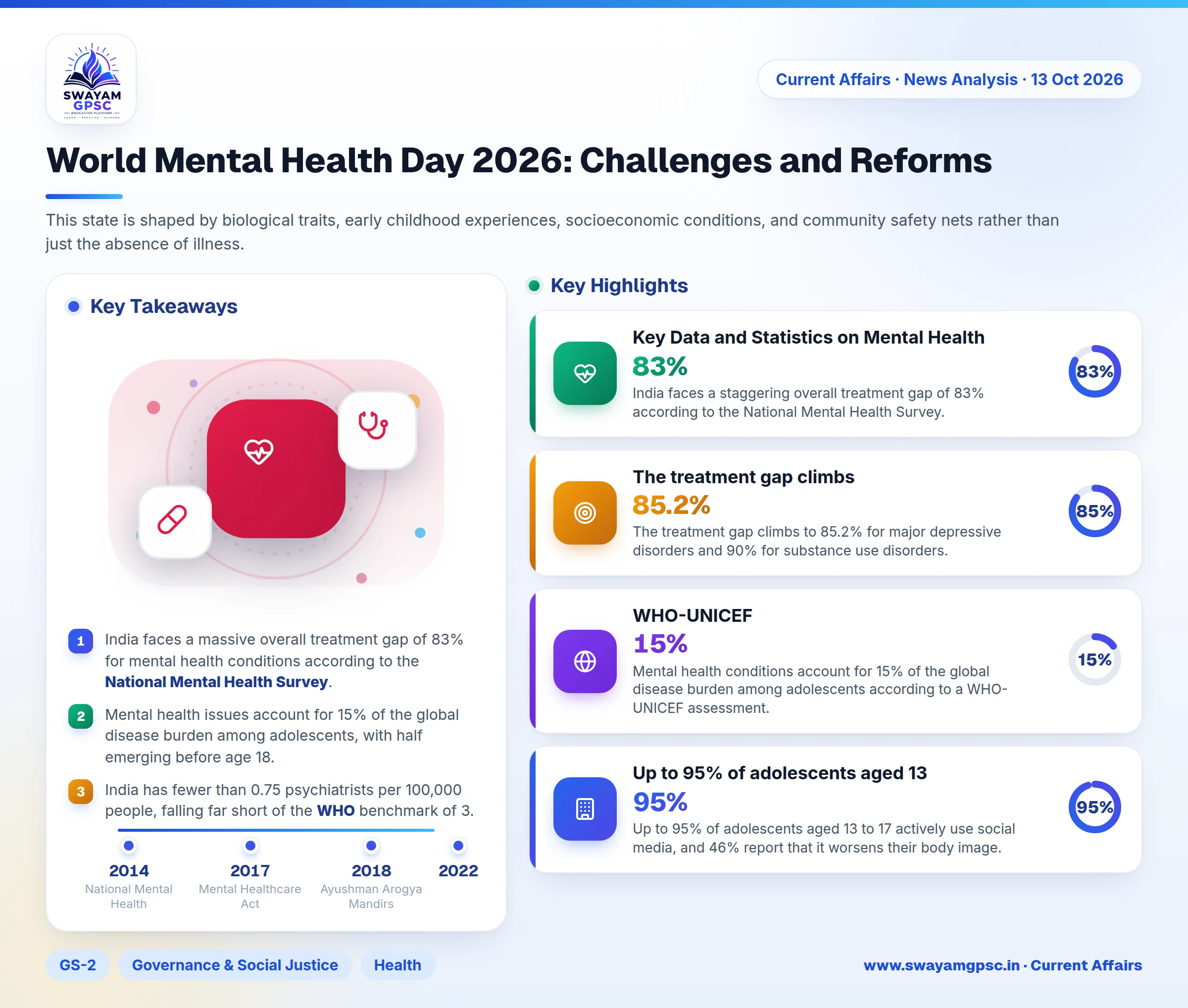
- India faces a massive overall treatment gap of 83% for mental health conditions according to the National Mental Health Survey.
- Mental health issues account for 15% of the global disease burden among adolescents, with half emerging before age 18.
- India has fewer than 0.75 psychiatrists per 100,000 people, falling far short of the WHO benchmark of 3.
- The Mental Healthcare Act of 2017 legally guaranteed access to care and decriminalized suicide attempts under Section 115.
- The Tele-MANAS program launched in 2022 provides round-the-clock multilingual digital counseling across the country.
Context and Theme
- The global observance of World Mental Health Day on October 10 highlights the importance of mental well-being and deinstitutionalization.
- The theme Lived Experiences Heard: Real Voices, Real Change brings mental health back to the center of public policy discussions.
Understanding Mental Health
- Mental health is a dynamic state of psychological, emotional, and social well-being that dictates how people think, feel, and cope with daily stress.
- This state is shaped by biological traits, early childhood experiences, socioeconomic conditions, and community safety nets rather than just the absence of illness.
Key Data and Statistics on Mental Health
- India faces a staggering overall treatment gap of 83% according to the National Mental Health Survey.
- The treatment gap climbs to 85.2% for major depressive disorders and 90% for substance use disorders.
- Mental health conditions account for 15% of the global disease burden among adolescents according to a WHO-UNICEF assessment.
- One-third of mental health conditions emerge before age 14, and half emerge before age 18.
- Globally, 1 in 7 children and adolescents aged 10 to 19 experiences a diagnosed mental health condition.
- Up to 95% of adolescents aged 13 to 17 actively use social media, and 46% report that it worsens their body image.
Evolution of Mental Health Policies
- The National Mental Health Programme was launched in 1982 to shift away from colonial asylums and integrate psychiatric care into public health.
- The District Mental Health Program of 1996 and the Manpower Scheme of 2009 extended clinical outreach to districts and funded specialized training.
- The National Mental Health Policy of 2014 shifted the national focus from mere disease management to holistic promotion, prevention, and rehabilitation.
- The Mental Healthcare Act of 2017 guaranteed the right to access care, prohibited cruel treatment, introduced advance directives, and decriminalized suicide under Section 115.
- Mental healthcare was embedded into primary care via Ayushman Arogya Mandirs in 2018, followed by the Tele-MANAS helpline in 2022 for round-the-clock digital counseling.
Challenges in Mental Healthcare
- India suffers from an acute shortage of mental health professionals, possessing fewer than 0.75 psychiatrists per 100,000 people against the WHO benchmark of 3.
- Rapid urbanization and the collapse of joint families have stripped individuals of informal emotional buffers and worsened loneliness among the elderly.
- Persistent stigma, shame, and moral labeling cause families to delay clinical help until acute behavioral breakdowns occur.
- Unchecked screen time and short-form algorithmic feeds create dopamine loops that elevate social anxiety and depressive withdrawal among teenagers.
Way Forward
- Schools should adopt multidisciplinary support models by hiring certified counselors and adding emotional regulation modules to their curricula.
- Governments must involve individuals with lived recovery experiences in policy planning to make care more human-centric.
- Frontline health workers like ASHAs and ANMs should be trained in psychological first aid to detect distress at the village level.
- Public awareness campaigns must promote digital hygiene and balanced device usage rather than outright bans.
- Communities should establish decentralized day-care centers and geriatric hubs to reduce isolation and build intergenerational connections.