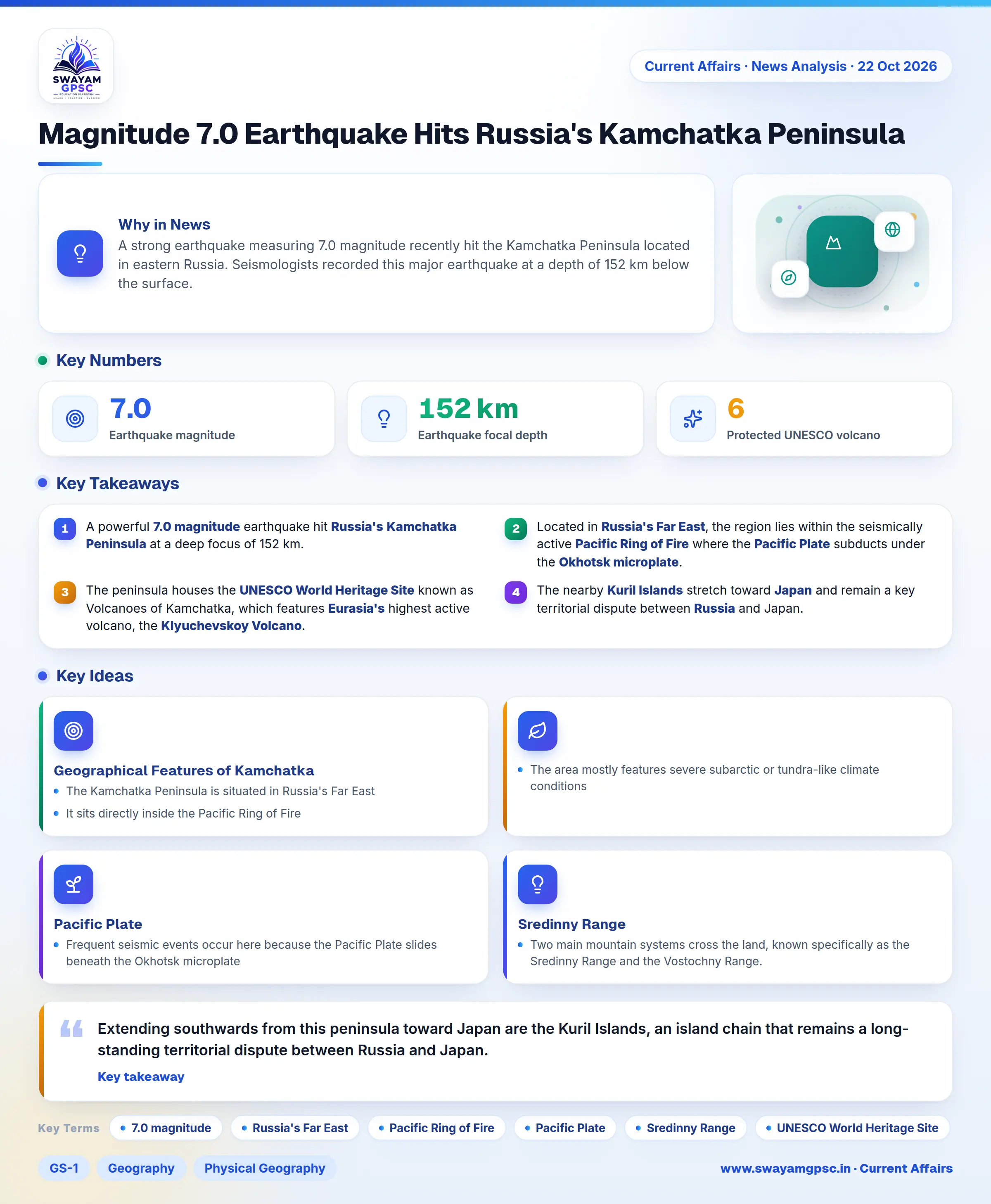
Magnitude 7.0 Earthquake Hits Russia's Kamchatka Peninsula
#GS-1 #Geography #Physical Geography #Disaster Geography #Current Events #International #Earthquakes #Kamchatka Peninsula
Key takeaways
- A powerful 7.0 magnitude earthquake hit Russia's Kamchatka Peninsula at a deep focus of 152 km.
- Located in Russia's Far East, the region lies within the seismically active Pacific Ring of Fire where the Pacific Plate subducts under the Okhotsk microplate.
- The peninsula houses the UNESCO World Heritage Site known as Volcanoes of Kamchatka, which features Eurasia's highest active volcano, the Klyuchevskoy Volcano.
- The nearby Kuril Islands stretch toward Japan and remain a key territorial dispute between Russia and Japan.
Why in News
- A strong earthquake measuring 7.0 magnitude recently hit the Kamchatka Peninsula located in eastern Russia.
- Seismologists recorded this major earthquake at a depth of 152 km below the surface.
Geographical Features of Kamchatka Peninsula
- The Kamchatka Peninsula is situated in Russia's Far East, positioned with the Sea of Okhotsk on its west side and the Pacific Ocean and Bering Sea on its east side.
- It sits directly inside the Pacific Ring of Fire, making the region extremely prone to active volcanoes and frequent earthquakes due to interacting tectonic boundary lines.
- The area mostly features severe subarctic or tundra-like climate conditions, which keeps the local human population density very low.
- Frequent seismic events occur here because the Pacific Plate slides beneath the Okhotsk microplate, which forms part of the bigger North American Plate.
- Two main mountain systems cross the land, known specifically as the Sredinny Range and the Vostochny Range.
- Numerous active volcanoes dot the peninsula, including six protected areas together designated as the Volcanoes of Kamchatka UNESCO World Heritage Site.
- The famous Klyuchevskoy Volcano stands as the tallest active volcano across Eurasia and remains one of the peninsula's most active eruption sites.
- The main water channel flowing through this landmass is called the Kamchatka River.
- Rich wildlife thrives in this harsh natural habitat, including large populations of brown bears, Steller's sea eagles, sea otters, and salmonid fish.
- Extending southwards from this peninsula toward Japan are the Kuril Islands, an island chain that remains a long-standing territorial dispute between Russia and Japan.