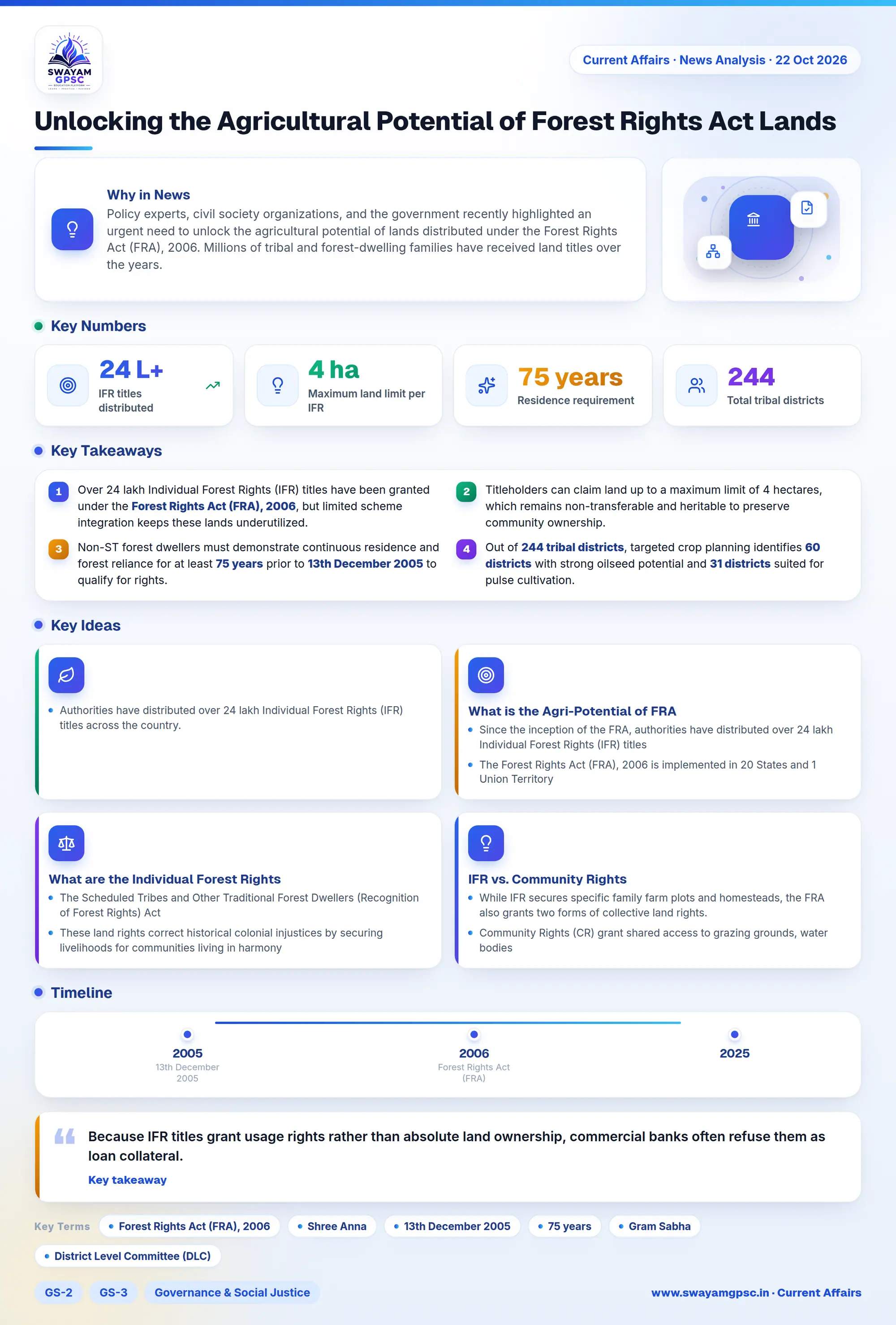
Unlocking the Agricultural Potential of Forest Rights Act Lands
#GS-2 #GS-3 #Governance & Social Justice #Economy #Agriculture #Land Reforms #Vulnerable Sections #Welfare Schemes #Issues Related to SCs & STs #Local Self Governance #Government Policies & Interventions
Key takeaways
- Over 24 lakh Individual Forest Rights (IFR) titles have been granted under the Forest Rights Act (FRA), 2006, but limited scheme integration keeps these lands underutilized.
- Titleholders can claim land up to a maximum limit of 4 hectares, which remains non-transferable and heritable to preserve community ownership.
- Non-ST forest dwellers must demonstrate continuous residence and forest reliance for at least 75 years prior to 13th December 2005 to qualify for rights.
- Out of 244 tribal districts, targeted crop planning identifies 60 districts with strong oilseed potential and 31 districts suited for pulse cultivation.
- Classifying IFR plots as Forest Land cuts off farmers from benefits like PM-KISAN and Kisan Credit Card (KCC) credit due to collateral rejections by commercial banks.
Why in News
- Policy experts, civil society organizations, and the government recently highlighted an urgent need to unlock the agricultural potential of lands distributed under the Forest Rights Act (FRA), 2006.
- Millions of tribal and forest-dwelling families have received land titles over the years.
- However, a lack of integration with mainstream agricultural programs leaves these lands underutilized.
- This gap directly hinders the true economic empowerment of marginalized communities.
Summary
- Authorities have distributed over 24 lakh Individual Forest Rights (IFR) titles across the country.
- Despite this progress, poor access to credit, irrigation, farming schemes, and markets keeps the agricultural potential of FRA lands underutilized.
- Combining rural development schemes with FRA lands can convert legal titles into economic empowerment.
- Promoting region-specific crops and stronger institutional support will boost sustainable agriculture and food security.
What is the Agri-Potential of FRA Lands?
- Since the inception of the FRA, authorities have distributed over 24 lakh Individual Forest Rights (IFR) titles covering millions of acres.
- The Forest Rights Act (FRA), 2006 is implemented in 20 States and 1 Union Territory, reflecting immense ecological and socio-economic diversity.
- Forest lands are traditionally free from chemical fertilizers and pesticides, making them ideal for high-value organic farming.
- These areas support agroforestry and Non-Timber Forest Products (NTFPs) like timber, fruit trees, and medicinal plants, which offer year-round income and boost carbon storage.
- Traditional tribal practices like cultivating millets (Shree Anna) and indigenous drought-resistant seeds build strong climate resilience.
- Growing pulses and oilseeds on FRA lands boosts tribal incomes because these crops thrive in rain-fed conditions and improve soil health.
- Cultivating crops like sesame, spices, and horticultural products cuts India's heavy import reliance on edible oils and pulses.
- Maximizing farm production on IFR lands directly tackles severe malnutrition across tribal belts, such as central India's tribal corridor.
What are the Individual Forest Rights (IFR) Titles under FRA, 2006?
- The Scheduled Tribes and Other Traditional Forest Dwellers (Recognition of Forest Rights) Act, 2006 grants legal ownership and land-use rights to forest dwellers for self-cultivation and living.
- These land rights correct historical colonial injustices by securing livelihoods for communities living in harmony with forests.
- An IFR title recognizes land actively farmed or occupied by a family up to a maximum limit of 4 hectares.
- The law only recognizes pre-existing land occupation and does not grant or clear any new forest land.
- IFR titles are legally heritable but non-transferable, meaning families cannot sell, lease, or transfer the land to outsiders.
- Authorities register titles jointly under the names of both spouses to protect women's property rights.
- The law strictly forbids any eviction or displacement of forest dwellers while their claim verification is ongoing.
- An eligible claimant must be a Forest Dwelling Scheduled Tribe (FDST) member or an Other Traditional Forest Dweller (OTFD) dependent on forests for livelihood.
- Scheduled Tribes must show continuous occupation of the forest land before 13th December 2005.
- Other Traditional Forest Dwellers (OTFD) must prove continuous residence and forest dependence for at least three generations (75 years) prior to 13th December 2005.
- The Gram Sabha acts as the initiating authority that receives, verifies, and passes resolutions on land claims.
- The Sub-Divisional Level Committee (SDLC) reviews and compiles records sent by the Gram Sabha.
- The District Level Committee (DLC) functions as the final authority that approves claims and issues legal titles.
IFR vs. Community Rights
- While IFR secures specific family farm plots and homesteads, the FRA also grants two forms of collective land rights.
- Community Rights (CR) grant shared access to grazing grounds, water bodies, and the collection of minor forest produce like honey or bamboo.
- Community Forest Resource Rights (CFRR) empower the local Gram Sabha to protect, manage, and regenerate broader forest zones sustainably.
What are the Challenges in Unlocking Agri-Potential of FRA Lands?
- Because IFR titles grant usage rights rather than absolute land ownership, commercial banks often refuse them as loan collateral.
- This collateral issue prevents tribal farmers from accessing the Kisan Credit Card (KCC) and institutional crop loans.
- Official records list IFR lands as Forest Land instead of Revenue Land, excluding titleholders from benefits like PM-KISAN, PM Fasal Bima Yojana (PMFBY), and fertilizer subsidies.
- Most FRA lands lie on uneven or hilly terrains and lack irrigation systems, leaving them dependent on rainfall without support from the Pradhan Mantri Krishi Sinchayee Yojana (PMKSY).
- Forest plots require heavy initial investments for land leveling, bunding, and soil treatment before active farming can start.
- A lack of nearby APMC mandis and Farmer Producer Organizations (FPOs) leaves tribal farmers vulnerable to middlemen.
What Measures are Needed for Convergence of FRA Lands into Agriculture?
- Out of 244 tribal districts, 60 districts show high potential for oilseeds, 31 districts for pulses, and 23 districts for both.
- Integrating schemes like PMKSY, the National Food Security and Nutrition Mission, the National Mission on Edible Oils, and the Van Dhan Yojana can improve irrigation, yields, and NTFP value addition.
- The Dharti Aaba Janjatiya Gram Utkarsh Abhiyan scheme can strengthen post-title livelihood support through sustainable farming and community forest plans.
- The Reserve Bank of India (RBI) should instruct commercial banks to accept IFR titles as valid collateral for Kisan Credit Card (KCC) loans.
- Authorities should direct rural employment funds under the Viksit Bharat-Guarantee for Rozgar and Ajeevika Mission (Gramin) (VB-G RAM G) Act, 2025 toward land leveling and farm pond construction on IFR lands.
- Empowering agencies like TRIFED to build tribal Farmer Producer Organizations (FPOs) can help process organic produce and link farmers to markets through the Van Dhan Yojana.
- States need to integrate IFR titles into digital land portals like Bhoomi and Dharani to simplify official administration.
- Strengthening Gram Sabhas ensures that crop choices and water conservation plans respect local community rights and environmental sustainability.
Conclusion
- Distributing legal land titles under the Forest Rights Act is only the starting point for tribal welfare.
- Combining farm support, credit access, and rural development schemes on FRA lands will lift millions out of poverty and expand climate-resilient agriculture.