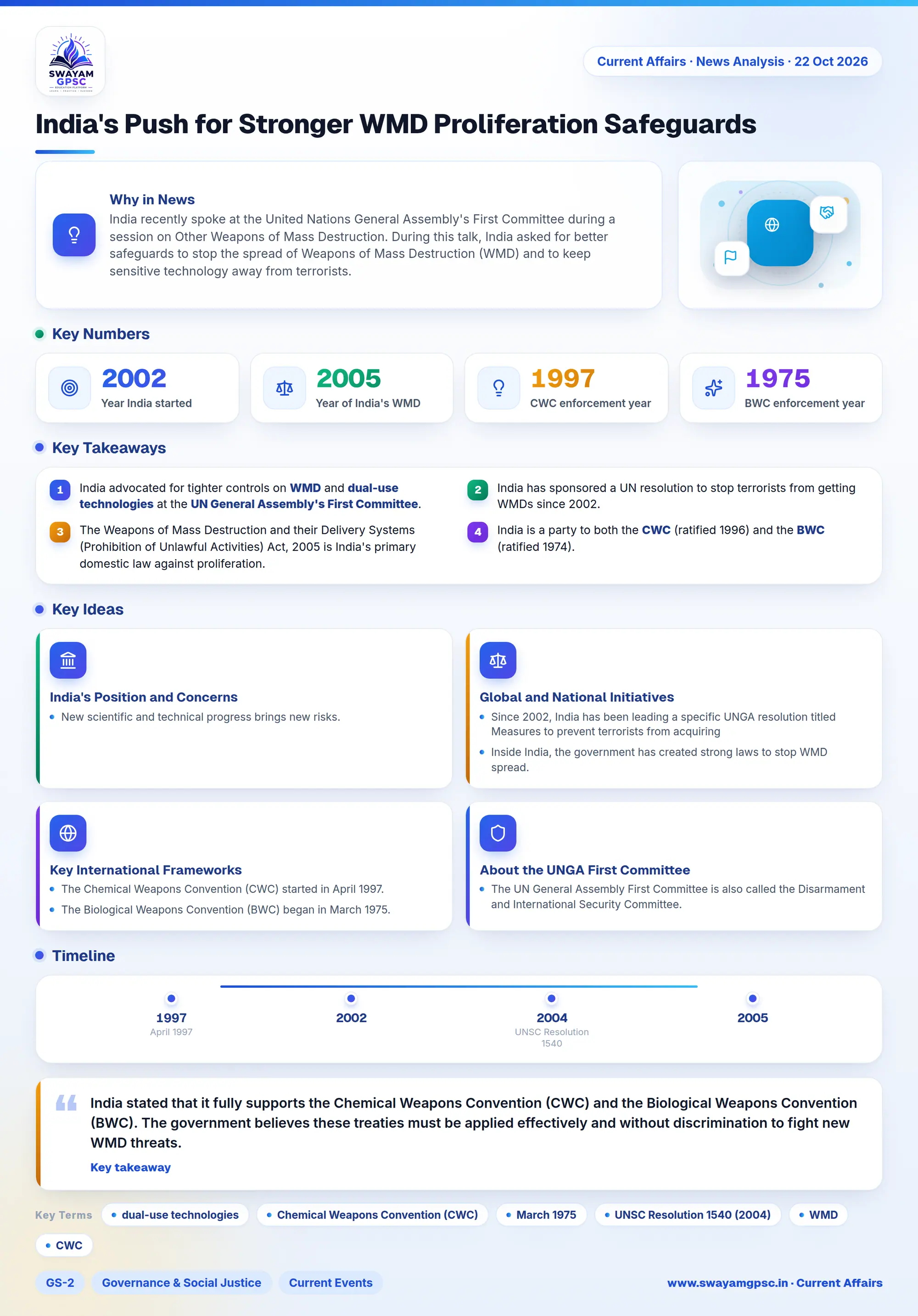
India's Push for Stronger WMD Proliferation Safeguards
#GS-2 #Governance & Social Justice #Current Events #International #Groupings & Agreements Involving India and/or Affecting India's Interests #WMD Proliferation #Disarmament
Key takeaways
- India advocated for tighter controls on WMD and dual-use technologies at the UN General Assembly's First Committee.
- India has sponsored a UN resolution to stop terrorists from getting WMDs since 2002.
- The Weapons of Mass Destruction and their Delivery Systems (Prohibition of Unlawful Activities) Act, 2005 is India's primary domestic law against proliferation.
- India is a party to both the CWC (ratified 1996) and the BWC (ratified 1974).
- UNSC Resolution 1540 (2004) mandates states to prevent non-state actors from accessing nuclear, chemical, and biological weapons.
Why in News
- India recently spoke at the United Nations General Assembly's First Committee during a session on Other Weapons of Mass Destruction. During this talk, India asked for better safeguards to stop the spread of Weapons of Mass Destruction (WMD) and to keep sensitive technology away from terrorists.
India's Position and Concerns
- India stated that it fully supports the Chemical Weapons Convention (CWC) and the Biological Weapons Convention (BWC). The government believes these treaties must be applied effectively and without discrimination to fight new WMD threats.
- New scientific and technical progress brings new risks. This is because dual-use technologies, which can be used for both peaceful civilian work and military purposes, could be misused.
Global and National Initiatives
- Since 2002, India has been leading a specific UNGA resolution titled Measures to prevent terrorists from acquiring weapons of mass destruction. This resolution pushes for better laws and global cooperation to stop terrorists from getting WMDs or the systems used to launch them.
- Inside India, the government has created strong laws to stop WMD spread. A key law is the Weapons of Mass Destruction and their Delivery Systems (Prohibition of Unlawful Activities) Act, 2005, which controls the export of sensitive materials.
Key International Frameworks
- The Chemical Weapons Convention (CWC) started in April 1997. It bans the creation, production, storage, and use of chemical weapons. India joined this treaty in 1996.
- The Biological Weapons Convention (BWC) began in March 1975. It stops countries from developing or transferring biological and toxin weapons. India ratified this in 1974.
- The UNSC Resolution 1540 (2004) was passed under Chapter VII of the UN Charter. It forces all countries to make laws that stop non-state actors, like terrorists, from getting nuclear, chemical, or biological weapons.
About the UNGA First Committee
- The UN General Assembly First Committee is also called the Disarmament and International Security Committee. Its main job is to handle global threats and matters related to disarmament and international safety.
Significance
- Better international teamwork and stronger rules can lower the risk of WMDs spreading. This helps protect the world by keeping dangerous tech away from terrorists and making the global non-proliferation system stronger.