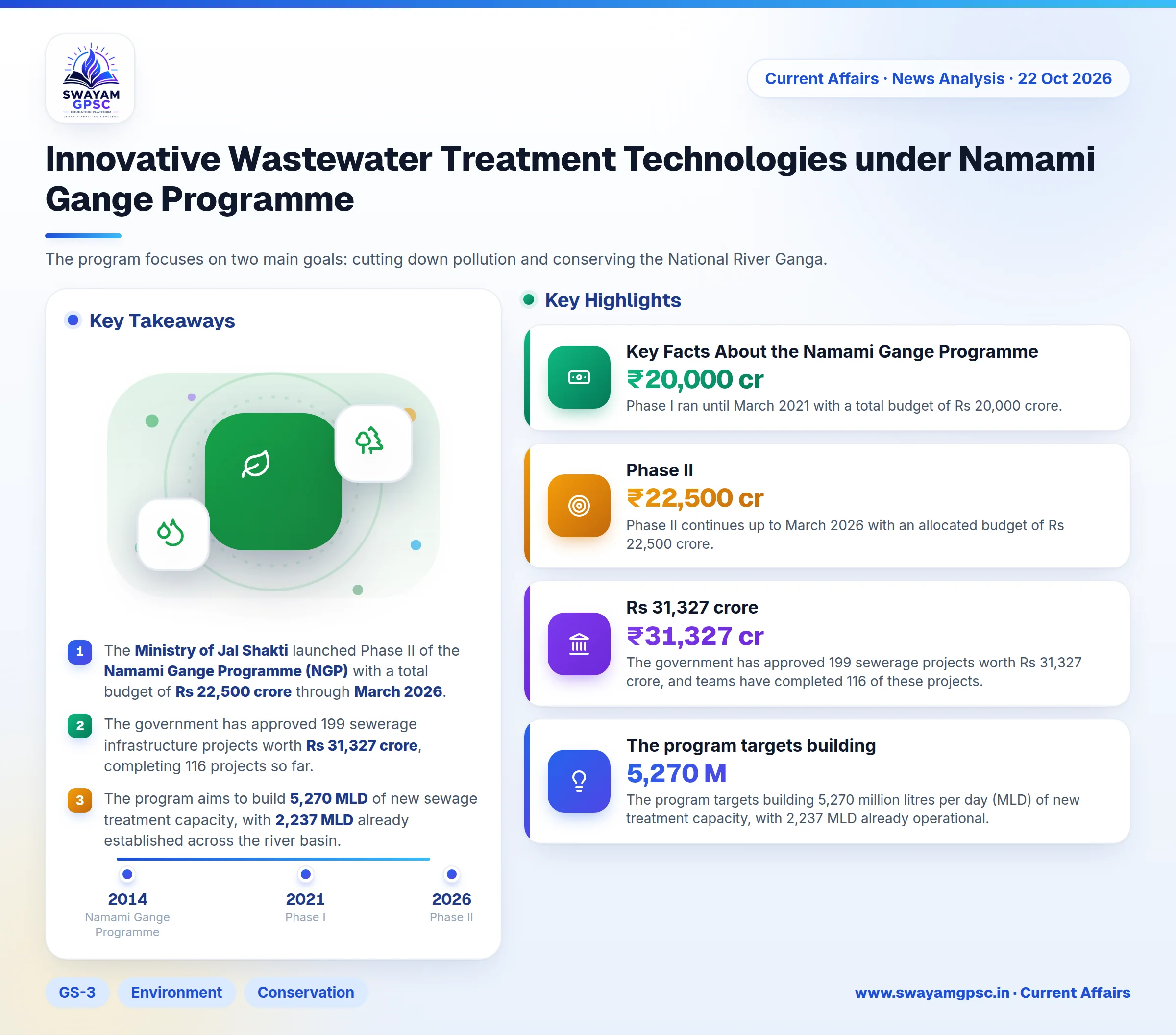
Innovative Wastewater Treatment Technologies under Namami Gange Programme
#GS-3 #Environment #Conservation #Science & Technology #Infrastructure #Water Resources #Namami Gange Programme
Key takeaways
- The Ministry of Jal Shakti launched Phase II of the Namami Gange Programme (NGP) with a total budget of Rs 22,500 crore through March 2026.
- The government has approved 199 sewerage infrastructure projects worth Rs 31,327 crore, completing 116 projects so far.
- The program aims to build 5,270 MLD of new sewage treatment capacity, with 2,237 MLD already established across the river basin.
- Energy-efficient NEREDA Technology provides approximately 50% power savings over conventional Activated Sludge Processes.
- India developed its first four-storey municipal sewage treatment plant at Muni Ki Reti in Uttarakhand with a capacity of 7.5 MLD.
Why in News
- The Ministry of Jal Shakti recently highlighted how modern wastewater treatment technologies under the Namami Gange Programme (NGP) are improving sewage management.
- These new techniques increase water treatment efficiency and promote the widespread reuse of treated water across various sectors.
Key Facts About the Namami Gange Programme
- The Namami Gange Programme (NGP) is an Integrated Conservation Mission that the Government of India launched in June 2014.
- The program focuses on two main goals: cutting down pollution and conserving the National River Ganga.
- The National Mission for Clean Ganga (NMCG) under the Ministry of Jal Shakti handles the ground implementation of this program.
- Phase I ran until March 2021 with a total budget of Rs 20,000 crore.
- Phase II continues up to March 2026 with an allocated budget of Rs 22,500 crore.
- Key program areas include building sewage treatment plants, cleaning river surfaces, developing riverfronts, protecting biodiversity, planting trees, spreading public awareness, and monitoring industrial pollution.
- The program operates through Nirmal Ganga to reduce pollution by treating sewage and industrial waste.
- It uses Aviral Ganga to maintain continuous river flow and protect the river ecosystem.
- It drives Jan Ganga to increase community participation and public involvement in river protection.
- It relies on Gyan Ganga to support scientific research and evidence-based river management.
- The program remains flexible on technology choice, picking systems based on local land availability, geography, sewage type, and specific treatment needs.
- Standard choices include Activated Sludge Process, Sequential Batch Reactor (SBR), Upflow Anaerobic Sludge Blanket (UASB), and Moving Bed Biofilm Reactor (MBBR).
- Modern choices include NEREDA, Food Chain Reactor (FCR), electrocoagulation, constructed wetlands, Soil Biotechnology, and Johkasou systems.
- The government has approved 199 sewerage projects worth Rs 31,327 crore, and teams have completed 116 of these projects.
- The program targets building 5,270 million litres per day (MLD) of new treatment capacity, with 2,237 MLD already operational.
- It also aims to repair 925 MLD of old treatment plant capacity, having successfully upgraded 873 MLD so far.
Advanced Biological Treatment Technologies
- The Food Chain Reactor (FCR) is an advanced biological system that combines activated sludge, artificial media, and live plant roots to clean organic pollutants using less space and power.
- Authorities currently operate 5 FCR plants, including 2 in Bhatpara, West Bengal and 3 in Prayagraj, Uttar Pradesh, while building another plant in Bhagalpur, Bihar.
- NEREDA Technology uses aerobic granular sludge where compact microbe granules settle rapidly, saving significant space and operating energy.
- This system cuts power usage by roughly 50% compared to traditional Activated Sludge processes and 20% compared to Sequential Batch Reactor (SBR) setups.
Electrochemical and Advanced Oxidation Technologies
- Electrocoagulation uses electrical current and metal plates to settle and remove suspended impurities from water without using biological agents.
- This chemical-free setup works well in cold areas, mountain zones, and tight spaces, leading to 17 installations across Uttarakhand, including Badrinath and Chamoli.
- Advanced Oxidation Process (AOP) uses strong chemical oxidation to break down complex pollutants right on site, cutting the need for long pipeline networks.
Nature-Based and Decentralised Treatment Systems
- Constructed Wetlands are man-made natural systems that use aquatic plants, engineered soil, and helpful microbes to filter water using biological pathways.
- In Bithoor, Uttar Pradesh, 6 constructed wetlands treat 2 MLD of wastewater, dropping Biochemical Oxygen Demand (BOD) from 75 mg/L to under 10 mg/L.
- Soil Biotechnology combines filtration, natural settling, and soil microbes to clear out both organic and mineral pollutants from dirty water.
- Johkasou Technology is a compact, factory-built unit that handles biological cleaning, settling, and water disinfection in one tiny footprint.
- This portable system serves small communities, remote hills, and areas without sewer lines, with 6 units operating in Uttarakhand.
Space-Efficient and On-Site Treatment Infrastructure
- Multi-Storey Sewage Treatment Plants stack treatment equipment vertically to save ground space in crowded towns and hilly locations.
- India built its first four-storey municipal treatment plant at Muni Ki Reti in Uttarakhand with a processing capacity of 7.5 MLD.
- Faecal Sludge and Septage Management (FSSM) empties septic tanks directly, extending safe sanitation to un-sewered communities.
- A pilot plant handling 10 kilolitres per day was set up at Chunar in Uttar Pradesh to clean septage waste in small settlements.
Conclusion
- The Namami Gange Programme marks a big shift from old-fashioned waste treatment toward modern, local, and energy-saving setups.
- Combining new technologies, nature-friendly filters, green energy, and performance-based contracts will protect rivers and secure urban water needs.