Ladakh Autonomous Hill Development Councils Amendment 2026
#GS-2 #Indian Polity & Constitution #Federalism #Governance & Social Justice #Current Events #National #Ladakh #Issues Relating to Development
Key takeaways
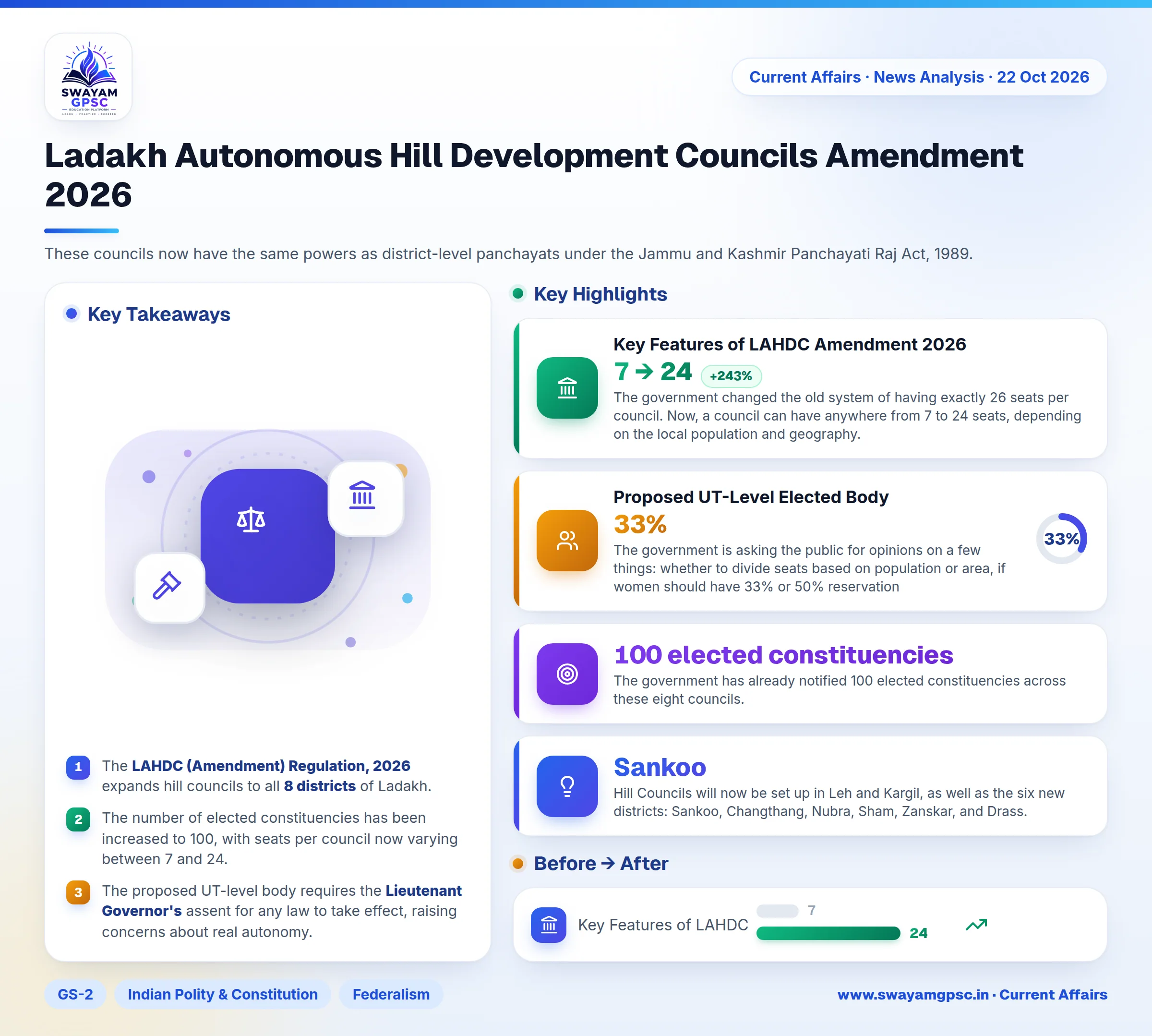
- The LAHDC (Amendment) Regulation, 2026 expands hill councils to all 8 districts of Ladakh.
- The number of elected constituencies has been increased to 100, with seats per council now varying between 7 and 24.
- The proposed UT-level body requires the Lieutenant Governor's assent for any law to take effect, raising concerns about real autonomy.
- Ladakhi activists continue to demand full Statehood and inclusion in the Sixth Schedule for stronger legislative protection.
Why in News
- The President of India has issued the Ladakh Autonomous Hill Development Councils (LAHDC) (Amendment) Regulation, 2026.
- This new rule expands the reach of Hill Councils to cover all eight districts of Ladakh.
- The government has already notified 100 elected constituencies across these eight councils.
Key Features of LAHDC Amendment 2026
- Hill Councils will now be set up in Leh and Kargil, as well as the six new districts: Sankoo, Changthang, Nubra, Sham, Zanskar, and Drass.
- The government changed the old system of having exactly 26 seats per council. Now, a council can have anywhere from 7 to 24 seats, depending on the local population and geography.
- To ensure fairness, the regulation allows the government to nominate up to four members from women's groups and communities that lack representation. This number cannot exceed one-sixth of the elected seats.
- These councils now have the same powers as district-level panchayats under the Jammu and Kashmir Panchayati Raj Act, 1989.
- The State Election Commission for the UT of Ladakh will be in charge of managing and controlling these council elections.
Proposed UT-Level Elected Body
- The Ministry of Home Affairs (MHA) is planning a new elected body for the entire Union Territory.
- A major point of debate is the Lieutenant Governor's (L-G) power. The draft says any law passed by this body needs the L-G's approval before it can start.
- The government wants to use Article 371 for a constitutional setup and Article 240 to let the President make rules for the peace and progress of Ladakh.
- The government is asking the public for opinions on a few things: whether to divide seats based on population or area, if women should have 33% or 50% reservation, and if members should be elected directly or through the LAHDCs.
Challenges
- Local activists are worried that the L-G's power to veto laws makes the elected members mere advisors. They feel this is not real legislative power.
- Many believe this new system does not provide the same level of autonomy that the Sixth Schedule of the Constitution offers.
- The current changes ignore the main demands of the Ladakhi people, which include full Statehood, Sixth Schedule status, a separate Public Service Commission (PSC), and individual Lok Sabha seats for Leh and Kargil.