World Lion Day 2026: Asiatic Lion Conservation and Population Recovery
#GS-3 #Environment #Wildlife #Biodiversity #GS-2 #Current Events #Gujarat #National #Conservation #Project Lion #Asiatic Lion
Key takeaways
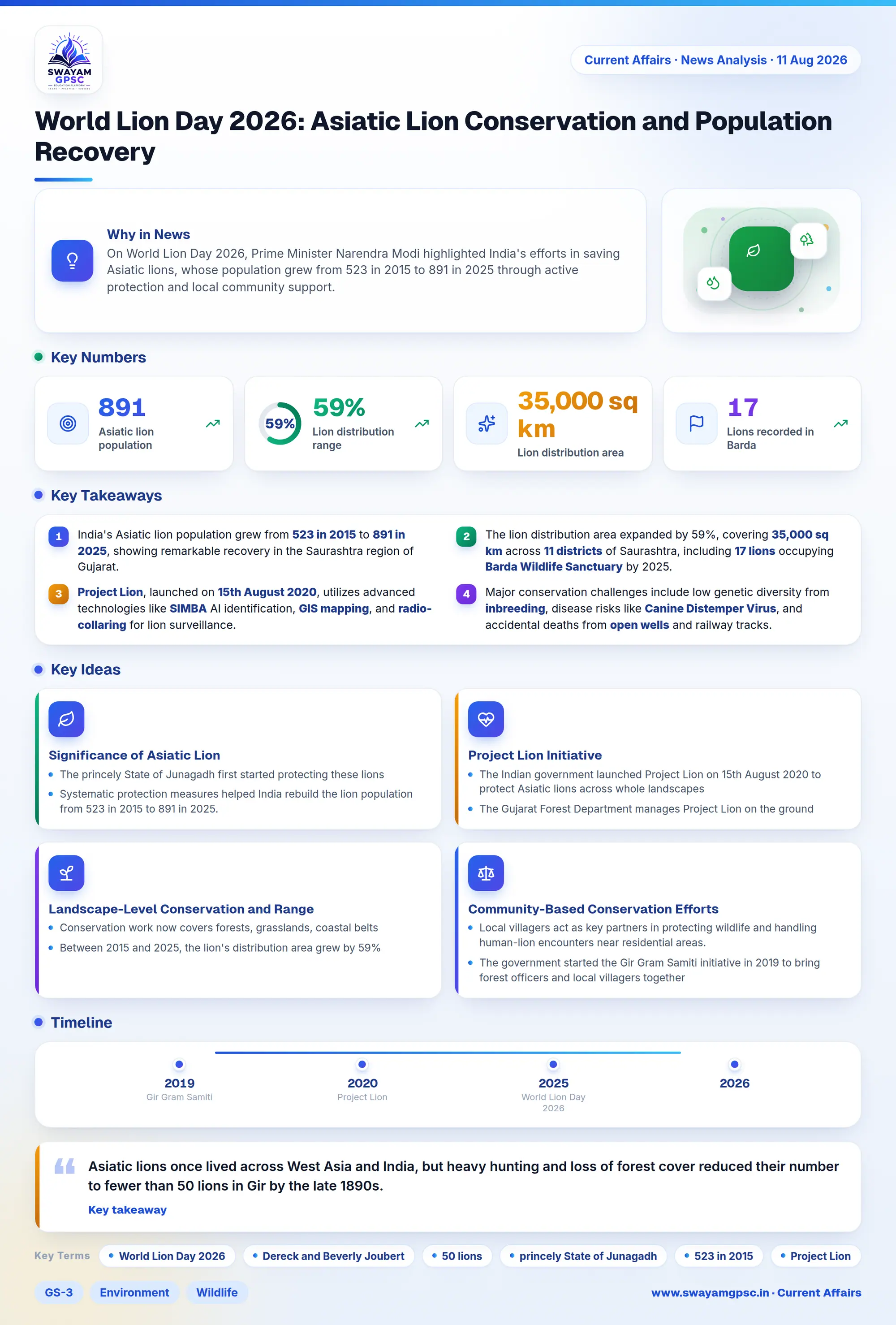
- India's Asiatic lion population grew from 523 in 2015 to 891 in 2025, showing remarkable recovery in the Saurashtra region of Gujarat.
- The lion distribution area expanded by 59%, covering 35,000 sq km across 11 districts of Saurashtra, including 17 lions occupying Barda Wildlife Sanctuary by 2025.
- Project Lion, launched on 15th August 2020, utilizes advanced technologies like SIMBA AI identification, GIS mapping, and radio-collaring for lion surveillance.
- Major conservation challenges include low genetic diversity from inbreeding, disease risks like Canine Distemper Virus, and accidental deaths from open wells and railway tracks.
Why in News
- On World Lion Day 2026, Prime Minister Narendra Modi highlighted India's efforts in saving Asiatic lions, whose population grew from 523 in 2015 to 891 in 2025 through active protection and local community support.
- Conservationists Dereck and Beverly Joubert started World Lion Day in 2013 to spread global awareness about declining wild lion populations.
Significance of Asiatic Lion Conservation in India
- Asiatic lions once lived across West Asia and India, but heavy hunting and loss of forest cover reduced their number to fewer than 50 lions in Gir by the late 1890s.
- The princely State of Junagadh first started protecting these lions, followed by the government establishing Gir Wildlife Sanctuary in 1965 and expanding protection to Gir National Park, Girnar, Mitiyala, Pania, and Barda.
- Systematic protection measures helped India rebuild the lion population from 523 in 2015 to 891 in 2025.
- Strong legal rules, larger natural habitats, healthy prey numbers, and local community support made this conservation success possible.
Project Lion Initiative
- The Indian government launched Project Lion on 15th August 2020 to protect Asiatic lions across whole landscapes through habitat improvement, disease monitoring, radio-collaring, camera trapping, and prey management.
- The Gujarat Forest Department manages Project Lion on the ground, conducting regular lion censuses while involving local villagers to reduce conflicts and protect biodiversity.
Landscape-Level Conservation and Range Expansion
- Conservation work now covers forests, grasslands, coastal belts, and agricultural fields outside protected boundaries to provide larger connected habitats.
- Between 2015 and 2025, the lion's distribution area grew by 59%, spreading across 35,000 sq km in 11 districts of Saurashtra, while Barda Wildlife Sanctuary recorded 17 lions by 2025 where no lions lived since 1879.
Community-Based Conservation Efforts
- Local villagers act as key partners in protecting wildlife and handling human-lion encounters near residential areas.
- The government started the Gir Gram Samiti initiative in 2019 to bring forest officers and local villagers together, supported by honorary wildlife wardens, village leaders, eco-guides, and eco-development committees.
Application of Technology in Lion Conservation
- Forest officials use GPS tracking systems to monitor lion movements and keep track of patrolling vehicles in real time.
- India developed SIMBA (Software with Intelligent Marking Based Identification of Asiatic lions) to identify individual lions using artificial intelligence, alongside extensive radio-collaring.
- Officers also use Geographic Information System (GIS) tools for real-time data analysis, enabling quick conservation decisions on the ground.
Key Biological and Ecological Facts About Asiatic Lions
- The scientific name of the Asiatic lion is Panthera leo persica.
- Historically, these lions roamed a massive territory stretching from West Asia to eastern India.
- Today, the world's only wild Asiatic lion population lives in the Saurashtra region of Gujarat, across the Greater Gir Landscape.
- Due to space constraints in Gir, lions have naturally migrated to Barda Wildlife Sanctuary near Porbandar as their second home.
- Their natural habitat consists of dry deciduous forests, scrublands, grasslands, and open farming landscapes.
- Unlike African lions, male Asiatic lions live alone or in small male pairs, while females live together in prides with cubs.
- These big cats are mostly active during the night and at dawn or dusk, while resting in shady bushes during the hot day.
- Asiatic lions are carnivores and often scavenge on dead livestock and wild prey in the Gir landscape.
- They coexist with Indian leopards and striped hyenas by hunting different prey and occupying slightly different areas.
- The Maldhari pastoral community has lived peacefully alongside these wild lions inside Gir forests for generations.
Challenges
- All living Asiatic lions came from a tiny surviving population, leading to low genetic diversity and high risk from inbreeding.
- Dangerous viral infections such as Canine Distemper Virus (CDV) and Babesiosis pose severe threats to large numbers of lions at once.
- As Gir forest reaches its capacity limit, lions move into human-dominated villages, raising instances of human-lion conflict and farm animal hunting.
- Unprotected open wells, busy highways, and high-speed railway tracks running through lion zones cause accidental lion deaths every year.
Frequently Asked Questions (FAQs)
- What is Project Lion? Launched in 2020, it is a long-term plan that improves habitats, monitors diseases, uses AI tracking, and involves local citizens to protect lions.
- What is the conservation status of Asiatic lions? The Asiatic lion is listed as Endangered on the IUCN Red List, protected under Schedule I of the Wildlife (Protection) Act, 1972, and placed in Appendix I of CITES.
- Where do Asiatic lions live in India? They live natively in the Saurashtra region of Gujarat, mainly around the Gir landscape, with new groups expanding into Barda Wildlife Sanctuary.
- What are the biggest threats facing Asiatic lions? Low genetic diversity, sudden disease outbreaks, overcrowding in forests, human conflicts, and hazards like open wells and train tracks are key threats.
- How does technology protect lions? Conservation teams use radio-collaring, camera traps, GIS tracking, and the AI-based SIMBA platform to track individual lions and prevent poaching.