Legislative Privileges and Constitutional Rights
#GS-2 #Indian Polity & Constitution #Parliament #Constitution #Judiciary #Current Events #National
Key takeaways
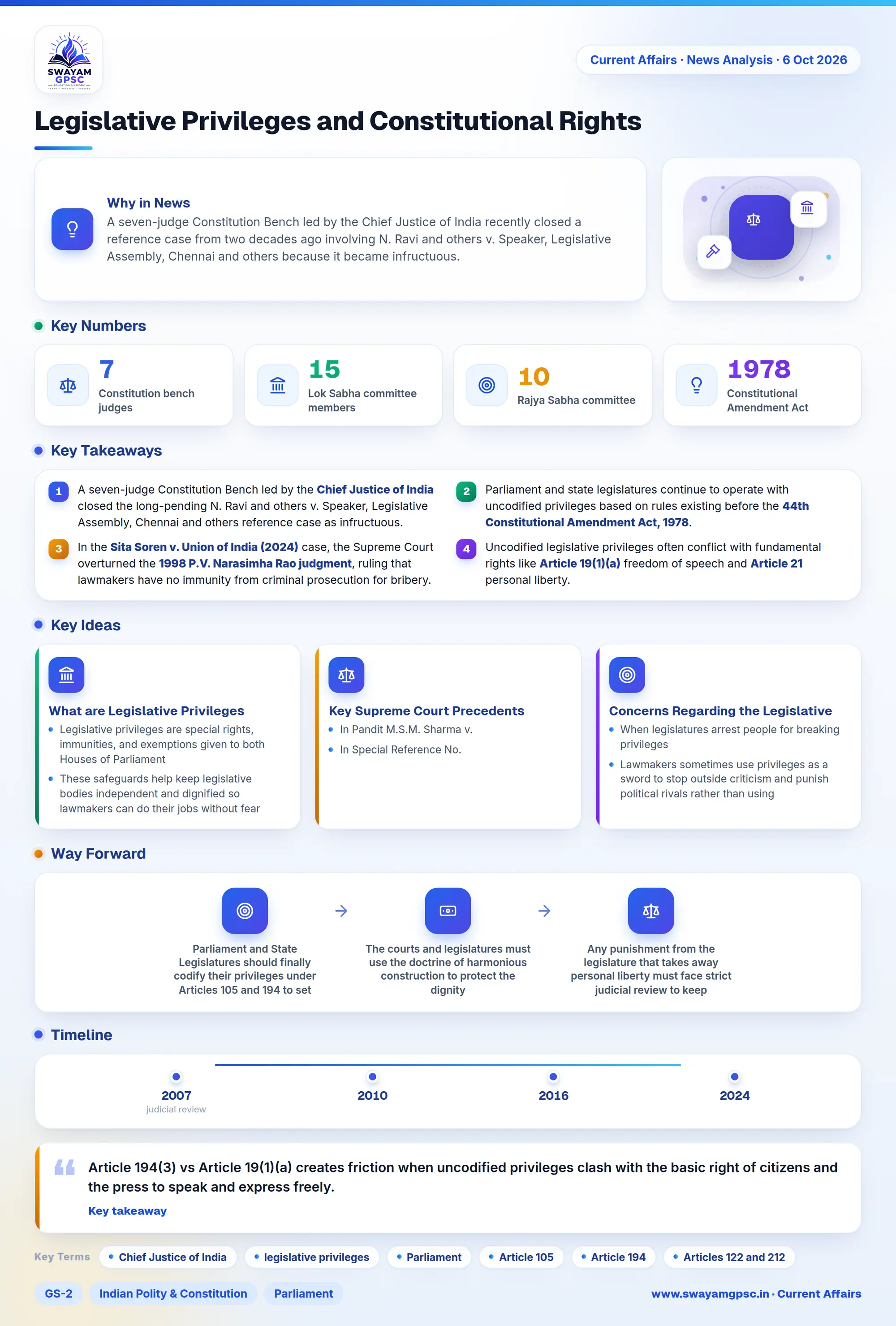
- A seven-judge Constitution Bench led by the Chief Justice of India closed the long-pending N. Ravi and others v. Speaker, Legislative Assembly, Chennai and others reference case as infructuous.
- Parliament and state legislatures continue to operate with uncodified privileges based on rules existing before the 44th Constitutional Amendment Act, 1978.
- In the Sita Soren v. Union of India (2024) case, the Supreme Court overturned the 1998 P.V. Narasimha Rao judgment, ruling that lawmakers have no immunity from criminal prosecution for bribery.
- Uncodified legislative privileges often conflict with fundamental rights like Article 19(1)(a) freedom of speech and Article 21 personal liberty.
Why in News
- A seven-judge Constitution Bench led by the Chief Justice of India recently closed a reference case from two decades ago involving N. Ravi and others v. Speaker, Legislative Assembly, Chennai and others because it became infructuous.
- The case dealt with the clash between legislative privileges and the fundamental right to freedom of speech and expression, though the Court kept the core legal questions open for a future case.
What are Legislative Privileges
- Legislative privileges are special rights, immunities, and exemptions given to both Houses of Parliament, State Legislatures, their committees, and their members.
- These safeguards help keep legislative bodies independent and dignified so lawmakers can do their jobs without fear of outside interference or legal trouble.
- Collective privileges belong to the House as a whole, such as the right to regulate internal proceedings, publish reports, exclude strangers, and punish members or outsiders for contempt.
- Individual privileges belong to lawmakers personally, such as absolute freedom of speech within the Parliament and freedom from arrest in civil cases during sessions.
- Article 105 covers the powers, privileges, and immunities of Parliament, its members, and its committees.
- Article 194 covers the corresponding powers, privileges, and immunities of State Legislatures, their members, and committees.
- Articles 122 and 212 stop courts from questioning legislative proceedings just because of a procedural mistake, though actions can still face judicial review for breaking the constitution or having substantive illegality.
- Article 105(3) gives Parliament the power to define its privileges through formal laws.
- Parliament and state legislatures have not yet fully codified their privileges, meaning they still rely on the rules that existed right before the 44th Constitutional Amendment Act, 1978.
- A Privilege Notice is a formal complaint filed by an MP claiming that someone broke parliamentary privileges or the dignity of the House.
- Lawmakers or outsiders can face a privilege notice for things like misleading the House, hiding facts, or insulting members.
- The Committee of Privileges is a permanent standing committee that acts like a court to look into breaches of privilege.
- The Lok Sabha committee has 15 members chosen by the Speaker.
- The Rajya Sabha committee has 10 members chosen by the Chairman.
- When the Speaker/Chairman accepts a privilege notice, it usually goes to the Committee of Privileges for a detailed review.
- The committee checks the facts, decides if a breach happened, and suggests action to the House, ranging from a warning and apology to suspension or expulsion.
- Parliamentary freedom of speech follows the Constitution and the rules set under Article 118.
- Article 121 stops MPs from discussing the conduct of Supreme Court or High Court judges in Parliament, unless an official removal motion is underway.
Key Supreme Court Precedents
- In Pandit M.S.M. Sharma v. Sri Krishna Sinha (1959), the Court ruled that legislative privileges under Article 194(3) come before a citizen's right to free speech under Article 19(1)(a).
- In Special Reference No. 1 of 1964 (Keshav Singh Case), the Court stated that Fundamental Rights do not automatically take a back seat to legislative privileges, and courts can review a legislature's punishment orders.
- In Raja Ram Pal v. Hon’ble Speaker, Lok Sabha (2007), the Court decided that kicking a member out of the House using parliamentary privilege is still subject to judicial review.
- In Amarinder Singh v. Special Committee, Punjab Vidhan Sabha (2010), the Court ruled that privileges cannot be used to punish a member for past executive actions that have nothing to do with current House work.
- In Alagaapuram R. Mohanraj v. Tamil Nadu Legislative Assembly (2016), the Court held that privileges exist to protect the House, not to save the personal reputation of a Chief Minister or a ruling party.
- In Sita Soren v. Union of India (2024), the Supreme Court completely overruled the 1998 P.V. Narasimha Rao judgment which gave immunity to bribed voting MPs, deciding instead that lawmakers do not enjoy constitutional immunity from criminal prosecution for accepting bribes.
Concerns Regarding the Legislative Privileges
- Article 194(3) vs Article 19(1)(a) creates friction when uncodified privileges clash with the basic right of citizens and the press to speak and express freely.
- When legislatures arrest people for breaking privileges, it directly threatens Article 21 and personal liberty without proper due process.
- Lawmakers sometimes use privileges as a sword to stop outside criticism and punish political rivals rather than using them as a protective shield.
- Using privilege rules against investigative journalists creates a chilling effect that damages the press in its role as a democratic watchdog.
- Unlike the United Kingdom, India follows Constitutional Supremacy, meaning no legislative privilege should ignore Part III of the Constitution (Fundamental Rights).
Way Forward
- Parliament and State Legislatures should finally codify their privileges under Articles 105 and 194 to set clear boundaries and stop arbitrary actions.
- The courts and legislatures must use the doctrine of harmonious construction to protect the dignity of the House without hurting free speech and investigative journalism.
- Any punishment from the legislature that takes away personal liberty must face strict judicial review to keep the rule of law strong.