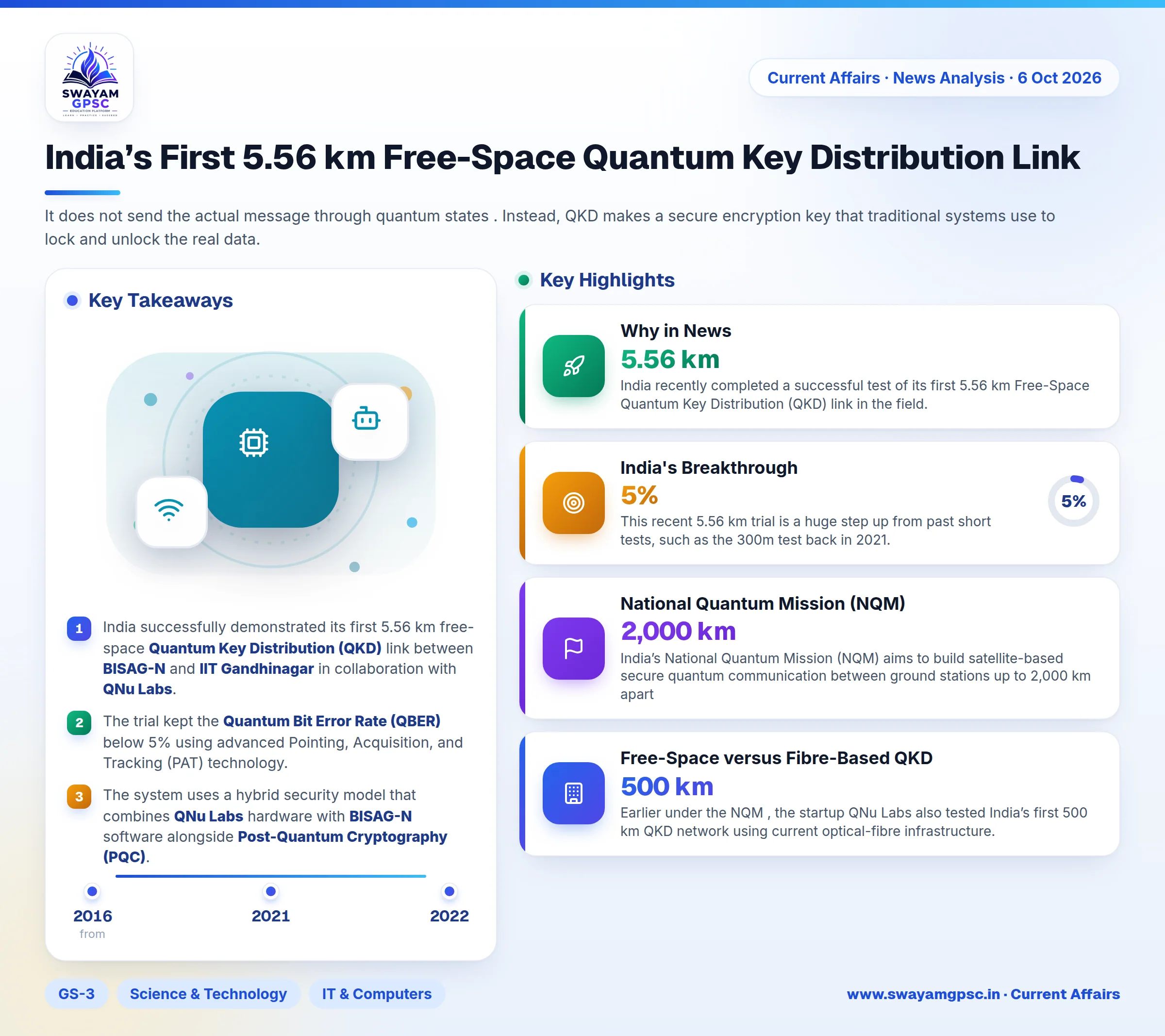
India’s First 5.56 km Free-Space Quantum Key Distribution Link
#GS-3 #Science & Technology #IT & Computers #Quick Facts For Prelims #Achievements of Indians in Science & Technology #Indigenization of Technology
Key takeaways
- India successfully demonstrated its first 5.56 km free-space Quantum Key Distribution (QKD) link between BISAG-N and IIT Gandhinagar in collaboration with QNu Labs.
- The trial kept the Quantum Bit Error Rate (QBER) below 5% using advanced Pointing, Acquisition, and Tracking (PAT) technology.
- The system uses a hybrid security model that combines QNu Labs hardware with BISAG-N software alongside Post-Quantum Cryptography (PQC).
- This breakthrough supports the goals of India’s National Quantum Mission (NQM) to develop long-range secure quantum communication networks and satellite links.
Why in News
- India recently completed a successful test of its first 5.56 km Free-Space Quantum Key Distribution (QKD) link in the field.
- The trial created a secure communication channel between BISAG-N (Bhaskaracharya National Institute for Space Applications and Geo-informatics) and IIT Gandhinagar .
- The project was carried out jointly with QNu Labs , an Indian deep-tech startup.
What is Free-Space Quantum Key Distribution
- Quantum Key Distribution (QKD) is a secure method that uses the quantum properties of photons to share secret cryptographic keys between two distant locations.
- It does not send the actual message through quantum states . Instead, QKD makes a secure encryption key that traditional systems use to lock and unlock the real data.
- Free-Space QKD sends these encryption keys through laser beams in open air , removing the need for physical fibre-optic cables.
- QKD works based on Heisenberg’s Uncertainty Principle and the No-Cloning Theorem.
- According to Heisenberg’s Uncertainty Principle , measuring a quantum system changes it. If a spy tries to intercept the photons, the quantum state collapses and immediately alerts the users of a breach.
- The No-Cloning Theorem states that creating a perfect copy of an unknown quantum state is physically impossible , which stops hackers from secretly copying the keys.
- QKD does not send the real message. It only creates a secure cryptographic key to protect the data.
- Any attempt to read the quantum states disturbs them and causes visible errors. This lets users catch eavesdropping and throw away the compromised key.
- Unlike fibre-based setups, free-space QKD needs a direct line-of-sight between the transmitter and receiver. It requires careful alignment, and weather conditions like atmospheric turbulence or bright daylight can weaken the optical signal.
India's Breakthrough
- This recent 5.56 km trial is a huge step up from past short tests, such as the 300m test back in 2021.
- The Quantum Bit Error Rate (QBER) measures the share of incorrect quantum bits received. A lower QBER means a safer channel, and during this 5.56 km trial, the QBER stayed below 5%.
- The trial used QNu Labs' advanced Pointing, Acquisition, and Tracking (PAT) system to keep the laser beam aligned across the open air over the entire distance.
- The setup used a Two-Layered Security Architecture combining hardware from QNu Labs (Armos) and software from BISAG-N (Vedic Kavach).
- This hybrid setup mixed QKD with Post-Quantum Cryptography (PQC), which uses encryption algorithms built to stay safe against future quantum computers.
- If bad weather temporarily breaks the physical atmospheric link, the mathematical PQC software keeps protecting the data.
- Free-space terrestrial QKD is an important stepping stone toward satellite-based quantum communication because both send quantum signals through the atmosphere between line-of-sight optical terminals.
- As quantum computers grow strong enough to break normal encryption, this technology provides a quantum-safe shield for defence, critical infrastructure, and financial networks against future cyber attacks.
- India’s National Quantum Mission (NQM) aims to build satellite-based secure quantum communication between ground stations up to 2,000 km apart, alongside a 2,000 km inter-city QKD network using optical fibre.
Free-Space versus Fibre-Based QKD
- Fibre-based QKD uses fibre-optic cables for transmission, while free-space QKD uses open air, the atmosphere, or space.
- Fibre-based systems usually cover only a few hundred kilometres without trusted repeaters due to signal loss, whereas free-space systems can cover thousands of kilometres, especially using satellites.
- Fibre-based connections are more stable and protected from weather, while free-space links face disruptions from fog, rain, turbulence, and daylight.
- Fibre setups use fixed connections without active tracking, but free-space setups need precise Line-of-Sight (LoS) along with active pointing and tracking systems.
- Earlier under the NQM , the startup QNu Labs also tested India’s first 500 km QKD network using current optical-fibre infrastructure.
- Globally, China launched the world’s first quantum-communication satellite, Micius, in 2016 from low-Earth orbit at roughly 500 km, and later launched Jinan-1 in 2022.