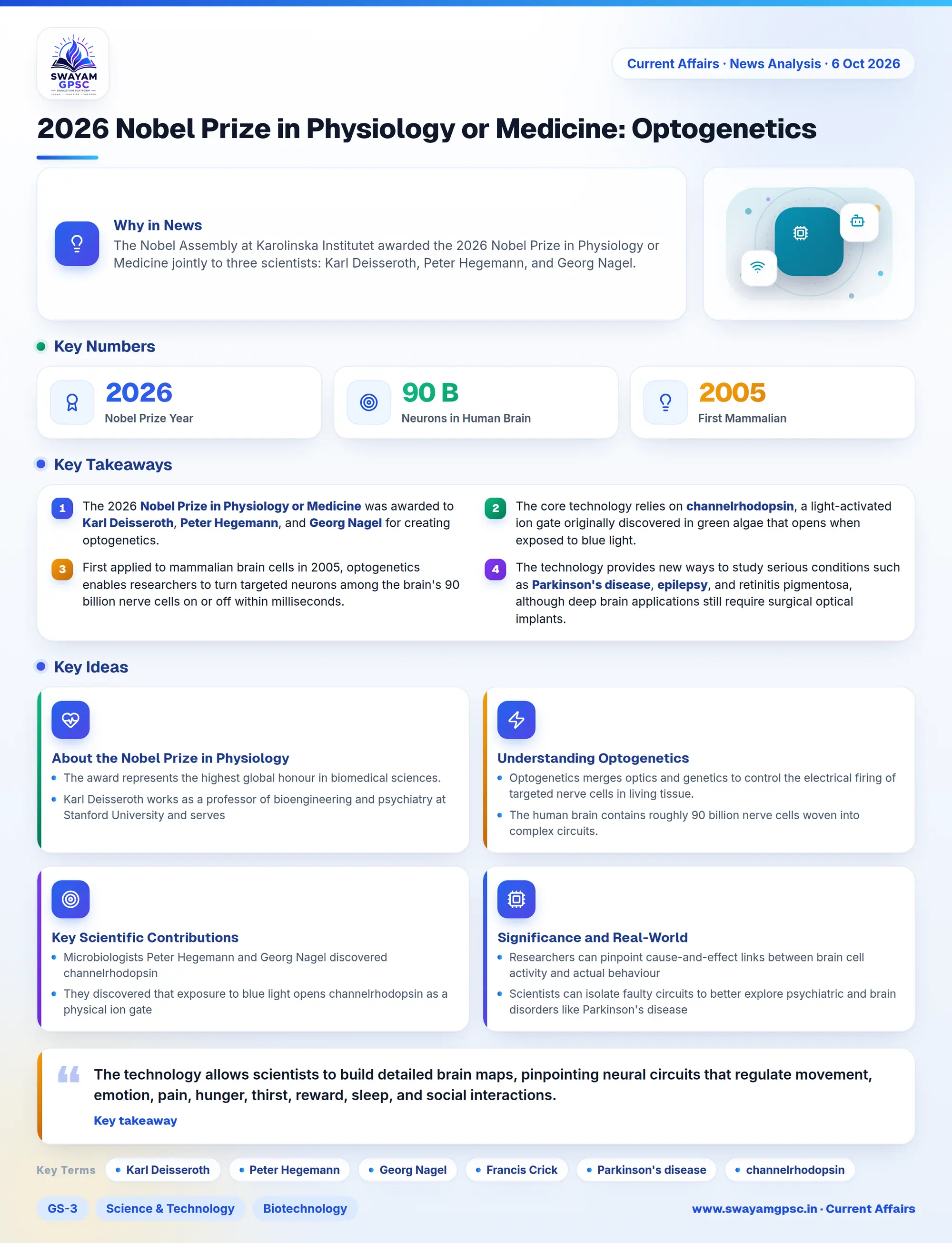
2026 Nobel Prize in Physiology or Medicine: Optogenetics
#GS-3 #Science & Technology #Biotechnology #Current Events #International #Quick Facts For Prelims #Nobel Prize
Key takeaways
- The 2026 Nobel Prize in Physiology or Medicine was awarded to Karl Deisseroth, Peter Hegemann, and Georg Nagel for creating optogenetics.
- The core technology relies on channelrhodopsin, a light-activated ion gate originally discovered in green algae that opens when exposed to blue light.
- First applied to mammalian brain cells in 2005, optogenetics enables researchers to turn targeted neurons among the brain's 90 billion nerve cells on or off within milliseconds.
- The technology provides new ways to study serious conditions such as Parkinson's disease, epilepsy, and retinitis pigmentosa, although deep brain applications still require surgical optical implants.
Why in News
- The Nobel Assembly at Karolinska Institutet awarded the 2026 Nobel Prize in Physiology or Medicine jointly to three scientists: Karl Deisseroth, Peter Hegemann, and Georg Nagel.
- The Nobel committee recognised the trio for discovering light-gated ion channels and developing optogenetics, which lets researchers control specific nerve cells using light flashes.
About the Nobel Prize in Physiology or Medicine
- The award represents the highest global honour in biomedical sciences. It recognizes foundational breakthroughs that reshape how we understand biology and treat human diseases.
- Karl Deisseroth works as a professor of bioengineering and psychiatry at Stanford University and serves as an investigator at the Howard Hughes Medical Institute (HHMI) in the United States.
- Peter Hegemann serves as a senior neuroscience professor at Humboldt University of Berlin in Germany.
- Georg Nagel works as a professor of molecular plant physiology and biophysics at the University of Würzburg in Germany.
Understanding Optogenetics and Light-Gated Ion Channels
- Optogenetics merges optics and genetics to control the electrical firing of targeted nerve cells in living tissue.
- The human brain contains roughly 90 billion nerve cells woven into complex circuits. Traditional brain tools like drugs or electrodes affect large areas all at once.
- Optogenetics solves this limitation by allowing scientists to switch single neural circuits on or off within milliseconds using light.
- In the 1970s, Nobel laureate Francis Crick suggested that light would be the ultimate rapid tool to manipulate brain cells, an idea that this research finally proved practical.
- Light-gated ion channels are tiny protein gates sitting on cell membranes. When light hits them, they open or shut to let charged ions flow through, instantly switching cell activity on or off.
Key Scientific Contributions of the Laureates
- Microbiologists Peter Hegemann and Georg Nagel discovered channelrhodopsin, a light-sensitive protein found naturally inside green algae.
- They discovered that exposure to blue light opens channelrhodopsin as a physical ion gate, letting positive ions flow across membranes to create an electrical current.
- They also proved that inserting the algal channelrhodopsin gene into foreign cells makes those host cells respond directly to illumination.
- Neuroscientist Karl Deisseroth introduced channelrhodopsin-2 into mammalian rat neurons, demonstrating in 2005 that blue light pulses could fire neurons within milliseconds.
- He delivered blue light into live mouse brains using micro-optical fibres, which activated ion channels and proved that light can precisely steer specific circuits and behaviors.
- This breakthrough combined light detection and ion-channel opening into a single protein, creating an all-in-one molecular switch for electrically active cells.
Significance and Real-World Applications
- The technology allows scientists to build detailed brain maps, pinpointing neural circuits that regulate movement, emotion, pain, hunger, thirst, reward, sleep, and social interactions.
- Researchers can pinpoint cause-and-effect links between brain cell activity and actual behaviour, overcoming the major flaws of older stimulation methods.
- Scientists can isolate faulty circuits to better explore psychiatric and brain disorders like Parkinson's disease, Alzheimer's, schizophrenia, depression, and epilepsy.
- Optogenetics could upgrade neural prosthetics such as cochlear implants by delivering far sharper auditory nerve stimulation than basic electrical pulses.
- It provides a pathway for vision restoration in eye conditions like retinitis pigmentosa by making surviving retina cells detect light directly.
- Scientists now use it beyond the central nervous system to study communication between the brain, heart, and the gut-based enteric nervous system.
Challenges
- Applying the technique to humans requires viral gene therapy to modify neurons, which raises serious clinical safety risks.
- The human skull and scalp reflect and absorb visible light, requiring invasive brain surgery to insert fibre-optic cables to reach deep neural pathways.