India's Growth in Supercomputing and the NSM
#GS-3 #Economy #Infrastructure #Science & Technology #Artificial Intelligence #ICT #National
Key takeaways
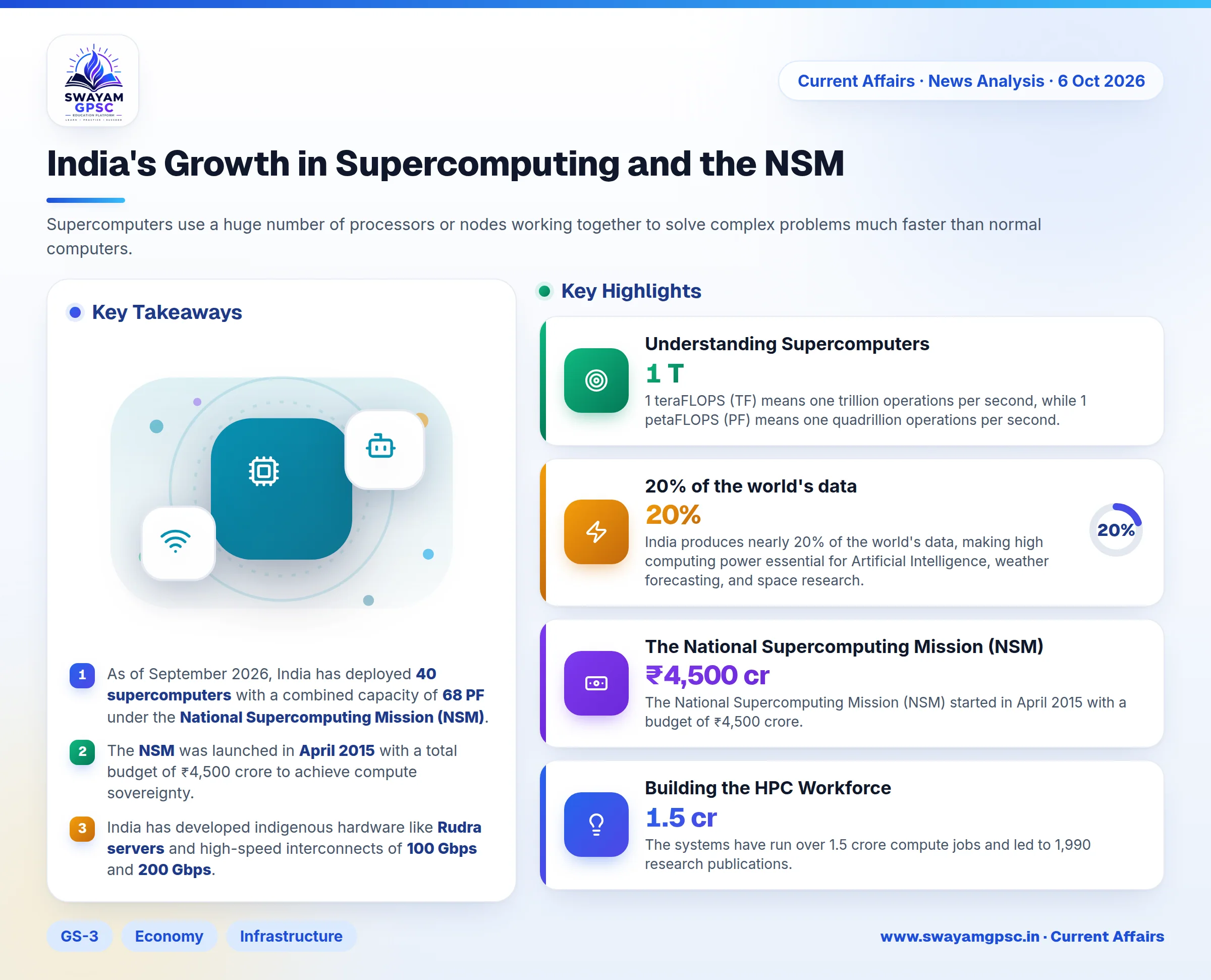
- As of September 2026, India has deployed 40 supercomputers with a combined capacity of 68 PF under the National Supercomputing Mission (NSM).
- The NSM was launched in April 2015 with a total budget of ₹4,500 crore to achieve compute sovereignty.
- India has developed indigenous hardware like Rudra servers and high-speed interconnects of 100 Gbps and 200 Gbps.
- Despite progress, a huge gap exists as the US Frontier system alone (1,200 PF) is about 18 times more powerful than India's entire network.
- The mission has supported over 16,000 researchers and helped in critical tasks like flood prediction for the Mahanadi River basin.
Why in News
- By September 2026, India successfully deployed 40 supercomputers with a total capacity of 68 PetaFLOPS (PF).
- These systems were set up under the National Supercomputing Mission (NSM).
- The government is now focusing on creating local servers, system software, high-speed connections, and cooling systems.
Understanding Supercomputers
- Supercomputers use a huge number of processors or nodes working together to solve complex problems much faster than normal computers.
- They are often called parallel computers because many CPUs can work on one calculation at the same time.
- Computing power is measured in FLOPS (Floating Point Operations Per Second).
- 1 teraFLOPS (TF) means one trillion operations per second, while 1 petaFLOPS (PF) means one quadrillion operations per second.
- The fastest supercomputer in the world reached about 2.19 exaflops in 2026, which is 2.19 quintillion calculations per second.
- These machines are vital for climate research, healthcare, space studies, agriculture, and engineering.
- They help in predicting crop yields, tracking disease outbreaks, discovering new drugs, and forecasting floods.
- India produces nearly 20% of the world's data, making high computing power essential for Artificial Intelligence, weather forecasting, and space research.
- The government is providing this infrastructure to research institutes to support Aatmanirbhar Bharat.
The National Supercomputing Mission (NSM)
- The National Supercomputing Mission (NSM) started in April 2015 with a budget of ₹4,500 crore.
- The Department of Science and Technology (DST) and the Ministry of Electronics and Information Technology (MeitY) lead this mission.
- The main goal is to make India self-reliant in supercomputing and boost research and innovation.
- Two main bodies implement the mission: C-DAC, Pune and the Indian Institute of Science (IISc), Bengaluru.
- The mission uses a three-phase build approach: first assembly, then manufacturing, and finally full design and manufacturing support.
Current Status of NSM
- The mission aims to set up 50 supercomputers with a combined capacity of over 123 PF across Indian institutions.
- India's journey started with PARAM 8000 in 1991, developed by C-DAC, which had a speed of 1 gigaflop.
- Later systems like PARAM Yuva (54 teraflops) helped in weather forecasting and fluid dynamics.
- As of September 2026, the 40 deployed systems include 13 high-end systems (above 1 PF), 12 mid-range systems (500 TF to 1 PF), and 15 systems below 500 TF.
- The mission supports 11 SDGs by helping with forest-fire management, climate modelling, and industry collaboration.
Applications of Supercomputing under NSM
- In medicine, it helps in drug discovery. During COVID-19, it screened drugs and predicted side effects like cardiac risks.
- For cities, it uses weather and air-pollution models to predict heavy rain and smog, helping in disaster planning.
- In energy, it maps underground geological structures for oil and gas exploration, matching the quality of commercial tools.
- The Early Warning System predicts floods up to two days in advance, specifically helping the Mahanadi River basin.
- The Forest Fire Spread Model uses satellites and computing to predict fire movement, tested in the Sikkim Himalayas.
- In chemistry and materials science, it simulates atoms and alloys to study their properties.
Key Indigenous Achievements
- C-DAC developed the Rudra servers, which handle AI and complex simulations. These are now made by Indian Electronics Manufacturing Services (EMS) partners.
- PARAM Rudra supercomputers use these local servers and a domestic software stack for research in astronomy and physics.
- By September 2026, 6,000 Rudra servers were deployed, with 1,500 more being made.
- India created its own high-speed interconnect networks with speeds of 100 Gbps (Trinetra-A) and 200 Gbps (Trinetra-B).
- Local cooling technology is now being deployed to make systems more power-efficient.
- A full High-Performance Computing (HPC) system software stack was developed for better management.
- PARAM Shavak is a compact supercomputing-in-a-box for students and researchers in colleges.
- Local applications are now used by the India Meteorological Department (IMD), Central Water Commission (CWC), Central Pollution Control Board (CPCB), and Ministry of AYUSH.
Building the HPC Workforce
- Over 16,000 researchers and 2,900 PhD scholars from 400+ institutions have used the NSM infrastructure.
- The systems have run over 1.5 crore compute jobs and led to 1,990 research publications.
- Workshops and hackathons teach students about High-Performance Computing (HPC), Deep Learning (DL), and Generative AI.
- Faculty from non-CS backgrounds get training in AI and Machine Learning through AICTE collaboration.
- Learning is available through the EduHPC Workshop and the SWAYAM platform under NPTEL.
- The HPC Shiksha Portal provides lectures and materials for practical learning.
- The NSM Users Forum allows experts to share knowledge and solve technical problems.
- The National Knowledge Network (NKN) acts as the high-speed backbone connecting all these facilities across India.
Challenges
- India still imports the core silicon, such as CPUs and GPUs, from foreign vendors like NVIDIA and Intel.
- There is a huge gap in capacity. The US Frontier supercomputer alone has 1,200 PF, which is about 18 times India's total capacity.
- Private companies in India rarely use NSM nodes, often renting foreign clouds for tasks like virtual crash tests.
- High heat in India makes cooling these machines expensive and energy-intensive.
- Many Indian researchers are locked into foreign software like NVIDIA's CUDA, making it hard to switch to local architectures like RISC-V.
Way Forward
- India should use the India Semiconductor Mission (ISM) to make its own multi-core processors, like the Shakti and Vega chips.
- The supercomputing goals should align with the IndiaAI Mission to build GPU clusters for training Large Language Models.
- New exascale systems should be powered by solar and renewable energy to keep power usage efficient.
- The government should provide subsidized compute access through NKN for deep-tech and biotech startups.
Conclusion
- India has come a long way from PARAM 8000 in 1991 to the PARAM Rudra ecosystem.
- True technological independence now depends on making domestic silicon chips and reaching exascale computing levels.
- This progress is key to achieving the goals of Viksit Bharat 2047.
Prelims in Focus: Supercomputing Terms
- PetaFLOPS (PF): A measure of computing speed equal to one quadrillion floating-point operations per second.
- Exascale Computing: The highest tier of computing, performing quintillions of calculations per second.
- PARAM Series: The family of indigenous supercomputers developed by C-DAC.
- National Knowledge Network (NKN): The high-speed network connecting India's research and academic institutions.