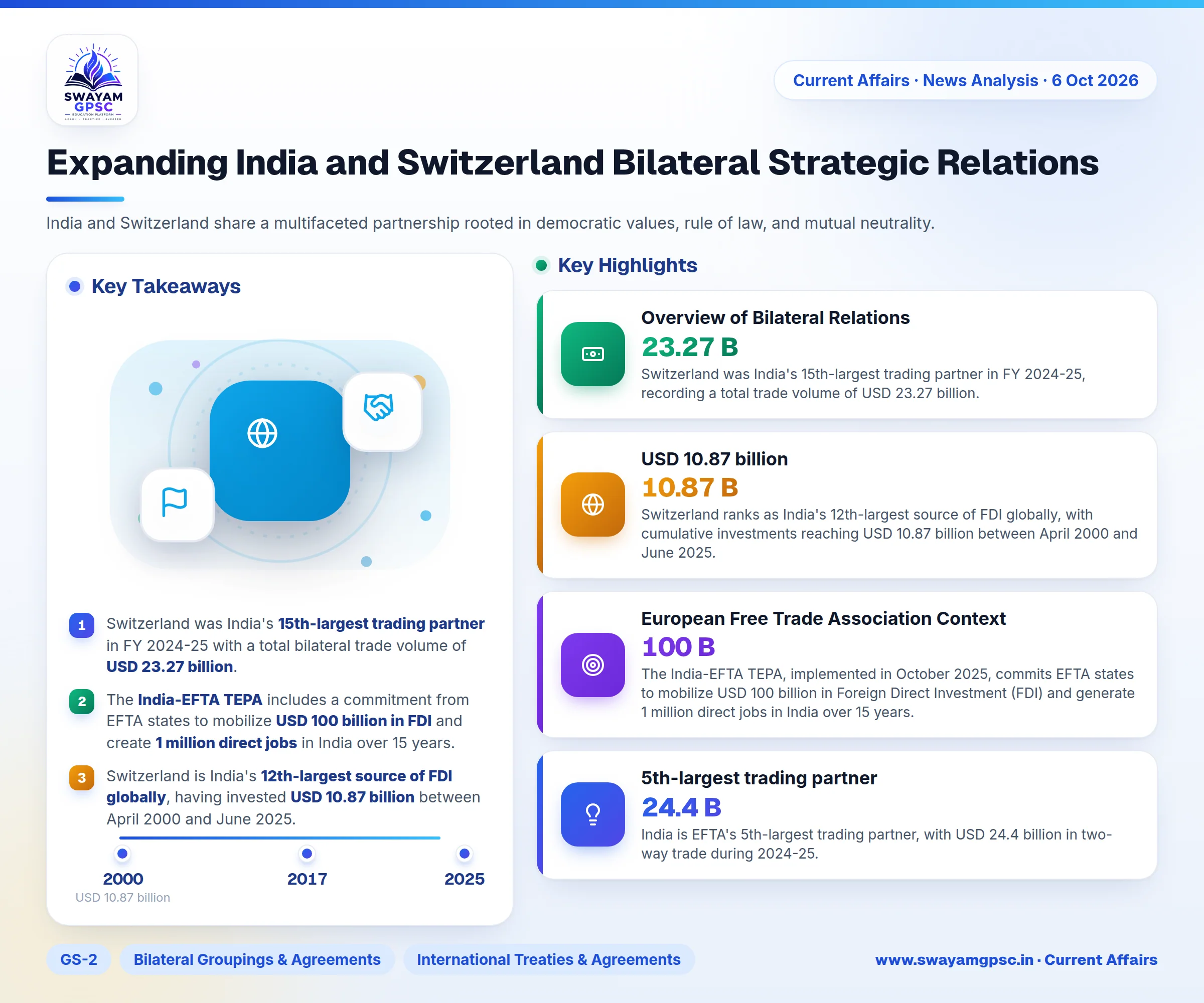
Expanding India and Switzerland Bilateral Strategic Relations
#GS-2 #Bilateral Groupings & Agreements #International Treaties & Agreements #Economy #Infrastructure #Science & Technology
Key takeaways
- Switzerland was India's 15th-largest trading partner in FY 2024-25 with a total bilateral trade volume of USD 23.27 billion.
- The India-EFTA TEPA includes a commitment from EFTA states to mobilize USD 100 billion in FDI and create 1 million direct jobs in India over 15 years.
- Switzerland is India's 12th-largest source of FDI globally, having invested USD 10.87 billion between April 2000 and June 2025.
- The newly signed Exchange of Young Professionals Agreement enables an annual exchange of 300 young professionals between the two countries.
Why in News
- The President of the Swiss Confederation recently held detailed bilateral talks with the Indian Prime Minister in New Delhi.
- This high-level state visit marked the first anniversary of the landmark Trade and Economic Partnership Agreement (TEPA) between India and the European Free Trade Association (EFTA).
- During the meetings, both countries agreed to expand their cooperation into new areas like trade, investment, defence, nuclear energy, and infrastructure.
Overview of Bilateral Relations
- India and Switzerland share a multifaceted partnership rooted in democratic values, rule of law, and mutual neutrality.
- Diplomatic ties began with the Treaty of Friendship signed in New Delhi in 1948, which is one of independent India's earliest treaties.
- Switzerland was India's 15th-largest trading partner in FY 2024-25, recording a total trade volume of USD 23.27 billion.
- India's exports to Switzerland include organic chemicals, jewellery, metals, textiles, and pharmaceuticals, while Swiss exports feature gold bullion, machinery, and watches.
- Switzerland ranks as India's 12th-largest source of FDI globally, with cumulative investments reaching USD 10.87 billion between April 2000 and June 2025.
Key Outcomes of the 2026 State Visit
- The Migration and Mobility Partnership (MMP) Agreement allows legal movement of talent, offering multiple-entry visas valid for up to 5 years and renewable 1-year student permits.
- The Exchange of Young Professionals (YPS) Agreement facilitates an annual exchange of 300 young professionals for skill enhancement, which is scalable to 500.
- A transport and infrastructure MoU formalizes cooperation between India and Switzerland in sustainable mobility, electric vehicles (EVs), ropeways, and alpine tunneling technologies.
- A research framework agreement between the Department of Science and Technology (DST) and the Swiss National Science Foundation (SNSF) supports joint scientific projects.
- The Indo-Swiss Academia-Industry Training program helps scale early-stage science and deep-tech startups through an agreement with the Zurich University of Applied Sciences.
- Both nations agreed to expand cooperation into defence equipment manufacturing, military exchanges, civilian nuclear energy, and ethical Artificial Intelligence (AI) governance.
European Free Trade Association Context
- The European Free Trade Association (EFTA) is an intergovernmental organization established in 1960 under the Stockholm Convention.
- EFTA includes four member states: Iceland, Liechtenstein, Norway, and Switzerland.
- EFTA is not a customs union, meaning each member sets its own external tariffs and none belong to the European Union (EU).
- The India-EFTA TEPA, implemented in October 2025, commits EFTA states to mobilize USD 100 billion in Foreign Direct Investment (FDI) and generate 1 million direct jobs in India over 15 years.
- India is EFTA's 5th-largest trading partner, with USD 24.4 billion in two-way trade during 2024-25.
Challenges
- Swiss investors lack explicit treaty protection in India because India terminated its older bilateral investment treaties in 2017, leading to a push for a new Bilateral Investment Treaty (BIT).
- Swiss pharmaceutical firms raise concerns over Indian patent laws, particularly Section 3(d) of the Patents Act, 1970, which prevents evergreening and protects India's supply of affordable generic drugs.
- India faces a persistent structural trade deficit with Switzerland due to heavy imports of Swiss gold bullion and high-end machinery.
- The USD 100 billion TEPA investment commitment relies entirely on private European companies rather than government guarantees, creating an implementation challenge.
- Switzerland maintains strict neutrality and neutrality statutes, which create divergent geopolitical approaches to global conflict resolution compared to India's multi-aligned foreign policy.
Way Forward
- India should use the India-EFTA Investment Desk to fast-track joint monitoring mechanisms and direct Swiss capital into priority sectors under Production Linked Incentive (PLI) schemes.
- Both sides should shift pharmaceutical discussions from litigation to co-development by encouraging Swiss firms to set up research and manufacturing centers in India.
- India should integrate Swiss alpine tunneling, avalanche protection, and ropeway engineering into Himalayan connectivity projects like the Char Dham route.
- Both nations must leverage Swiss research leadership in green hydrogen, carbon capture, and quantum technology to support the National Green Hydrogen Mission.