World Food Day 2026: Food Security in India, Challenges and Way Forward
#GS-2 #GS-3 #Governance & Social Justice #Poverty #Hunger #Economy #Agriculture #Food Security #Infrastructure #Current Events #National #Environment #Climate Change
Key takeaways
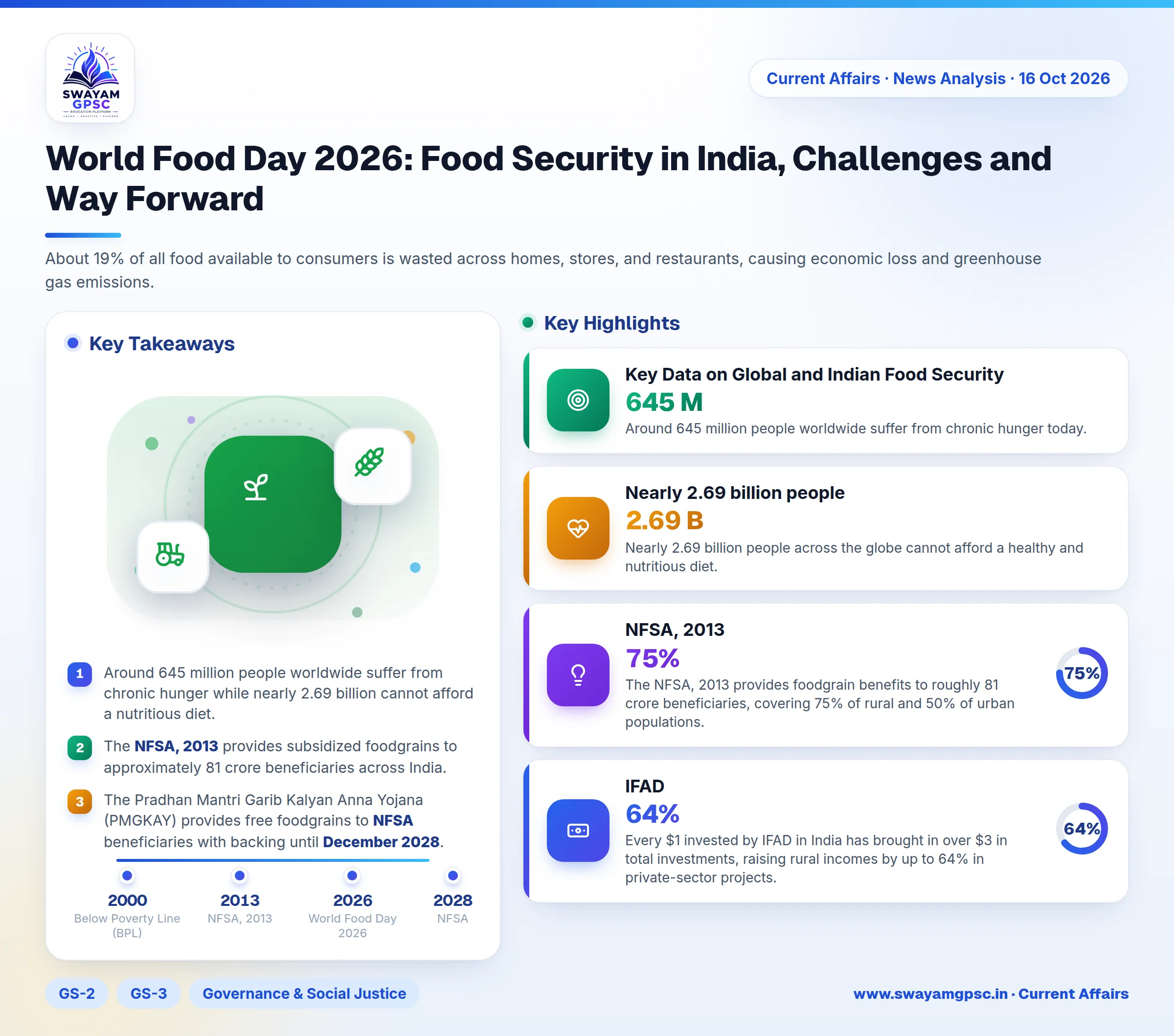
- Around 645 million people worldwide suffer from chronic hunger while nearly 2.69 billion cannot afford a nutritious diet.
- The NFSA, 2013 provides subsidized foodgrains to approximately 81 crore beneficiaries across India.
- The Pradhan Mantri Garib Kalyan Anna Yojana (PMGKAY) provides free foodgrains to NFSA beneficiaries with backing until December 2028.
- India's digital food security updates include ONORC, e-PoS machines, and Grain ATMs (Annapurti) to reduce leakages and aid migrants.
Why in News
- On World Food Day 2026 celebrated on October 16, leaders from the FAO, IFAD, and WFP focused on technology-driven farming methods to solve global hunger.
- They praised India's digital food security model as a successful example of feeding millions efficiently.
About World Food Day 2026 and Food Security
- World Food Day takes place every year on October 16 to mark the creation of the FAO in 1945 and to support global efforts against hunger under SDG 2: Zero Hunger.
- The 2026 theme highlights that traditional farming alone cannot fight climate changes and economic shocks, urging the use of digital tools, biofortification, and better supply chains.
Key Data on Global and Indian Food Security
- Around 645 million people worldwide suffer from chronic hunger today.
- Nearly 2.69 billion people across the globe cannot afford a healthy and nutritious diet.
- The NFSA, 2013 provides foodgrain benefits to roughly 81 crore beneficiaries, covering 75% of rural and 50% of urban populations.
- Every $1 invested by IFAD in India has brought in over $3 in total investments, raising rural incomes by up to 64% in private-sector projects.
- About 19% of all food available to consumers is wasted across homes, stores, and restaurants, causing economic loss and greenhouse gas emissions.
Evolution of Food Security in India
- During the 1960s and 70s, the Green Revolution helped India stop relying on PL-480 food aid by introducing high-yielding wheat and rice seeds along with MSP support.
- In 1997, the Targeted Public Distribution System replaced universal rationing to focus strictly on Below Poverty Line (BPL) households, followed by the Antyodaya Anna Yojana (AAY) in 2000.
- The National Food Security Act (2013) gave legal rights to food by offering 5 kg of grain per person monthly for priority families and 35 kg for AAY households.
- India updated its distribution network using digital ration cards, Aadhaar authentication, e-PoS machines, and One Nation One Ration Card (ONORC).
UN Agency Interventions in India
- The FAO helps improve dairy hygiene, livestock care, and waste reduction through tools like the Clean Milk Scorecard.
- The IFAD brings in private funds and connects Farmer Producer Organisations (FPOs) directly with agricultural markets.
- The WFP introduces modern supply chain tools like Grain ATMs (Annapurti) and helps add millets to school meal programs.
Key Indian Initiatives
- The Pradhan Mantri Garib Kalyan Anna Yojana (PMGKAY) supplies free foodgrains to about 81 crore NFSA beneficiaries, with funding approved until December 2028.
- The One Nation One Ration Card (ONORC) lets migrant workers collect their ration supplies from any fair price shop across the country using Aadhaar.
- The government promotes nutrient-rich millets called Shree Anna by including them in PM-POSHAN and other nutrition schemes.
Challenges Associated with Food and Nutrition Security
- Heavy focus on basic staple grains provides enough calories but leaves people suffering from hidden hunger and vitamin deficiencies.
- For example, adolescent girls and children continue to face persistent anaemia even when they receive subsidized foodgrains.
- Extreme heatwaves, unpredictable monsoons, and unseasonal rains caused by climate change damage crop yields and farmer earnings.
- For instance, terminal heat stress reduces wheat productivity across the Indo-Gangetic plains.
- Lack of enough cold storage units and transport facilities leads to heavy food spoilage and distress sales by farmers.
- For example, farmers often throw away tomatoes and onions during market gluts because they cannot store them safely.
- Assured MSP rates and free electricity push farmers to grow water-heavy paddy, which lowers crop variety and drains groundwater.
- For instance, excessive groundwater pumping in Punjab and Haryana has dangerously lowered water tables.
Way Forward
- Public distribution baskets must include pulses, millets, and fortified staples to fix micronutrient shortages.
- Deploying automated Grain ATMs (Annapurti) in cities and migrant zones will cut down waiting times and stop leakage.
- Promoting Direct Seeding of Rice (DSR), micro-irrigation, and digital weather alerts will help save water and stabilize harvests.
- Expanding IFAD style blended finance will give women-led FPOs better access to credit for food processing work.
- India should share its Digital Public Infrastructure (DPI) and PDS innovations with other developing nations to help improve global food security.