World Elephant Day 2026: India's Conservation Initiatives and Gaj Gaurav Awards
#GS-3 #Environment #Biodiversity #Wildlife #Issues on Environmental Ecology #Conservation
Key takeaways
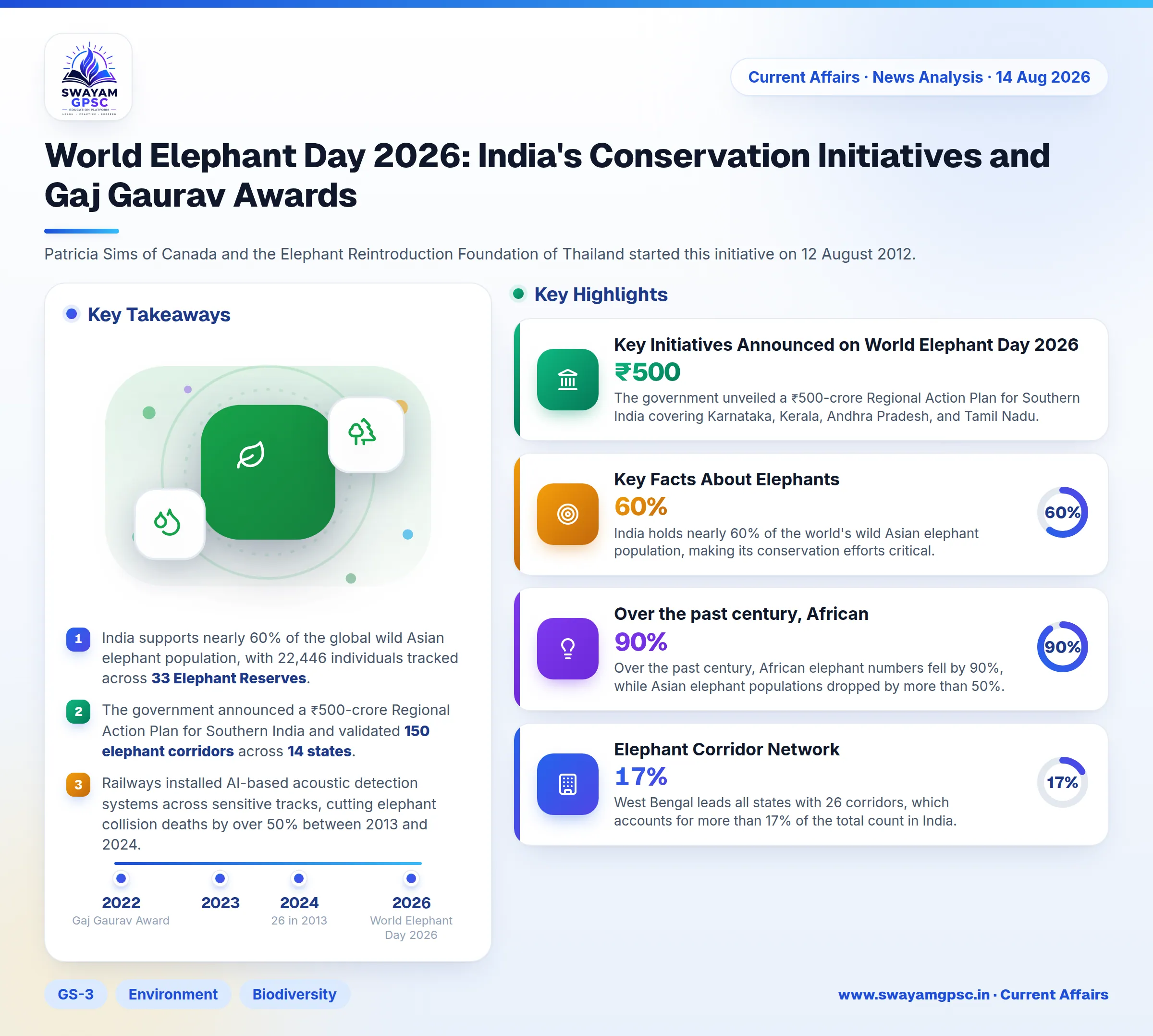
- India supports nearly 60% of the global wild Asian elephant population, with 22,446 individuals tracked across 33 Elephant Reserves.
- The government announced a ₹500-crore Regional Action Plan for Southern India and validated 150 elephant corridors across 14 states.
- Railways installed AI-based acoustic detection systems across sensitive tracks, cutting elephant collision deaths by over 50% between 2013 and 2024.
- The Gajah Suchana app tracks captive elephants using DNA profiling under the Captive Elephant Rules, 2024.
- Frontline forest staff and mahouts received the Gaj Gaurav Awards 2026 during World Elephant Day celebrations in Visakhapatnam.
Why in News
- India reaffirmed its commitment to saving wild elephants during the national celebrations of World Elephant Day 2026 in Visakhapatnam.
- The government highlighted new technology, forest community support, and joint efforts to reduce conflict between humans and elephants.
Key Facts About World Elephant Day
- People across the globe celebrate World Elephant Day every year on 12 August to protect Asian and African elephants.
- Patricia Sims of Canada and the Elephant Reintroduction Foundation of Thailand started this initiative on 12 August 2012.
- The official theme for 2026 is Bringing the world together to help elephants.
- This event highlights major threats like habitat loss, poaching for ivory, human conflict, blocked migration routes, and mistreatment in captivity.
Key Initiatives Announced on World Elephant Day 2026
- The government unveiled a ₹500-crore Regional Action Plan for Southern India covering Karnataka, Kerala, Andhra Pradesh, and Tamil Nadu.
- Officials released a Model Elephant Conservation Plan for the Nilgiri Elephant Reserve to improve scientific management.
- A new guidebook titled Captive Elephant Husbandry: Science, Welfare and Practice was launched to improve care standards for captive animals.
- Outstanding forest staff and local community members received the Gaj Gaurav Awards 2026 for exemplary conservation work.
- The government published 30 Giant Steps to document major achievements of Project Elephant from 2020 to 2026.
- Phase II of the research study on human-elephant conflict was expanded across Kerala, Karnataka, Tamil Nadu, Odisha, and West Bengal.
Key Facts About Elephants
- The world has three distinct elephant species: the African Savannah elephant, the African Forest elephant, and the Asian elephant.
- African elephants have large ears shaped like the African continent, while Asian elephant ears look like the Indian subcontinent.
- The African Savannah elephant holds the record as the largest land animal on Earth.
- Elephants can live up to 65 years, females reach puberty at 11, carry pregnancies for 22 months, and stay fertile until their late 40s.
- A family herd is led by a matriarch, who is usually the oldest and most experienced female.
- Tusks are oversized incisor teeth that grow throughout life, but poachers target them for illegal ivory.
- Elephants communicate using sounds, body postures, touch, scent, and ground vibrations picked up through their foot bones.
- India holds nearly 60% of the world's wild Asian elephant population, making its conservation efforts critical.
- The SAIEE 2021-25 survey estimated India's wild elephant population at 22,446, living across 33 Elephant Reserves and 150 corridors.
- Over the past century, African elephant numbers fell by 90%, while Asian elephant populations dropped by more than 50%.
Project Elephant and DNA-Based Assessment
- The Ministry of Environment, Forest and Climate Change manages Project Elephant as India's main program to protect wild herds and stop conflict.
- The SAIEE 2021-25 survey used India's first nationwide DNA test by analyzing dung samples to count individual elephants accurately.
Elephant Corridor Network
- Corridors link split patches of forest, letting elephants roam freely across expanding human settlements.
- Safe passage between forests keeps elephant groups genetically healthy and prevents isolated populations from dying out.
- Clear travel paths reduce crop raiding and property damage by keeping herds away from villages and roads.
- Government surveys identified and verified 150 elephant corridors across 14 states.
- According to the Elephant Corridors of India, 2023 report, the East-Central zone has 52 corridors, the North-East has 48, the South has 32, and the North has 18.
- West Bengal leads all states with 26 corridors, which accounts for more than 17% of the total count in India.
- The network features 19 inter-state corridors and 6 transboundary corridors linking India with Nepal.
- Monitoring shows increased elephant movement in 59 corridors, stable use in 29, reduced use in 29, and damage in 15.
- Forest departments are adding corridor boundaries into official state land plans to protect travel paths permanently.
Growing the Reserve Network
- Protected reserves now cover 80,777 km² across 14 states after steady growth since 2014.
- Recent expansions added 8,610 km² to the protected reserve system, securing crucial wilderness areas.
- Larger reserve areas link broken landscapes so wild herds can migrate safely across administrative boundaries.
- Expanding the reserves helps forest officers run better scientific surveys and plan long-term protection.
- Combining Project Elephant, genetic counting, reserves, and corridors creates a complete landscape approach to conservation.
Management Effectiveness Evaluation
- The government introduced an assessment system in 2023 to measure how well reserve teams protect elephant habitats.
- Initial testing took place in four sites: Shivalik, Kaziranga-Karbi Anglong, Mayurbhanj, and Nilgiri.
- Authorities are expanding this evaluation framework across all national reserves using CAMPA funds.
- This system helps forest officers track clear results and adjust management choices quickly based on real field data.
- The ministry created Regional Action Plans so neighboring states can coordinate elephant protection together.
- Joint plans allow state officers to solve migration issues and handle human conflict across shared state borders.
- These plans give all states a single framework to focus funds on urgent corridor protection and safety.
Railway Collision Mitigation Measures
- Joint inspection teams checked 127 railway stretches spanning 3,452.4 km to locate high-risk crossing zones.
- Experts selected 77 railway sections across 14 states, covering 1,965.2 km, for immediate safety upgrades.
- Authorities recommended building 705 structures, including underpasses, overpasses, ramps, and modified bridges.
- Railways are installing optical fiber sensors, ground vibration detectors, and thermal cameras to spot approaching herds.
- AI-powered acoustic systems alert train drivers and station staff in real time when elephants get near tracks.
- Whenever a train hits an elephant, forest and railway officers investigate together to prevent similar accidents.
- These safety measures helped drop train collision deaths from 26 in 2013 down to 12 in 2024, marking a reduction of over 50%.
Genetic Monitoring of Captive Elephants
- The government uses DNA profiles, digital records, and legal checks to stop illegal buying and selling of captive animals.
- State Chief Wildlife Wardens handle illegal transfer cases under the provisions of the Wildlife (Protection) Act, 1972.
- The Gajah Suchana mobile app keeps a central register containing DNA signatures, photos, and ownership proof for every captive elephant.
- This database confirms animal identities before transport and offers strong proof in court cases.
- The Captive Elephant (Transfer or Transport) Rules, 2024 set strict rules for moving captive animals across state lines.
- A Supreme Court-appointed High-Powered Committee reviews all applications to move captive elephants between states.
Community Compensation and Conflict Management
- The central government offers financial relief through Project Tiger and Elephant and Development of Wildlife Habitats.
- Families receive ₹10 lakh for loss of life or permanent disability, ₹2 lakh for major injuries, and up to ₹25,000 for minor treatment.
- Farmers receive compensation for destroyed crops and broken property according to state relief guidelines.
- The national conflict advisory urges quick setup of rapid response teams, local review panels, and fast payout systems.
- Elephant guidelines issued in 2023 help local forest officers and residents coordinate conflict response smoothly.
Way Forward
- India's elephant strategy combines traditional cultural respect, modern science, advanced tracking technology, and public support.
- Protecting habitats, fixing broken corridors, and creating safer train tracks will help humans and wild herds live peacefully.
- Sustained conservation effort forms a vital pillar of the Viksit Bharat vision to protect national wildlife heritage.
Prelims in Focus: Gaj Gaurav Awards 2026
- The Ministry of Environment, Forest and Climate Change instituted the Gaj Gaurav Award in 2022 during the 30th year of Project Elephant.
- The award honors frontline forest guards, mahouts, trackers, and local community committees for field service in elephant protection.
- Seven mahouts from Jaldapara National Park in West Bengal won awards for saving stranded elephants during severe floods in the Torsha and Malangi rivers.
- Mahout Bikash Kharia and Rajiv Oraon received special recognition for guiding five captive elephants to safety through dangerous flood currents.
- Two staff members from Namdapha National Park in Arunachal Pradesh, Ganesh Tamang and Sumit Gogoi, were honored for long-term captive elephant care.