WHO Pandemic Treaty and India's Stakes in Global Health
#GS-2 #Governance & Social Justice #Health #Economy #Environment #Current Events #International #Important International Institutions #Global Health Security #Pandemic Agreement #One Health #Pathogen Access and Benefit-Sharing #Biopharma SHAKTI
Key takeaways
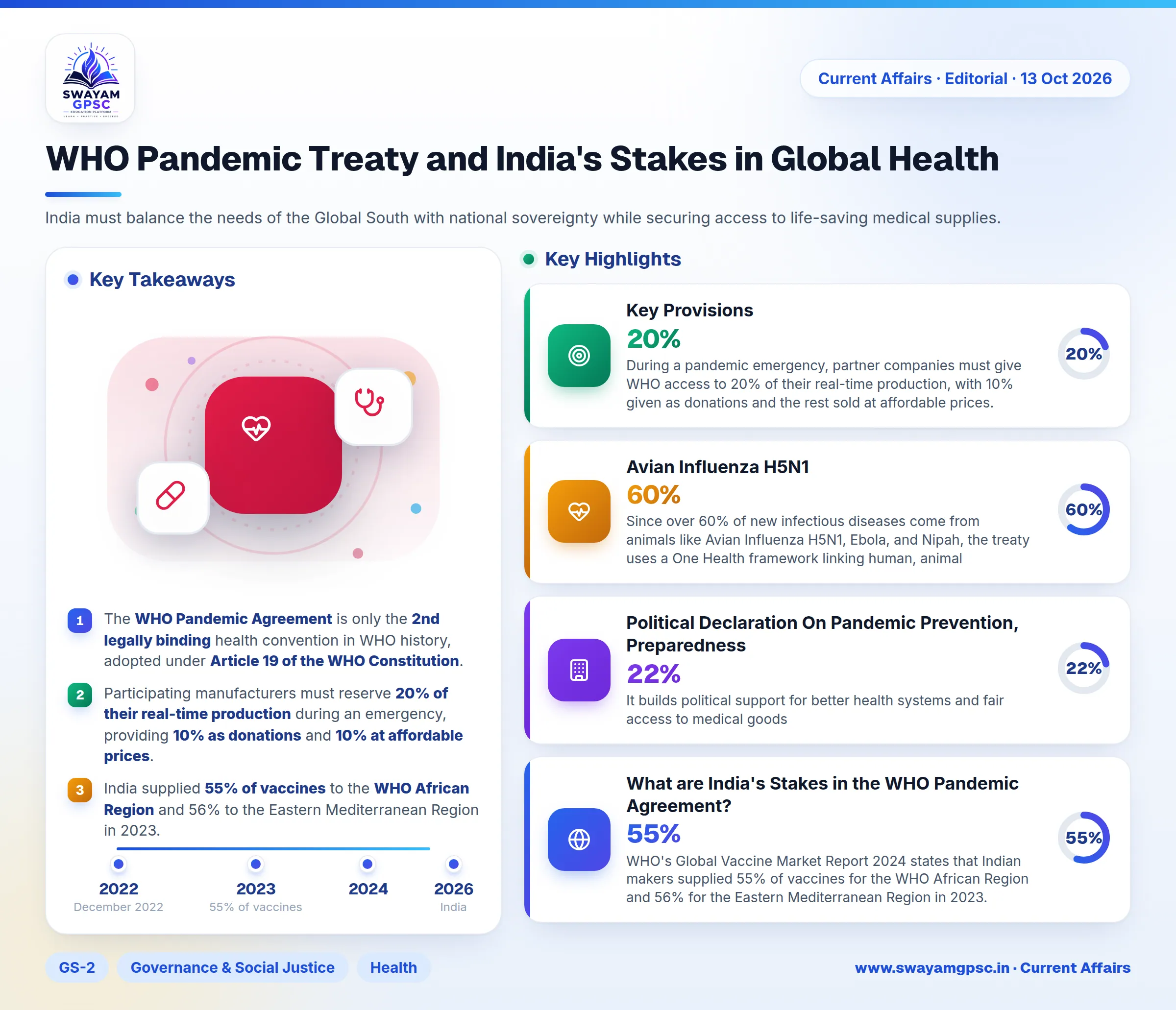
- The WHO Pandemic Agreement is only the 2nd legally binding health convention in WHO history, adopted under Article 19 of the WHO Constitution.
- Participating manufacturers must reserve 20% of their real-time production during an emergency, providing 10% as donations and 10% at affordable prices.
- India supplied 55% of vaccines to the WHO African Region and 56% to the Eastern Mediterranean Region in 2023.
- In FY 2024-25, India imported roughly US$4.35 billion in APIs, with China providing about 73.7% of that import value.
- The Biopharma SHAKTI scheme provides ₹10,000 crore over 5 years to boost domestic biologic and biosimilar manufacturing.
Why in News
- At the UN High-Level Meeting held in September 2026, India delivered formal remarks on the Political Declaration on Pandemic Prevention, Preparedness, and Response (PPPR).
- This statement highlights India as a central player in shaping the upcoming international health rules led by the WHO Pandemic Agreement (PA).
- The new WHO Pandemic Agreement is a major step to fix global health security after Covid-19 by creating a legally binding system based on fairness and readiness.
- India must balance the needs of the Global South with national sovereignty while securing access to life-saving medical supplies.
- However, finishing talks on pathogen benefit-sharing is still necessary to make this global health setup work in practice.
What is the WHO Pandemic Agreement?
- The WHO Pandemic Agreement, often called the Pandemic Treaty, is a major international treaty agreed upon by consensus at the 78th World Health Assembly under Article 19 of the WHO Constitution.
- It is only the 2nd legally binding health convention in WHO history, following the 2003 Framework Convention on Tobacco Control (FCTC) which India ratified in 2004.
- Countries pursued two parallel legal and political paths: the binding WHO Pandemic Agreement and high-level Political Declarations on Pandemic Prevention, Preparedness, and Response (PPPR) led by the UN General Assembly.
- Talks took three years through the Intergovernmental Negotiating Body (INB) to build a fair system designed to stop, prepare for, and handle future health emergencies.
- The text is adopted, but the agreement is not yet in force because the Pathogen Access and Benefit-Sharing (PABS) annex is still being negotiated.
- Once the PABS annex is finalized, countries can sign and ratify it, and under Article 33, it becomes active 30 days after the 60th country deposits its instrument of ratification.
Key Provisions
- The treaty links the rapid sharing of pathogen materials and genetic sequence information directly to the fair sharing of resulting vaccines, therapeutics and diagnostics.
- This solves the problem where countries sharing virus samples often struggle to get the medicines made from them.
- During a pandemic emergency, partner companies must give WHO access to 20% of their real-time production, with 10% given as donations and the rest sold at affordable prices.
- Since over 60% of new infectious diseases come from animals like Avian Influenza H5N1, Ebola, and Nipah, the treaty uses a One Health framework linking human, animal, and environmental health monitoring.
- It requires continuous live bio-surveillance at high-risk spots like wet markets and deforestation edges to catch outbreaks early.
- The agreement builds stronger health systems, trains staff, and Article 7 specifically protects workers regarding safety, mental health, discrimination, and injury compensation.
- It promotes voluntary licensing, knowledge sharing, and patent pools to avoid relying only on Western and East Asian factories.
- It supports the mRNA Technology Transfer Programme based in South Africa and regional vaccine facilities across Latin America, Asia, and Africa.
- Member states must harmonize national regulatory authorities to speed up emergency approvals for medical products.
- Article 8 covers fast-tracked reviews and ongoing checks on product safety and effectiveness to cut approval delays.
- A Global Supply Chain and Logistics Network (GSCL) managed by WHO will deliver medical supplies fairly based on public health risk and need.
- The Coordinating Financial Mechanism will help implement the treaty and provide emergency funding, especially for developing nations.
- The agreement does not let the WHO force lockdowns, vaccine mandates, or national laws, leaving a Conference of the Parties (COP) to oversee it through non-punitive rules.
- It complements the International Health Regulations (IHR) by adding cooperation on manufacturing and fair access.
Political Declaration On Pandemic Prevention, Preparedness And Response
- The UN Political Declaration is a non-binding political commitment separate from the WHO treaty framework.
- The UN General Assembly adopted the PPPR Political Declaration on 12th October 2026 with 153 votes in favor, 3 against, and 2 abstentions.
- It builds political support for better health systems and fair access to medical goods, noting past inequality such as in December 2022 when only 22% of people in low-income countries were fully vaccinated compared to 75% in high-income countries.
- While the Political Declaration secures political backing, the WHO Pandemic Agreement sets binding treaty rules that become law for participating nations after entry into force.
What are India's Stakes in the WHO Pandemic Agreement?
- WHO's Global Vaccine Market Report 2024 states that Indian makers supplied 55% of vaccines for the WHO African Region and 56% for the Eastern Mediterranean Region in 2023.
- Indian companies want predictable orders and fair supply contracts while looking for growth via regional partnerships, joint ventures, and tech services.
- At the 79th World Health Assembly in May 2026, India demanded standardized, legally binding contracts for pathogen sharing and strong traceability mechanisms.
- India wants actual product access and technology transfer rather than relying on optional help.
- Announced in the Union Budget 2026-27, Biopharma SHAKTI provides ₹10,000 crore over 5 years for biologics and biosimilars, which pairs well with international research partnerships.
- India wants manufacturing know-how and protection of TRIPS public health flexibilities for cheap drug production.
- In FY 2024-25, India imported about US$4.35 billion worth of APIs across 200 categories, with China supplying 73.7% of that total, making supply chain security vital.
- The National One Health Mission reviewed in May 2026 has started genomics and metagenomics-based surveillance networks involving zoos and bird sanctuaries.
- The 2026-27 Budget proposed a network of over 1,000 accredited clinical trial sites and a dedicated review team to strengthen the CDSCO.
- At the September 2026 UN PPPR meeting, India noted it supplied 300 million Covid-19 vaccine doses to around 100 countries and medical aid to over 150 countries.
Challenges
- Developing nations wanted automatic IP waivers, but the final treaty limits technology transfers to Mutually Agreed Terms (MAT), relying instead on existing TRIPS flexibilities.
- High-income nations and pharma groups argue that forcing a 20% production quota and mandatory payments hurts private research, stalling the PABS Annex talks.
- Article 5 requires heavy One Health surveillance, but the treaty lacks direct funding to build labs and genomics infrastructure in high-biodiversity developing regions.
- The final text relies on a Coordinating Financial Mechanism using voluntary funds rather than a mandatory global fund, risking the same underfunding seen in COVAX and ACT-Accelerator.
- The agreement lacks penalties or legal teeth against nations enforcing export bans or bulk pre-booking during shortages.
- Some public debates falsely claim the WHO can force domestic lockdowns, though Article 3 confirms the WHO has no legal authority to overrule domestic laws.
- Major economies like the US have distanced themselves from the framework due to sovereignty and IP concerns.
- Industry groups warn that forced know-how transfers without quality controls could hurt global supply chains and spark substandard manufacturing.
Way Forward
- Develop standard contract templates for PABS detailing product reservations, delivery schedules, and pricing methods, adapting WHO's Standard Material Transfer Agreement 2 (SMTA2).
- Set up multi-year funding and partner with the Pandemic Fund and regional banks like ADB and AfDB to create pre-approved credit lines that release cash instantly during emergencies.
- Add equitable-access clauses to public grants requiring affordable pricing, stockpile duties, and backup manufacturing options.
- Design the Conference of the Parties (COP) to include civil society groups, healthcare unions, and public health experts alongside an independent Fact-Finding and Compliance Panel.
- Turn the Global Supply Chain and Logistics Network into an independent body with pre-set transit rights and rules that automatically suspend export bans on essential medical items during emergencies.
- Create regional stockpiles under WHO oversight to avoid national hoarding by wealthy nations.