Building an Inclusive India for Transgender Community
#GS-2 #Governance & Social Justice #Welfare Schemes #Vulnerable Sections #Gender Equality #Government Policies & Interventions #Issues Related to Transgenders #Constitution
Key takeaways
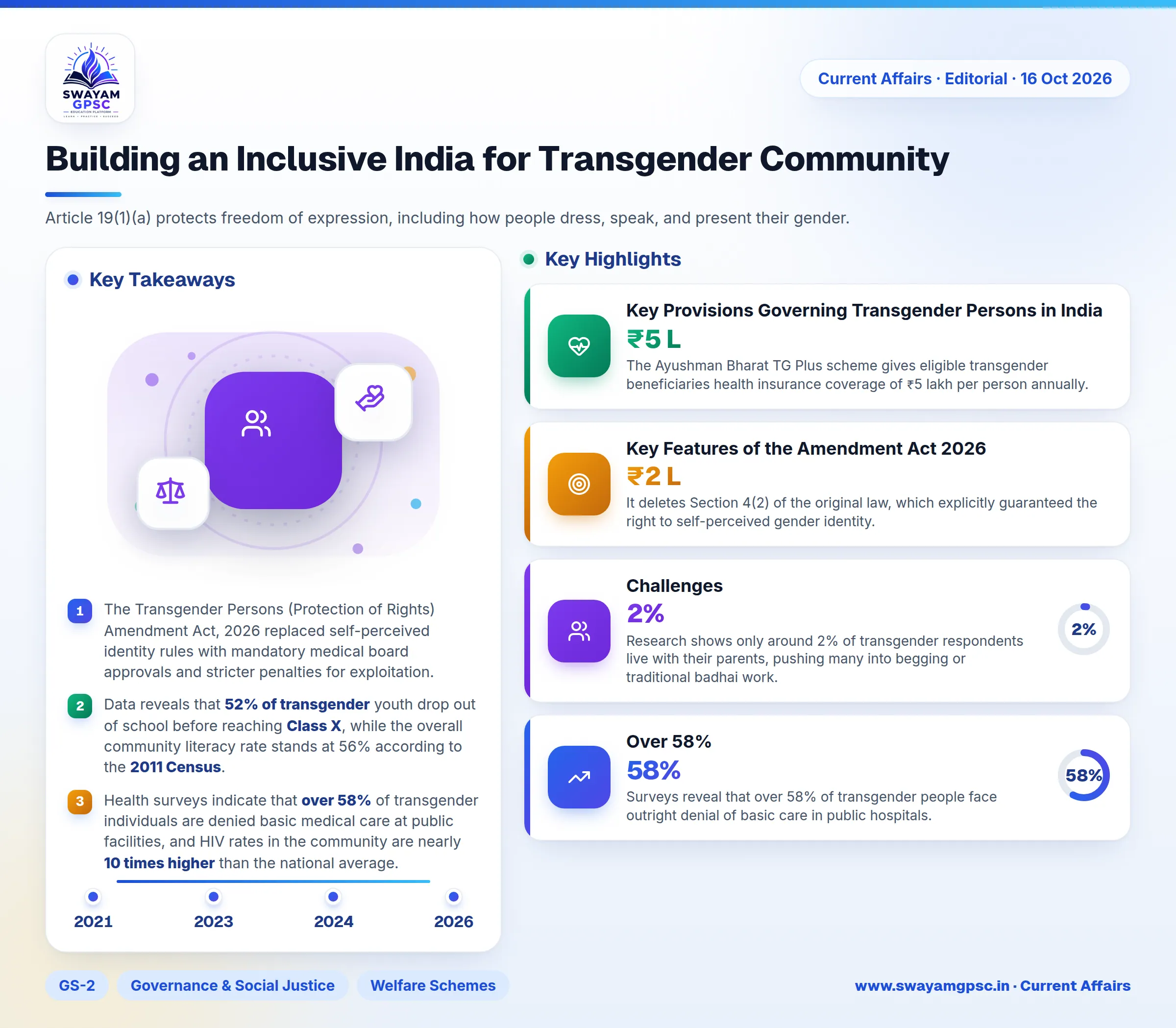
- The Transgender Persons (Protection of Rights) Amendment Act, 2026 replaced self-perceived identity rules with mandatory medical board approvals and stricter penalties for exploitation.
- Data reveals that 52% of transgender youth drop out of school before reaching Class X, while the overall community literacy rate stands at 56% according to the 2011 Census.
- Health surveys indicate that over 58% of transgender individuals are denied basic medical care at public facilities, and HIV rates in the community are nearly 10 times higher than the national average.
- The Ayushman Bharat TG Plus scheme provides eligible transgender beneficiaries with health insurance coverage of ₹5 lakh per person annually.
- A 2026 BMJ Global Health study found that only 75.6% of transgender respondents possessed a transgender identity card, highlighting ongoing documentation gaps.
Why in News
- The central government recently told the Karnataka High Court that the Income Tax Act, 1961 cannot give spousal tax breaks to same-sex couples.
- This case shows a clear gap between court rulings and actual tax laws.
- Experts point out that queer couples need proper legal frameworks to share assets and enjoy basic civil rights.
Key Provisions Governing Transgender Persons in India
- Articles 14 and 15 protect the right to equality and forbid the state from discriminating based on sex, which the NALSA v. Union of India Case (2014) expanded to include sexual orientation and gender identity.
- Article 19(1)(a) protects freedom of expression, including how people dress, speak, and present their gender.
- Article 21 guarantees the right to privacy and personal liberty, which covers a person's choice of gender identity and private relationships.
- The NALSA v. Union of India (2014) ruling officially recognized transgender people as the third gender and allowed self-identification without requiring surgery.
- The K.S. Puttaswamy v. Union of India (2017) judgment ruled that sexual orientation is a core part of personal privacy.
- The Navtej Singh Johar v. Union of India (2018) verdict struck down Section 377 of the IPC, ending the criminalization of consensual adult same-sex relations.
- The Supriyo v. Union of India (2023) ruling protected the right of queer people to live together safely, though it stopped short of legalizing same-sex marriage.
- The Transgender Persons (Protection of Rights) Act, 2019 bans discrimination in schools, jobs, healthcare, and housing.
- The Transgender Persons (Protection of Rights) Amendment Act, 2026 updated definitions, added medical boards for identity checks, and set stricter penalties for exploitation.
- The Mental Healthcare Act, 2017 bans discrimination in mental health clinics and completely outlaws unscientific conversion therapy.
- The Surrogacy (Regulation) Act, 2021 and Assisted Reproductive Technology (Regulation) Act, 2021 mostly limit fertility treatments to married heterosexual couples, leaving out single and queer individuals.
- The National Portal for Transgender Persons lets people apply online for their official identity cards easily.
- The Garima Greh Scheme runs shelter homes that offer food, medical care, and job training for destitute transgender individuals.
- A Cabinet Secretary-Led Committee (2024) was set up after the Supriyo judgment to fix welfare issues like joint bank accounts and ration cards for queer couples.
- State police and district offices run special protection cells to stop hate crimes and harassment.
- The SMILE Scheme provides dedicated help for transgender education, healthcare, and job training.
- The Ayushman Bharat TG Plus scheme gives eligible transgender beneficiaries health insurance coverage of ₹5 lakh per person annually.
Key Features of the Amendment Act 2026
- The updated law replaces the broad definition of transgender people with specific terms like kinner, hijra, aravani, jogta, and eunuch.
- It removes direct references to trans-men, trans-women, and genderqueer individuals from the statute.
- It deletes Section 4(2) of the original law, which explicitly guaranteed the right to self-perceived gender identity.
- It requires a medical board headed by a chief medical officer to review applications before the District Magistrate issues an identity certificate.
- It adds Section 6(4), which lets certified transgender individuals update their first names on official identity papers.
- It amends Section 7 to make medical reporting mandatory after gender-affirming surgery.
- It mandates that state and union territory representatives on the National Council for Transgender Persons must hold at least the rank of Director.
- It updates Section 18 to punish severe crimes like forced identity conversion with 10 years to life imprisonment and a minimum ₹2 lakh fine.
Challenges
- Deep social stigma often leads to families throwing out their children when they reveal their non-traditional identities.
- Research shows only around 2% of transgender respondents live with their parents, pushing many into begging or traditional badhai work.
- Severe medical bias and gatekeeping keep many queer individuals away from public health centers.
- Surveys reveal that over 58% of transgender people face outright denial of basic care in public hospitals.
- HIV rates among transgender populations remain nearly 10 times higher than the national average.
- Informal clinics and religious centers still practice harmful conversion therapy despite legal bans.
- Employment surveys show an employment denial rate exceeding 90% among transgender citizens due to widespread corporate bias.
- A 2018 National Human Rights Commission (NHRC) report noted that 52% of transgender youth drop out of school before finishing Class X.
- The 2011 Census recorded a total literacy rate of just 56% among roughly 4.88 lakh transgender individuals.
- A UNESCO study in Tamil Nadu found that one in three queer students faces school bullying, which harms their mental health.
- Without legal recognition, same-sex partners cannot make medical decisions for each other or inherit property jointly.
- Minority stress and social rejection cause high rates of depression, anxiety, and suicide risk among queer youth.
- A 2026 BMJ Global Health study found that only 75.6% of transgender respondents possessed a transgender identity card.
- The NHRC’s May 2026 advisory noted that lack of data categories for intersex and trans-minority groups in official surveys hides their true needs.
Way Forward
- Passing a dedicated Civil Unions Act or updating the Special Marriage Act, 1954 will give queer couples equal legal rights.
- State governments should implement 1% horizontal reservations in jobs and education to fix deep economic exclusion.
- State health schemes must include Gender-Affirming Care (GAC) and mental health support under programs like Ayushman Bharat PM-JAY.
- The Ministry of Labour must force companies to enforce equal opportunity policies and build gender-neutral restrooms.
- Schools and universities must adopt anti-bullying rules, inclusive dress codes, and non-binary housing options.
- District police headquarters should set up dedicated protection cells and partner with NALSA to provide free legal aid.
- The government should run major public awareness campaigns to shift social attitudes and reduce stigma.