India-US Relations: Resolving Friction and Building Strategic Trust
#GS-2 #Current Events #International #International Relations #Bilateral Groupings & Agreements #Indian Diaspora #Defense #Economy #Trade #Technology
Key takeaways
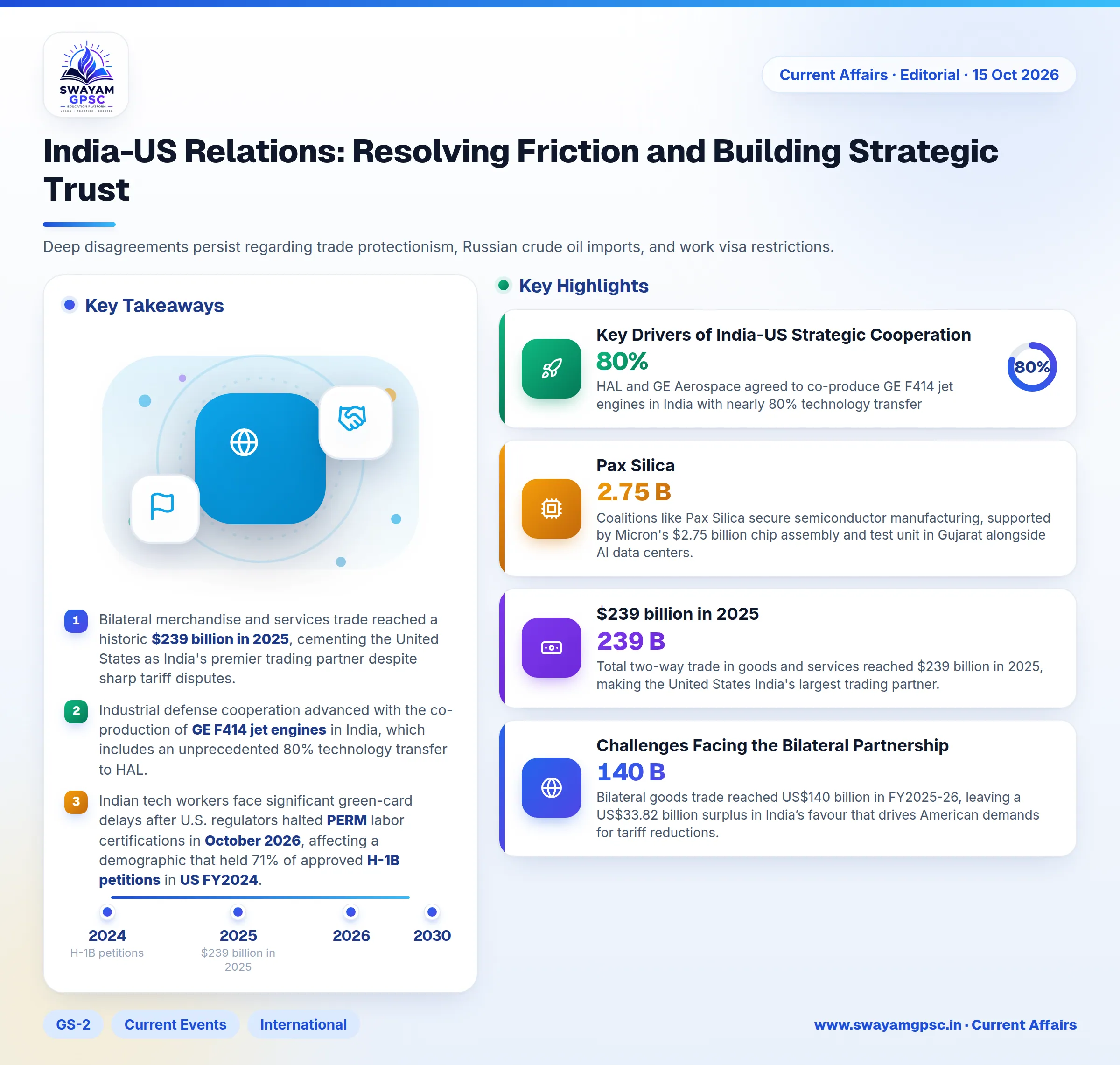
- Bilateral merchandise and services trade reached a historic $239 billion in 2025, cementing the United States as India's premier trading partner despite sharp tariff disputes.
- Industrial defense cooperation advanced with the co-production of GE F414 jet engines in India, which includes an unprecedented 80% technology transfer to HAL.
- Indian tech workers face significant green-card delays after U.S. regulators halted PERM labor certifications in October 2026, affecting a demographic that held 71% of approved H-1B petitions in US FY2024.
- Trade frictions persist over India's US$33.82 billion surplus in merchandise trade for FY2025-26, creating renewed pressure over agricultural price supports, patent rules, and Russian crude imports.
Why in News
- Recent immigration crackdowns and economic disagreements have brought major strains into the India-U.S. strategic ties.
- These issues challenge the long-term sustainability of the bilateral partnership between New Delhi and Washington.
- Both countries cooperate closely on defense co-production, critical technologies, clean energy, and Indo-Pacific security.
- Deep disagreements persist regarding trade protectionism, Russian crude oil imports, and work visa restrictions.
- Overcoming these operational roadblocks requires formal institutional channels and mutual respect for strategic autonomy.
Key Drivers of India-US Strategic Cooperation
- Defense ties have shifted from simple buyer-seller deals to joint industrial manufacturing under the US-India Defense Industrial Cooperation Roadmap, supported by foundational pacts like LEMOA, COMCASA, and BECA.
- HAL and GE Aerospace agreed to co-produce GE F414 jet engines in India with nearly 80% technology transfer, alongside manufacturing Stryker armored vehicles and M777 howitzer components to boost indigenous defense production.
- Indo-Pacific maritime security grows stronger through Quad initiatives, anti-submarine drills during Exercise Malabar, and the INDUS-X defense startup platform.
- The Initiative on Critical and Emerging Technology (iCET) and the U.S.-India TRUST platform secure global dual-use supply chains across both nations.
- Collaborative technological efforts target secure 5G/6G Open RAN deployments, quantum computing networks, and advanced artificial intelligence systems.
- Coalitions like Pax Silica secure semiconductor manufacturing, supported by Micron's $2.75 billion chip assembly and test unit in Gujarat alongside AI data centers.
- Total two-way trade in goods and services reached $239 billion in 2025, making the United States India's largest trading partner.
- Trade flows concentrate on non-oil merchandise, generic pharmaceuticals, machinery, and software services, guided by the U.S.-India Strategic Trade Dialogue (IUSSTD).
- The U.S.-India CEO Forum and the Innovation Handshake resolve non-tariff hurdles, facilitate startup funding, and advance shared digital public infrastructure.
- India signed the Artemis Accords to guide peaceful space exploration and deepen joint research between ISRO and NASA.
- The NISAR satellite project uses dual-frequency (L-band and S-band) radar imaging to observe land changes, ecosystems, and natural disasters.
- Commercial aviation partnerships expanded after Indian airlines ordered billions of dollars worth of aircraft from Boeing, creating contracts for local component suppliers.
- The U.S.-India Climate and Clean Energy Agenda 2030 Partnership focuses on industrial decarbonization and clean power infrastructure.
- The Critical Minerals and Rare Earths Framework secures supply chains for electric vehicles and battery storage by coordinating extraction, refining, and recycling.
- The US-India Energy Security Forum speeds up regional investments in green hydrogen production, massive solar parks, and off-grid renewable systems.
- Bilateral civil nuclear collaboration stems from the U.S.-India 123 Agreement and continues to advance toward next-generation nuclear facilities.
- Under new domestic rules like the SHANTI Act, 2025, both nations explore deploying Small Modular Reactors (SMRs) and Bharat Small Reactors (BSRs) to power industrial complexes.
- Technical teams from NPCIL and American nuclear contractors are working to solve longstanding engineering issues for large Pressurized Water Reactors.
- The U.S.-India Health Dialogue unites India's generic drug manufacturing capacity with American research innovation to safeguard global public health.
- Collaborative medical research pairs the Tata Memorial Centre with the U.S. National Cancer Institute for oncology and active pharmaceutical ingredient development.
- Joint biosecurity programs target Antimicrobial Resistance, strengthen disease monitoring, and align manufacturing standards via the U.S. FDA office in India.
- People-to-people connections remain foundational, highlighted by more than 330,000 Indian students enrolled across American educational institutions.
- American multinational corporations operate large Global Capability Centers (GCCs) across India to handle advanced global research and development.
- The U.S.-India Global Challenges Institute connects premier institutions like the IITs with the Association of American Universities for joint deep-tech research and doctoral degrees.
Challenges Facing the Bilateral Partnership
- Bilateral goods trade reached US$140 billion in FY2025-26, leaving a US$33.82 billion surplus in India’s favour that drives American demands for tariff reductions.
- The 2026 National Trade Estimate Report criticized Indian tariffs on farm and dairy products, price ceilings on medical devices, and industrial import controls.
- Tensions over Section 232 duties on steel and aluminium, strict testing rules, and import licenses generate operational hurdles for cross-border businesses.
- India's policy of strategic autonomy conflicts with American sanctions aimed at squeezing Russia's economy.
- Procuring Russian defense equipment like the S-400 system exposes India to sanctions risks under CAATSA.
- Washington slapped a 25% tariff linked to Russian oil purchases in August 2025, and although it paused the tariff in February 2026, the Lindsey O. Graham Sanctioning Russia and Iran Act, 2026 could revive it.
- India's External Affairs Minister characterized the US as a 'lonelier power' in October 2026 while publicly criticizing the coercive use of international economic leverage.
- The USTR placed India on the 2026 Special 301 Priority Watch List, criticizing Section 3(d) of the Patents Act, 1970.
- India firmly protects Section 3(d) because this provision prevents multinational drug firms from practicing patent evergreening without proving improved drug efficacy.
- Digital friction arises from RBI rules on domestic payment data storage alongside Section 16 of the Digital Personal Data Protection Act, 2023 on outbound data flows.
- India defends Minimum Support Prices and food stocks under the National Food Security Act (NFSA), 2013 and PMGKAY, whereas Washington argues these distort international farm trade.
- India demands a permanent solution for public stockholding at the WTO rather than remaining dependent on the interim WTO Peace Clause.
- The USCIRF’s 2026 Annual Report urged designating India as a Country of Particular Concern, triggering official protests from India's Ministry of External Affairs over bias and foreign interference.
- Former President Donald Trump met Pakistan's army chief in June 2025 and claimed he mediated an end to fighting following Operation Sindoor.
- India directly denied that claim, stating that the ceasefire resulted from direct bilateral military contact rather than American mediation.
- The Mecca Joint Defence Agreement of August 2026 among Saudi Arabia, Pakistan, and Turkiye received tacit American backing, causing national security concerns for New Delhi.
- Stringent export controls and bureaucracy continue to delay defense deliverables, including the shipment of GE F404 engines for India's LCA Tejas fighter jets.
- High-level strategic channels like iCET and the TRUST Initiative face practical administrative delays that slow actual technology sharing.
- In October 2026, U.S. labor authorities halted pending and new PERM certifications for firms like Infosys, TCS, Wipro, HCLTech, and Cognizant.
- Suspending PERM certifications disrupts employee green-card processing, hitting Indian professionals who secured 71% of approved H-1B petitions in US FY2024.
Way Forward
- Both countries should establish a structured Bilateral Trade and Investment Agreement (BTIA) or comprehensive free trade pact to systematically reduce tariff conflicts.
- Negotiating pre-cleared tariff corridors for farm exports and mutual recognition pacts for pharmaceuticals will curb unpredictable Section 301 trade investigations.
- Agreeing on a permanent WTO public stockholding formula will protect domestic welfare programs while allowing structured quotas for non-sensitive U.S. farm produce.
- Creating an independent Defense and Dual-Use Technology Licensing Cell will fast-track defense technology clearances under ITAR and EAR regulations.
- Establishing shared patent agreements for artificial intelligence, quantum systems, and telecom networks will encourage tech sharing while protecting intellectual property.
- A formal Strategic Energy and Security Dialogue can set up long-term supply arrangements for U.S. liquefied natural gas, clean hydrogen, and reactor projects under the SHANTI Act, 2025.
- Granting statutory CAATSA waivers for legacy military systems will remove sanctions risks and respect India's non-aligned foreign policy posture.
- Adopting a U.S.-India STEM Mobility Compact with dedicated visa channels and domestic visa renewals will provide predictability for skilled technical workers.
- Creating a Bilateral Data Privacy and Trust Corridor can balance Indian data storage laws under the DPDP Act, 2023 with international corporate data requirements.
- Launching a regular South Asia Security Consultative Mechanism will stop diplomatic blindsiding concerning regional matters involving Pakistan or Afghanistan.
- Expanding joint manufacturing ecosystems under the U.S.-India Defense Industrial Cooperation Roadmap will make critical international supply chains resilient.