Transforming India-UK Strategic Partnership
#GS-2 #Governance & Social Justice #Current Events #International #Effect of Policies & Politics of Countries on India's Interests #Indian Diaspora #Groupings & Agreements Involving India and/or Affecting India's Interests #CETA #India-UK Relations #Trade & Defense Cooperation
Key takeaways
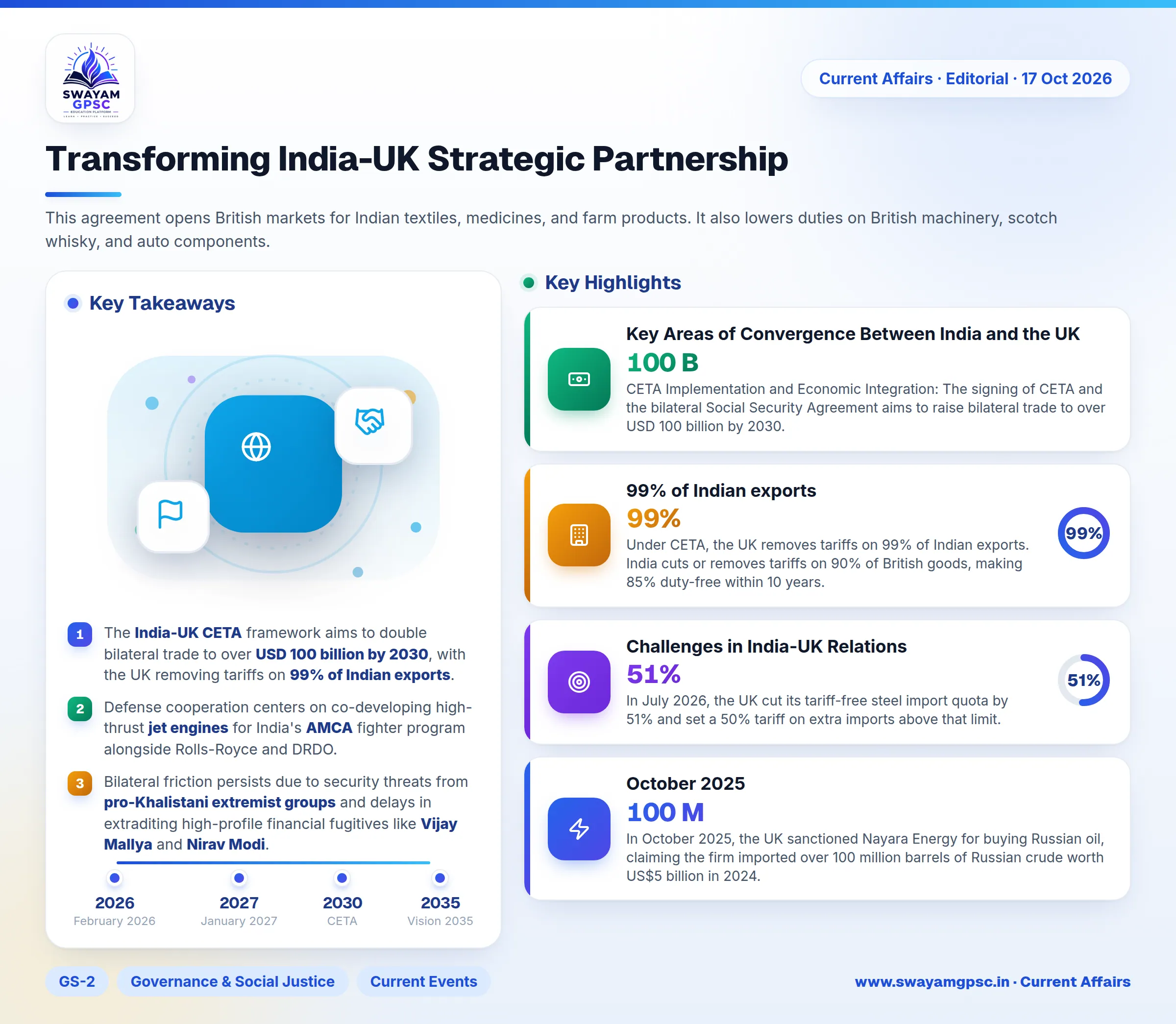
- The India-UK CETA framework aims to double bilateral trade to over USD 100 billion by 2030, with the UK removing tariffs on 99% of Indian exports.
- Defense cooperation centers on co-developing high-thrust jet engines for India's AMCA fighter program alongside Rolls-Royce and DRDO.
- Bilateral friction persists due to security threats from pro-Khalistani extremist groups and delays in extraditing high-profile financial fugitives like Vijay Mallya and Nirav Modi.
- The UK's Carbon Border Adjustment Mechanism, taking effect in January 2027, targets 5 carbon-heavy sectors, placing data reporting burdens on Indian exporters.
- In July 2026, the UK slashed its tariff-free steel import quota by 51%, imposing a steep 50% tariff on imports exceeding the set limit.
Why in News
- The British High Commissioner to India highlighted the changing trajectory of India-UK relations. Key agreements, trade growth, technology sharing, and strong social ties are driving this progress forward.
- Foundational agreements like Vision 2035 and the Comprehensive Economic and Trade Agreement (CETA) create a solid framework for cooperation. However, challenges remain in security, trade protectionism, and regulatory differences.
- Resolving these disputes through institutional mechanisms while respecting each nation's strategic autonomy remains crucial for long-term collaboration.
Key Areas of Convergence Between India and the UK
- CETA Implementation and Economic Integration: The signing of CETA and the bilateral Social Security Agreement aims to raise bilateral trade to over USD 100 billion by 2030.
- Under CETA, the UK removes tariffs on 99% of Indian exports. India cuts or removes tariffs on 90% of British goods, making 85% duty-free within 10 years.
- This agreement opens British markets for Indian textiles, medicines, and farm products. It also lowers duties on British machinery, scotch whisky, and auto components.
- Advanced Defense Co-Production and Maritime Domain Awareness: Defense cooperation under the India-UK Defense Industrial Cooperation Roadmap has shifted from simple purchasing to joint research and manufacturing.
- Joint projects focus on complex weapons, electric propulsion systems for ships, and high-thrust jet engine development for India's Advanced Medium Combat Aircraft (AMCA) with Rolls-Royce and DRDO.
- Naval coordination in the Indian Ocean Region (IOR) grows stronger through carrier deployments, joint drills like Exercise Konkan and Ajeya Warrior, and real-time data sharing via India's Information Fusion Centre-Indian Ocean Region (IFC-IOR).
- Critical and Emerging Technologies: The India-UK Technology Security Initiative (TSI) works alongside Vision 2035 to set up secure research corridors in critical dual-use domains.
- Strategic teamwork covers artificial intelligence, 6G networks, quantum computing, biotechnology, and critical minerals processing.
- Joint research funds link national tech hubs to reduce supply-chain vulnerabilities in legacy semiconductors and advanced tech sectors.
- Clean Energy Transition and Climate Action Frameworks: Climate partnerships under US-UK-India platforms and the UK-India Green Growth Equity Fund (GGEF) channel private capital into renewable energy.
- Joint global efforts like Infrastructure for Resilient Island States (IRIS) and One Sun One World One Grid (GGI-OSOWOG) help vulnerable Southern nations while boosting offshore wind, green hydrogen, and battery storage.
- Healthcare Security, Life Sciences, and Biomanufacturing: Building on the Covishield vaccine partnership, the UK-India Health and Life Sciences Partnership strengthens global health security.
- Bilateral efforts focus on fighting Antimicrobial Resistance (AMR), tracking genomic diseases, aligning digital health systems, and diversifying medical supply chains.
- Harmonizing regulations speeds up clinical trial clearances and generic drug approvals. This solidifies India's role as a top supplier of affordable medicine to the UK's National Health Service (NHS).
- Mobility, Skilled Labor, and Knowledge Economy Networks: The Migration and Mobility Partnership (MMP) and CETA professional tracks support legal migration while curbing illegal movements.
- The Young Professionals Scheme (YPS) allows thousands of degree-holding citizens aged 18 to 30 to live and work in either country for up to two years.
- Mutual recognition of degrees and easy visa processes for Indian IT professionals, healthcare workers, and researchers support high-value knowledge services.
- Indo-Pacific Strategic Convergence and Regional Security Alignment: The UK's Indo-Pacific Tilt matches India's Indo-Pacific Oceans Initiative (IPOI) and vision for a Free and Open Indo-Pacific (FOIP).
- The UK participates as a dialogue partner in regional frameworks like the Indian Ocean Rim Association (IORA) to boost maritime security, combat piracy, and protect undersea cables along key sea lanes of communication (SLOCs).
- Global Governance Reforms and Multilateral Coordination: The UK consistently supports India's permanent seat in a reformed United Nations Security Council (UNSC) and entry into the Nuclear Suppliers Group (NSG).
- Alignment within the G20, Commonwealth, and global financial institutions helps reform development banks, restructure debt for poor nations, and maintain fair trade rules.
Challenges in India-UK Relations
- Khalistani Extremism and Diplomatic Security: Threats, intimidation, and separatist violence against Indian officials remain serious sore points in bilateral relations.
- At the 6th India-UK Home Affairs Dialogue in February 2026, India raised deep concerns about pro-Khalistani extremist groups and security failures at diplomatic missions. The disruption of External Affairs Minister S. Jaishankar's London visit in March 2025 highlighted this threat.
- The core difficulty lies in stopping real threats while protecting legal political speech. Any failure to protect diplomats damages strategic trust between the two nations.
- Extradition Delays and Safe-Haven Perceptions: Legal delays in extraditing major economic offenders like Vijay Mallya and Nirav Modi strain judicial trust.
- Long appeal processes under UK human rights laws create long court delays. This creates a belief in India that British laws offer safe loopholes for financial fugitives.
- Industrial Protectionism and Persistent Market-Access Barriers: Trade deals have not removed all sector restrictions, product certification requirements, and regulatory hurdles.
- In July 2026, the UK cut its tariff-free steel import quota by 51% and set a 50% tariff on extra imports above that limit.
- A February 2026 House of Lords assessment warned that Indian Quality Control Orders could hurt market access for British goods, showing trade concerns exist on both sides.
- Carbon Border Charges and Climate-Equity Concerns: The UK's Carbon Border Adjustment Mechanism, starting in January 2027, introduces a new trade barrier beyond traditional customs duties.
- It applies to 5 sectors: aluminium, cement, fertilisers, hydrogen, and iron and steel. Importers must account for product emissions, forcing Indian suppliers to provide verified data and absorb extra costs.
- This system creates major competitive hurdles for small exporters and heavy industries. It also highlights the tension between stopping carbon leakage and supporting fair development for emerging nations.
- Russia Sanctions and India's Strategic Autonomy: British economic sanctions against Russia conflict with India's need for affordable energy and an independent foreign policy.
- In October 2025, the UK sanctioned Nayara Energy for buying Russian oil, claiming the firm imported over 100 million barrels of Russian crude worth US$5 billion in 2024.
- India opposed these double standards. This disagreement shows how Russian sanctions can disrupt commercial trade, financing, and energy deals despite good overall relations.
- Data-Transfer Compliance and Digital Regulatory Differences: Expanding digital services requires smooth cross-border data flows and strong privacy protections.
- India is not on the UK Information Commissioner's adequacy list, meaning data transfers require special legal steps and safety checks.
- Official guidance states that an Indian IT company accessing UK server data remotely is a restricted transfer. These rules create heavy compliance work for IT firms, fintech providers, cloud operations, and research teams.
Way Forward to Boost Bilateral Relations
- Make Trade Commitments Deliverable for Businesses: Set up a joint CETA implementation unit under JETCO with dedicated staff to resolve trade barriers by clear deadlines.
- Prioritize clear customs rules, simple rules of origin, and mutual recognition of product testing certificates.
- Provide multilingual help services and compliance assistance for MSMEs through export centers in India and business networks in the UK.
- Strengthen Security Cooperation Through Evidence and Due Process: Upgrade the Home Affairs Dialogue into a round-the-clock operational system with 24/7 contacts and joint security checks to protect diplomats.
- Form specialist legal teams to clear evidentiary gaps, speed up extradition requests, and track hidden financial assets.
- Ensure police action targets violence and illegal funding without suppressing peaceful political advocacy or raising community distrust.
- Create Predictable Skills and Professional-Mobility Pathways: Negotiate direct agreements between professional regulators to address skilled labor shortages in specific industries.
- Combine transparent licensing requirements with bridging courses, supervised placements, and employer-supported training programs.
- Encourage universities to offer joint degrees with work placements, allowing students to build international careers.
- Combine Investment Protection with Affordable Project Finance: Sign a fair Bilateral Investment Treaty that protects investors while safeguarding public interest regulations.
- Set up an investment ombudsman to resolve corporate grievances before they turn into major legal battles.
- Connect GIFT IFSC with London capital markets to fund viable development projects using standard legal frameworks and financial guarantees.
- Build Trusted Data Flows and Joint Innovation Pathways: Establish a joint regulatory forum uniting data protection officials, industry regulators, and business leaders.
- Develop reusable data transfer contracts and cyber rules while exploring a formal data bridge arrangement.
- Use joint regulatory sandboxes to test healthcare and financial software with synthetic data, avoiding unnecessary transfers of personal details.
- Turn Carbon-Trade Friction into Industrial Decarbonisation Cooperation: Launch a joint program offering technical advice, clean technology finance, and standard emission measurement tools.
- Set up shared emission reporting centers in Indian manufacturing hubs so small businesses can report carbon metrics easily.
- Make Defence Co-development Commercially and Strategically Credible: Turn the Defence Industrial Roadmap into concrete, funded projects with clear manufacturing goals.
- Finalize contracts that detail intellectual property rights, technology transfer rules, and export permissions before starting major work.
- Hold regular technology dialogues to clear export licenses early and discuss sanction risks through foreign defense channels.
Conclusion
- As India's External Affairs Minister noted, India acts as a power in the middle with 1.4 billion people and a $4 trillion economy, shaping world politics through strategic choices.
- To maximize the benefits of Vision 2035, both nations must move past diplomatic statements and build functional, equal partnerships that foster a stable, multipolar world.