GM Crops and India's Agricultural Future
#GS-3 #Economy #Agriculture #Food Security #Government Policies & Interventions #Science & Technology #Biotechnology #Environment #Sustainable Development #Climate Change
Key takeaways
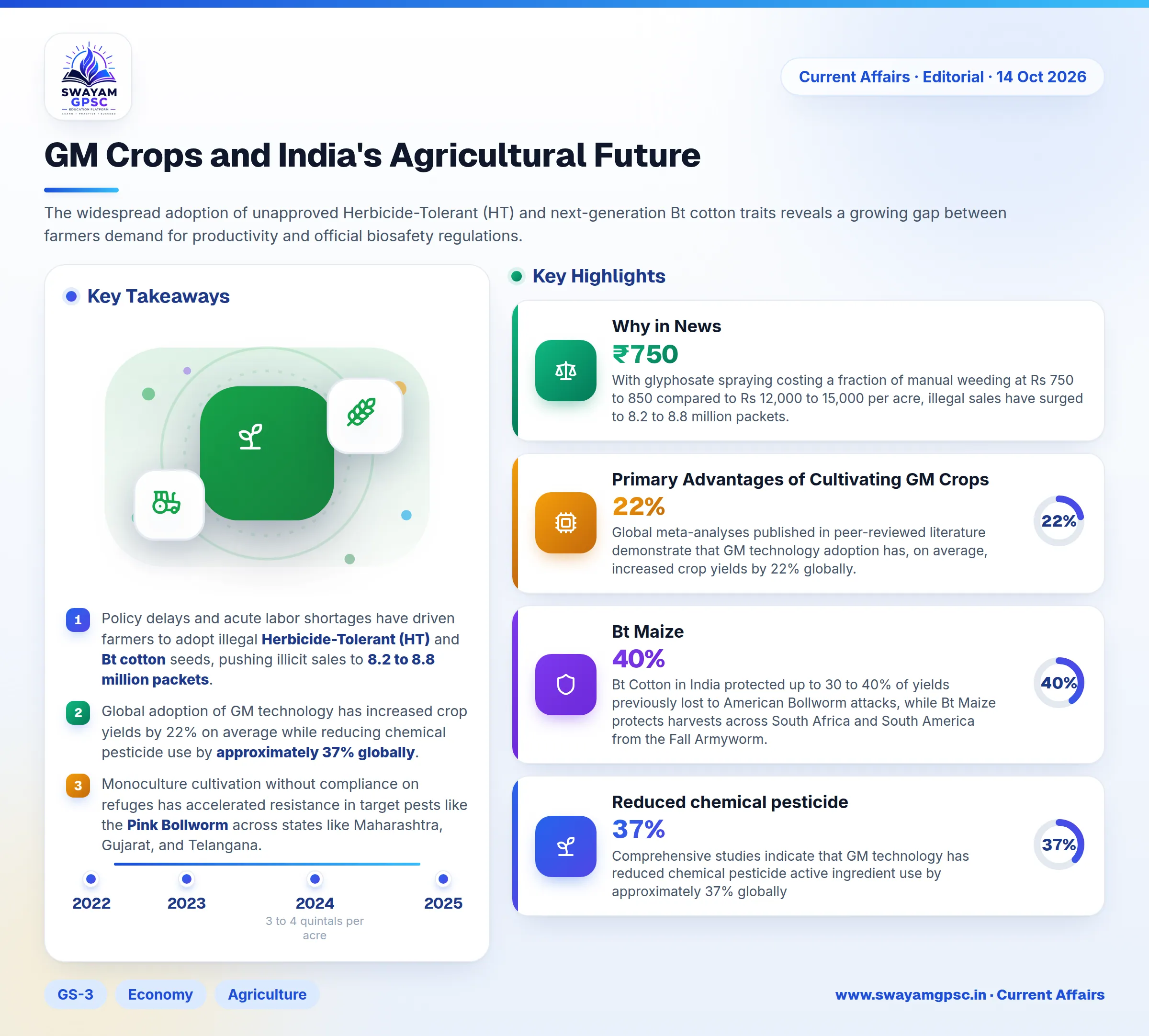
- Policy delays and acute labor shortages have driven farmers to adopt illegal Herbicide-Tolerant (HT) and Bt cotton seeds, pushing illicit sales to 8.2 to 8.8 million packets.
- Global adoption of GM technology has increased crop yields by 22% on average while reducing chemical pesticide use by approximately 37% globally.
- Monoculture cultivation without compliance on refuges has accelerated resistance in target pests like the Pink Bollworm across states like Maharashtra, Gujarat, and Telangana.
- The editorial recommends enacting the Biotechnology Regulatory Authority of India (BRAI) Bill, enforcing Refuge-in-a-Bag (RIB) mandates, and protecting smallholder seed rights under the PPV&FR Act, 2001.
Why in News
- A recent editorial highlights that policy delays in approving advanced GM traits force farmers toward illegal seeds to cut labor and pest costs, undermining official biosafety oversight, organized R&D, and national crop production.
- The widespread adoption of unapproved Herbicide-Tolerant (HT) and next-generation Bt cotton traits reveals a growing gap between farmers demand for productivity and official biosafety regulations.
- Driven by acute labor shortages and surging Pink Bollworm infestations, over a quarter of India's cotton acreage now relies on illicit seeds.
- With glyphosate spraying costing a fraction of manual weeding at Rs 750 to 850 compared to Rs 12,000 to 15,000 per acre, illegal sales have surged to 8.2 to 8.8 million packets.
Primary Advantages of Cultivating GM Crops
- GM crops express crystalline proteins derived from the soil bacterium *Bacillus thuringiensis* (Bt), such as Cry1Ac, Cry2Ab, or Vip3A, which are toxic to specific insect pests like bollworms and stalk borers while remaining harmless to non-target organisms.
- Global meta-analyses published in peer-reviewed literature demonstrate that GM technology adoption has, on average, increased crop yields by 22% globally.
- Bt Cotton in India protected up to 30 to 40% of yields previously lost to American Bollworm attacks, while Bt Maize protects harvests across South Africa and South America from the Fall Armyworm.
- By building endogenous insect resistance into the plant genome, GM crops drastically reduce the frequency of synthetic chemical pesticide applications.
- Comprehensive studies indicate that GM technology has reduced chemical pesticide active ingredient use by approximately 37% globally, preventing hundreds of millions of kilograms of synthetic chemicals from entering soil and water ecosystems.
- A 2024 parliamentary response reported that ICAR-CICR's Maharashtra studies during 2012 to 14 observed insecticide applications declining from eight to four, alongside a yield difference of 3 to 4 quintals per acre associated with Bt cotton adoption.
- Herbicide-Tolerant crops, which are engineered to withstand non-selective herbicides like glyphosate or glufosinate, allow farmers to control weeds without mechanical plowing.
- By enabling No-Till and Conservation Tillage farming, HT soybean, maize, and canola systems retain soil moisture, prevent topsoil erosion, and preserve soil microbiome health.
- Reduced tractor passes for tillage and spraying lower fossil fuel combustion, providing a global carbon offset equivalent to removing 15 to 16+ million cars from the road annually.
- The combination of reduced input costs and higher saved yields translates to an average 68% increase in farmer profits.
- Long-term economic tracking shows that GM crops have generated over $250+ billion in net farm-level economic benefits worldwide, with over 50% of these gains accruing to smallholder farmers in developing nations.
- In smallholder settings across the Global South like India, South Africa, and the Philippines, increased farm incomes from Bt cotton and Bt maize directly fund household education, healthcare, and local economic resilience.
- Engineered to biosynthesize Beta-Carotene as a Vitamin A precursor in the rice endosperm, Golden Rice addresses Vitamin A Deficiency as a major cause of childhood blindness and maternal mortality in Asia, with the Philippines becoming the first nation to issue commercial propagation approvals.
- Transgenic high-oleic soybeans and Omega-3 enriched canola provide sustainable, plant-based alternatives to fish oil, reducing pressure on marine ecosystems while supporting cardiovascular health.
- Climate-smart GM crops are engineered using stress-responsive genes, such as the cspB cold-shock protein from Bacillus subtilis, to maintain physiological function under water stress.
- Gene-edited and transgenic traits like Sub1A for submergence tolerance enable staple crops like rice to survive complete underwater inundation for up to two weeks without dying.
- In 2024, researchers at the ICAR-Sugarcane Breeding Institute, Coimbatore, reported transgenic Co 86032 sugarcane expressing the bacterial codA gene, which maintained 71 to 76% relative water content under experimental water-deficit conditions, compared with 59% in untransformed controls.
- Transgenic crops serve as low-cost biological factories or plant-made pharmaceuticals to produce high-value therapeutic proteins, monoclonal antibodies, and vaccines.
- GM maize modified with thermostable alpha-amylase enzymes simplifies the conversion of starch to bio-ethanol, reducing water and energy inputs in biofuel refining.
- Engineered oilseed crops with tailored fatty acid profiles supply eco-friendly biolubricants, industrial detergents, and biodegradable plastics, reducing industrial dependence on petroleum derivatives.
Challenges
- Monoculture cultivation of insect-resistant transgenic varieties without strict adherence to prescribed Insect Resistance Management (IRM) protocols, such as planting 20% non-Bt refuge crops, has accelerated resistance in target pest populations.
- In India, the field-level breakdown of Bollgard-II (BG-II) cotton against the Pink Bollworm across Maharashtra, Gujarat, and Telangana highlights how single-trait reliance leads to secondary pest resurgence and compromised economic protection.
- A 2025 Indian study in Scientific Reports, analyzing field observations during 2007 to 2023, documented pink bollworm resistance and its emergence as a mid-season pest.
- Cultivating Herbicide-Tolerant varieties encourages over-reliance on broad-spectrum, non-selective chemical weedicides, such as glyphosate or glufosinate ammonium.
- Continuous chemical application leads to intense selection pressure, accelerating the evolution of resistant superweeds that escape chemical control.
- This issue is central to Indian public interest litigation surrounding the conditional environmental release of Dhara Mustard Hybrid-11 (DMH-11), where critics express concern over its underlying *bar-barnase-barstar genetic framework, which utilizes the bar gene conferring tolerance to the herbicide glufosinate.
- Gene flow through wind- or insect-mediated cross-pollination from transgenic fields to non-GM crops, landraces, and wild relatives poses a threat to indigenous agro-biodiversity.
- In centers of origin or genetic diversity, uncontrolled outcrossing risks contaminating native germplasm banks.
- Civil society groups and agricultural scientists in India have raised biosecurity concerns regarding the risk of gene escape from GM mustard to wild Brassica species across primary mustard-growing belts like Rajasthan and Haryana.
- The commercialization of transgenic seeds is heavily dominated by multinational life-science corporations operating under strict Intellectual Property Rights (IPR), utility patents, and trait-fee pricing models.
- Because hybrid GM seeds must be repurchased every planting season rather than saved from the harvest, smallholder farmers face higher upfront input costs.
- This reliance on proprietary technology shifts market control from traditional farming communities to corporate seed suppliers, altering agrarian socio-economics.
- Continuous root exudation and seasonal incorporation of transgenic proteins into farm soils can alter the structure and functional dynamics of the soil microbiome.
- Laboratory and field studies indicate that prolonged accumulation of Cry proteins can temporarily disturb beneficial soil fauna, including nitrogen-fixing bacteria, mycorrhizal fungi, and detritivores like earthworms, potentially affecting long-term soil health and organic matter decomposition rates.
- Inserting foreign genetic material into a host genome can trigger unpredictable pleiotropic effects or alter secondary metabolic pathways.
- Regulatory concerns center on whether newly expressed transgenic proteins could act as novel allergens, anti-nutritional factors, or toxins in human or livestock digestive systems.
- These potential risks necessitate multi-generational feeding studies, stringent biosafety testing, and rigorous evaluation by regulatory authorities like India's Genetic Engineering Appraisal Committee (GEAC) under the Ministry of Environment, Forest and Climate Change.
- In India, the regulatory landscape has faced jurisdictional disputes between central appraisal bodies and state governments regarding field-trial permissions, as well as judicial scrutiny over biosafety protocols.
- This regulatory complexity is reflected in the Supreme Court of India's split verdict on GM mustard, which emphasized the need for a comprehensive, national policy framework governing GM crop research, environmental release, and long-term socio-economic impact assessments.
- The broad-spectrum suppression of primary target pests by transgenic crops can alter ecological dynamics, opening ecological niches for non-target, secondary insects to become primary agricultural pests.
- In Indian Bt cotton farming systems, while primary lepidopteran pests like the American Bollworm were initially suppressed, secondary sap-sucking pests such as whiteflies, thrips, and mealybugs have emerged as major threats, requiring additional pesticide applications and altering natural predator-prey dynamics.
- Different national approvals and consumer requirements can create market-access uncertainty, even when a crop is approved in its country of production.
- The US-Mexico dispute over genetically engineered corn culminated in a December 2024 United States-Mexico-Canada Agreement (USMCA) panel ruling, followed by Mexico declaring the challenged measures ineffective in February 2025.
- India's FSSAI also introduced non-GM certification requirements for 24 imported food crops, illustrating the importance of identity preservation.
Way Forward
- Transition from the multi-committee setup under the 1989 Rules of the Environment (Protection) Act, 1986 to a single, autonomous statutory regulator by passing an updated Biotechnology Regulatory Authority of India (BRAI) Bill.
- Structurally separating biotechnology promotion from safety regulation removes administrative conflicts of interest between promoter ministries and environmental regulators.
- Replace developer-generated biosafety dossiers with mandatory, double-blind testing conducted by accredited public laboratories like ICAR, ICMR, and CSIR to standardize multi-generational chronic toxicity, allergenicity, and soil metagenomic impact assessments before approving environmental releases.
- To prevent target pest resistance breakdown like the Pink Bollworm resistance witnessed in BG-II cotton, legally mandate the Refuge-in-a-Bag (RIB) system, which packages a certified proportion of 5 to 10% of non-GM seeds directly inside commercial seed packets.
- Establish statutory Post-Market Monitoring cells within the GEAC to track the long-term ecological, health, and economic impacts of approved GM events for 5 to 10 years post-commercialization, using spatial GIS-mapping and molecular markers to contain potential gene flow into wild relative belts.
- Implementing QR-code seed bag barcoding across the supply chain prevents unapproved or counterfeit GM seeds like illegal HT-Bt cotton from entering rural markets.
- Fully operationalizing Food Safety and Standards Authority of India (FSSAI) regulations requiring clear labeling on processed foods containing GM ingredients above a 1% threshold maintains strict segregation between GM, non-GM, and organic supply chains while protecting consumer choice.
- Direct public R&D funding toward ICAR institutes and State Agricultural Universities to develop open-access, public-domain GM traits and open-pollinated varieties, thereby reducing reliance on proprietary technologies from multinational life-science firms.
- Enforcing trait fee caps and price controls under the Essential Commodities Act, 1955 prevents commercial seed monopolization and high trait-fee escalations.
- Guaranteeing that all GM seed releases strictly comply with the Protection of Plant Varieties & Farmers' Rights (PPV&FR) Act, 2001 safeguards smallholders' statutory rights to save, sow, re-sow, exchange, or share farm-saved seeds without incurring corporate legal liability.
- Leverage the Guidelines for the Safety Assessment of Genome Edited Plants, 2022 which exempt site-directed nuclease technologies like SDN-1 and SDN-2 lacking foreign DNA insertions from cumbersome transgenic regulatory pathways to ensure that intensive GEAC clearances focus specifically on foreign transgenic insertions.
- Integrating these streamlined gene-editing pathways with the BioE3 Policy through specialized Biofoundries and Bio-AI Hubs accelerates climate-smart crop innovation while maintaining strict biosafety compliance.
- Maintaining an open, multilingual public portal publishing raw biosafety data, field-trial methodologies, and regulatory decision summaries builds societal trust and counters science misinformation transparently.