Recalibrating India and China Ties
#GS-2 #India and its Neighbourhood #Groupings & Agreements Involving India and/or Affecting India's Interests #Effect of Policies & Politics of Countries on India's Interests #Economy #Infrastructure #International #Current Events
Key takeaways
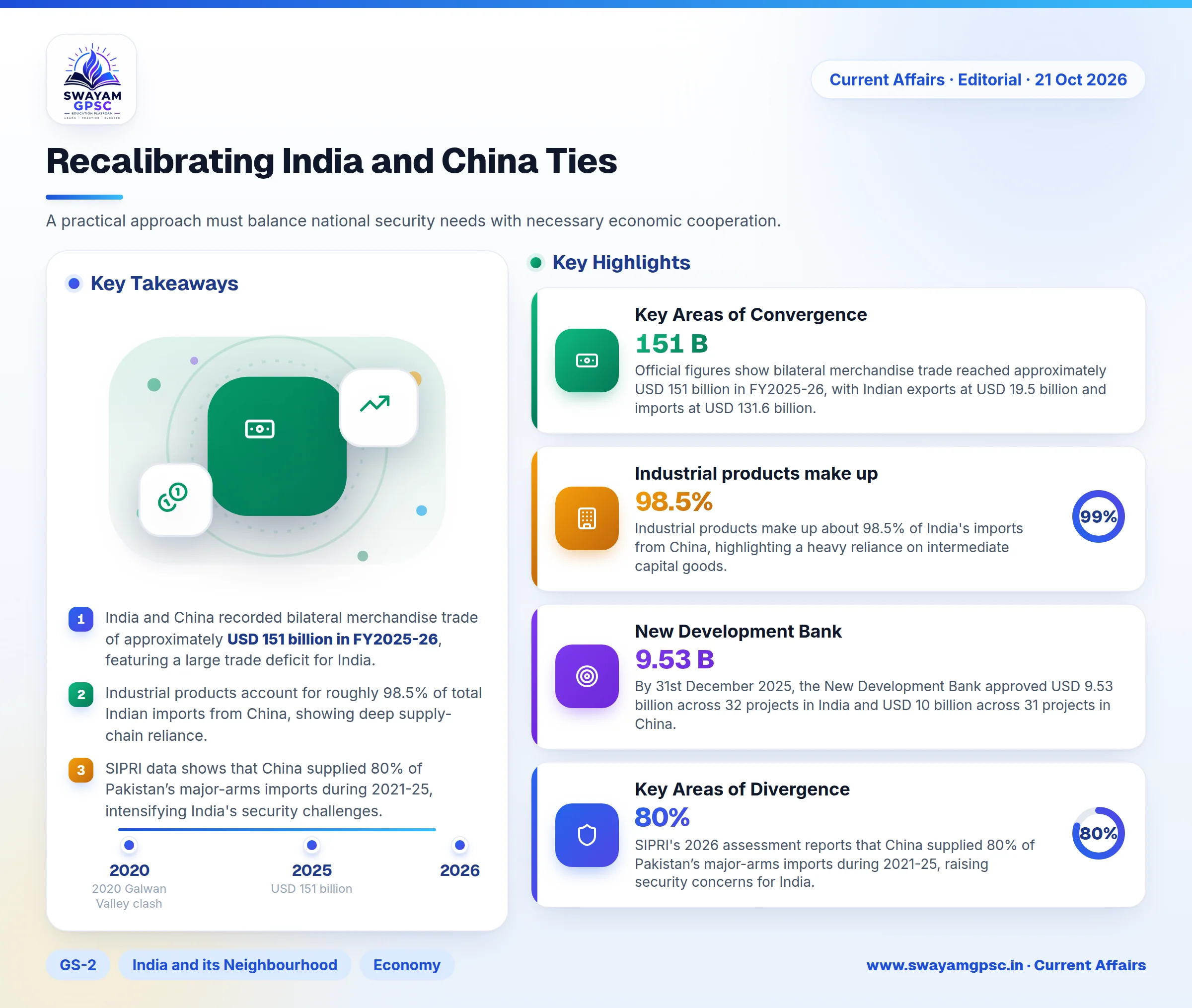
- India and China recorded bilateral merchandise trade of approximately USD 151 billion in FY2025-26, featuring a large trade deficit for India.
- Industrial products account for roughly 98.5% of total Indian imports from China, showing deep supply-chain reliance.
- SIPRI data shows that China supplied 80% of Pakistan’s major-arms imports during 2021-25, intensifying India's security challenges.
- The New Development Bank approved USD 9.53 billion across 32 projects in India to support infrastructure development.
Why in News
- The Union Minister of Commerce and Industry recently called for a careful rebuilding of economic ties with China.
- This push requires a practical dialogue that balances trade stabilization with strong safeguards against structural vulnerabilities.
- New Delhi and Beijing are holding high-level talks to steady trade gains and create a shared view of globalization.
- A practical approach must balance national security needs with necessary economic cooperation.
- Dr. S. Jaishankar notes that a settled relationship depends on both countries accepting multipolarity and mutuality.
Key Areas of Convergence
- Both nations recognize that peace along the Line of Actual Control (LAC) is vital for improving bilateral relations.
- During the 25th Special Representatives’ talks in August 2026, both sides agreed to set up two new military meeting points and two new border hotlines.
- Official figures show bilateral merchandise trade reached approximately USD 151 billion in FY2025-26, with Indian exports at USD 19.5 billion and imports at USD 131.6 billion.
- Industrial products make up about 98.5% of India's imports from China, highlighting a heavy reliance on intermediate capital goods.
- Air India announced four weekly Delhi-Shanghai flights from February 2026 to help restore civilian mobility and business travel.
- The Sikkim government confirmed that the first batch of the Kailash Mansarovar Yatra returned through Nathu La on 1st July, 2026.
- Both countries agreed to continue hydrological data sharing and renew memorandums of understanding on transboundary rivers.
- The 2026 BRICS New Delhi Declaration supported stronger representation for developing economies in the IMF and World Bank.
- China participated in the August 2026 BRICS environment meetings hosted by India to discuss sustainable practices and disaster resilience.
- At the August 2026 BRICS Trade Ministers’ Meeting in Jaipur, participants supported restoring a fully functioning WTO dispute-settlement system.
- By 31st December 2025, the New Development Bank approved USD 9.53 billion across 32 projects in India and USD 10 billion across 31 projects in China.
Key Areas of Divergence
- Persistent disagreement over the 3,488-km Line of Actual Control (LAC) and China's military buildup maintain active tension.
- Despite disengagement protocols after the 2020 Galwan Valley clash, China refuses to finalize a clear demarcation of the border.
- SIPRI's 2026 assessment reports that China supplied 80% of Pakistan’s major-arms imports during 2021-25, raising security concerns for India.
- Beijing and Islamabad agreed in May 2026 to accelerate CPEC 2.0, which passes through disputed territory.
- India's bilateral trade deficit with China reached a historic $112.16 billion in FY 2025-26 due to asymmetric market access.
- China supplied approximately 85-90% of India’s permanent-magnet imports by quantity during 2022-25, exposing Indian industries to sourcing risks.
- China's rapid naval expansion in the Indian Ocean Region challenges India's traditional role as a net security provider.
- China's mega-dam construction on the upper reaches of the Yarlung Tsangpo gives Beijing strategic control over downstream water security.
- Beijing consistently uses its veto at the UNSC to block India's bid for a permanent seat and obstructs India's entry into the NSG.
- China views the Quadrilateral Security Dialogue as an attempt to contain its rise, while India sees it as a vital counterweight.
Way Forward
- India should negotiate a clear progression from military disengagement to de-escalation through the Working Mechanism for Consultation and Coordination.
- Both nations must establish a predictable calendar of annual leadership reviews and regular foreign-minister consultations.
- India should negotiate a time-bound market-access package to remove regulatory barriers affecting Indian pharmaceuticals and agricultural exports.
- India should implement transparent investment screening while utilizing provisions from the 2026 FDI reforms for manufacturing proposals.
- New Delhi should seek renewed river-data agreements that ensure emergency alerts and reliable data sharing during diplomatic tensions.
- India should propose a bilateral maritime incident-prevention protocol referencing the Code for Unplanned Encounters at Sea.
- Both countries should use platforms like BRICS and the SCO to collaborate on urban heat resilience and climate-smart agriculture.
- Restoring visa issuance for researchers and journalists will help rebuild critical analytical capacity and improve strategic communication.