WHO First Guidelines on Managing Child and Adolescent Obesity
#GS-2 #Governance & Social Justice #Health #Current Events #International #Important International Institutions #Pediatric Obesity
Key takeaways
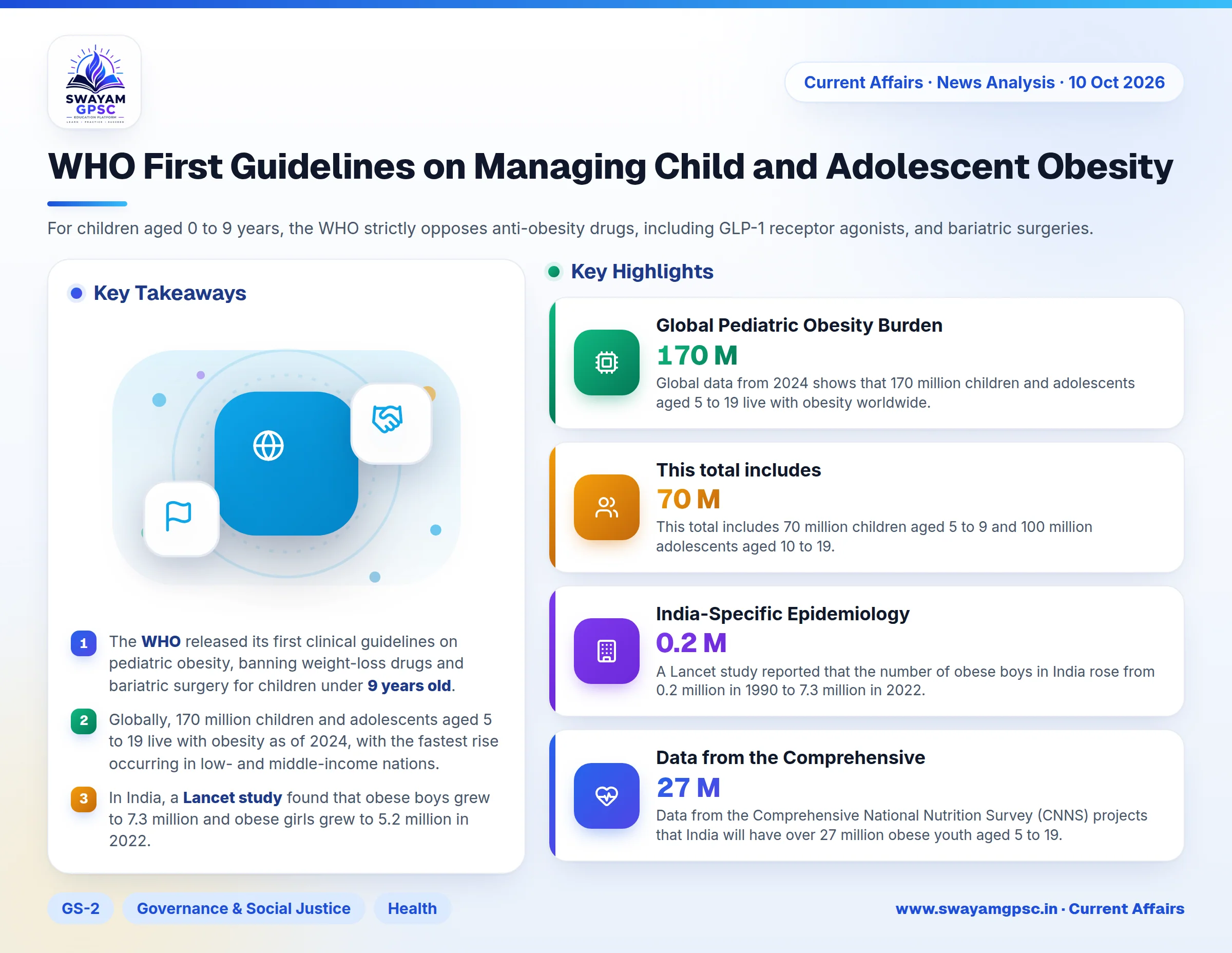
- The WHO released its first clinical guidelines on pediatric obesity, banning weight-loss drugs and bariatric surgery for children under 9 years old.
- Globally, 170 million children and adolescents aged 5 to 19 live with obesity as of 2024, with the fastest rise occurring in low- and middle-income nations.
- In India, a Lancet study found that obese boys grew to 7.3 million and obese girls grew to 5.2 million in 2022.
- India's CNNS projects the nation will house 27 million obese youth, representing 11% of the global burden.
- India's CDSCO permits semaglutide only for adolescents aged 12 and above who suffer from severe obesity with comorbidities like NAFLD.
Why in News
- The World Health Organization (WHO) released its first clinical guidelines to treat child and adolescent obesity.
- The guidelines set age-based rules that ban weight-loss drugs and weight-loss surgeries for children under nine years old.
- For adolescents between 10 and 19 years old, the agency allows limited medical treatments under strict supervision.
Age-Specific Mandates
- For children aged 0 to 9 years, the WHO strictly opposes anti-obesity drugs, including GLP-1 receptor agonists, and bariatric surgeries.
- Treatment for young children must focus entirely on family-supported habits, healthy eating, and routine physical exercise.
- For adolescents aged 10 to 19 years, doctors may consider approved weight-loss medicines only after structured lifestyle changes fail to work.
- Doctors can consider bariatric surgery for adolescents with severe obesity under strict medical controls.
Rationale for Pharmacotherapy Restrictions
- The WHO restricted weight-loss medicines because researchers lack long-term clinical trial data on young patients.
- Scientists do not fully understand the long-term safety, correct dosage duration, or safe stopping steps for drugs like semaglutide in children.
Integrated Mental Healthcare
- Obesity treatment plans must address mental health issues like anxiety, depression, low self-esteem, stigma, and bullying.
- Care teams should involve families to provide age-appropriate psychological support to young patients.
Promotion of Digital Health Interventions
- The guidelines suggest using active video games, known as exergames, to get children moving physical exercise into playtime.
- Health teams can use pedometers, accelerometers, and fitness applications to reduce inactive screen time and encourage daily movement.
Global Pediatric Obesity Burden
- Global data from 2024 shows that 170 million children and adolescents aged 5 to 19 live with obesity worldwide.
- This total includes 70 million children aged 5 to 9 and 100 million adolescents aged 10 to 19.
- Childhood obesity is growing fastest in low- and middle-income countries.
India-Specific Epidemiology
- A Lancet study reported that the number of obese boys in India rose from 0.2 million in 1990 to 7.3 million in 2022.
- The same study showed that the number of obese girls in India grew from 0.2 million in 1990 to 5.2 million in 2022.
- Data from the Comprehensive National Nutrition Survey (CNNS) projects that India will have over 27 million obese youth aged 5 to 19.
- This projection means India will account for 11% of the global burden of childhood obesity, worsening the country's dual burden of undernutrition and overnutrition.
Indian Regulatory and Clinical Context
- The Central Drugs Standard Control Organisation (CDSCO) has allowed semaglutide for adolescents aged 12 and above in India.
- This Indian approval applies strictly to severe obesity cases linked with conditions like non-alcoholic fatty liver disease (NAFLD) and prediabetes.
- Indian medical experts warn that weight-loss surgeries in children can cause poor nutrient absorption and disrupt normal physical growth.