National PNG Drive 3.0
#GS-2 #Governance & Social Justice #Regulatory Bodies #GS-3 #Infrastructure #Energy #Environment #Climate Change #Current Events #National #Rapid Fire CA #Quick Facts For Prelims #Government Policies & Interventions
Key takeaways
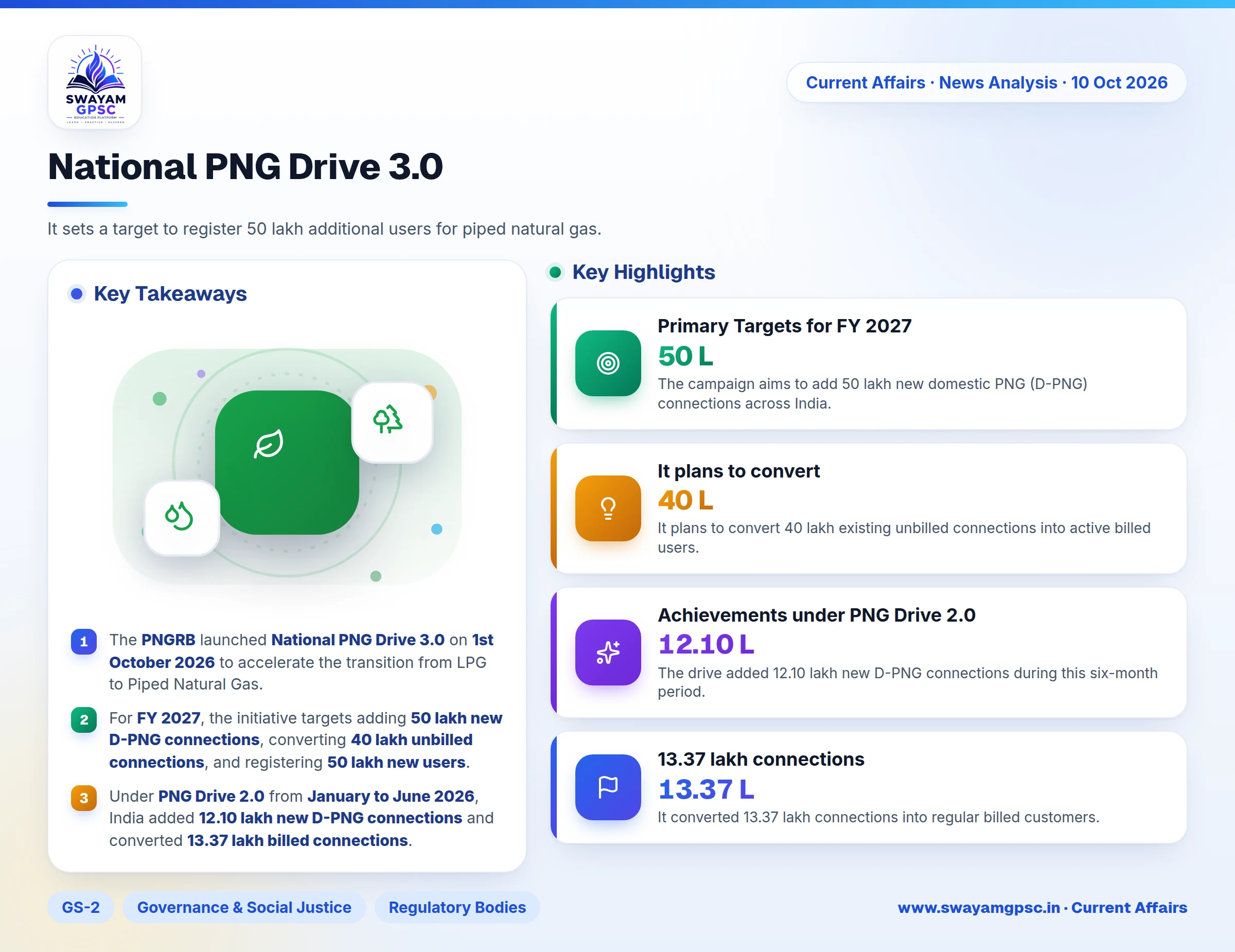
- The PNGRB launched National PNG Drive 3.0 on 1st October 2026 to accelerate the transition from LPG to Piped Natural Gas.
- For FY 2027, the initiative targets adding 50 lakh new D-PNG connections, converting 40 lakh unbilled connections, and registering 50 lakh new users.
- Under PNG Drive 2.0 from January to June 2026, India added 12.10 lakh new D-PNG connections and converted 13.37 lakh billed connections.
- The drive optimizes India's existing 6.9 lakh inch-kms pipeline network, which can immediately supply 1.3 crore additional connections.
- To spur network expansion, the government grants distributors 200 SCM of discounted APM gas for every new billed connection.
Why in News
- The Petroleum and Natural Gas Regulatory Board (PNGRB) launched National PNG Drive 3.0 on its 20th Foundation Day on 1st October 2026.
- This national campaign speeds up the shift from Liquefied Petroleum Gas (LPG) to Piped Natural Gas (PNG) across the country.
- This shift supports India's long-term energy security targets and environmental sustainability goals.
Primary Targets for FY 2027
- The campaign aims to add 50 lakh new domestic PNG (D-PNG) connections across India.
- It plans to convert 40 lakh existing unbilled connections into active billed users.
- It sets a target to register 50 lakh additional users for piped natural gas.
Achievements under PNG Drive 2.0
- The previous PNG Drive 2.0 ran from January to June 2026.
- The drive added 12.10 lakh new D-PNG connections during this six-month period.
- It converted 13.37 lakh connections into regular billed customers.
- It successfully registered 15.31 lakh new D-PNG registrations across the country.
Energy Security and Sustainability
- The initiative supports raising natural gas from its current 6% share in India's primary energy mix.
- It encourages the adoption of cleaner burning fuels for daily household cooking needs.
- It broadens energy access while creating a steady and reliable fuel supply for home cooking.
Environmental and Climate Goals
- Moving toward cleaner fuels aligns directly with India's net-zero carbon emissions commitments.
- This fuel shift directly supports global Sustainable Development Goals (SDGs).
- Increasing natural gas usage lowers household carbon footprints across the country.
Geopolitical Catalyst
- The push for PNG gained urgency during recent supply disruptions caused by the West Asia crisis.
- Imported LPG remains vulnerable to blockades along maritime transit points like the Strait of Hormuz.
- Expanding domestic PNG networks shields Indian kitchens from international fuel supply disruptions.
Government Policy Incentives
- The Petroleum Ministry offers policy rewards to City-Gas Distributors (CGDs) to expand network coverage.
- Distributors get 200 standard cubic metres (SCM) of cheaper Administered Price Mechanism (APM) gas for every new billed D-PNG connection.
Infrastructure Optimization
- The drive focuses on gasifying and using India's existing 6.9 lakh inch-kms laid pipeline network.
- This existing network infrastructure has ready capacity to support 1.3 crore additional connections.
Key Learnings from Drive 2.0
- PNG Drive 2.0 exposed a large operational gap between physical pipe connections and actual billed users.
- This gap showed the clear need for region-specific and localized expansion strategies.
- The campaign focuses on improving affordability and consumer awareness in emerging geographic areas.
- It strengthens customer service and engagement across mature gas distribution markets.