Understanding and Addressing Child Marriage in India
#GS-2 #Governance & Social Justice #Social Justice #Vulnerable Sections #Women #Poverty #Current Events #National
Key takeaways
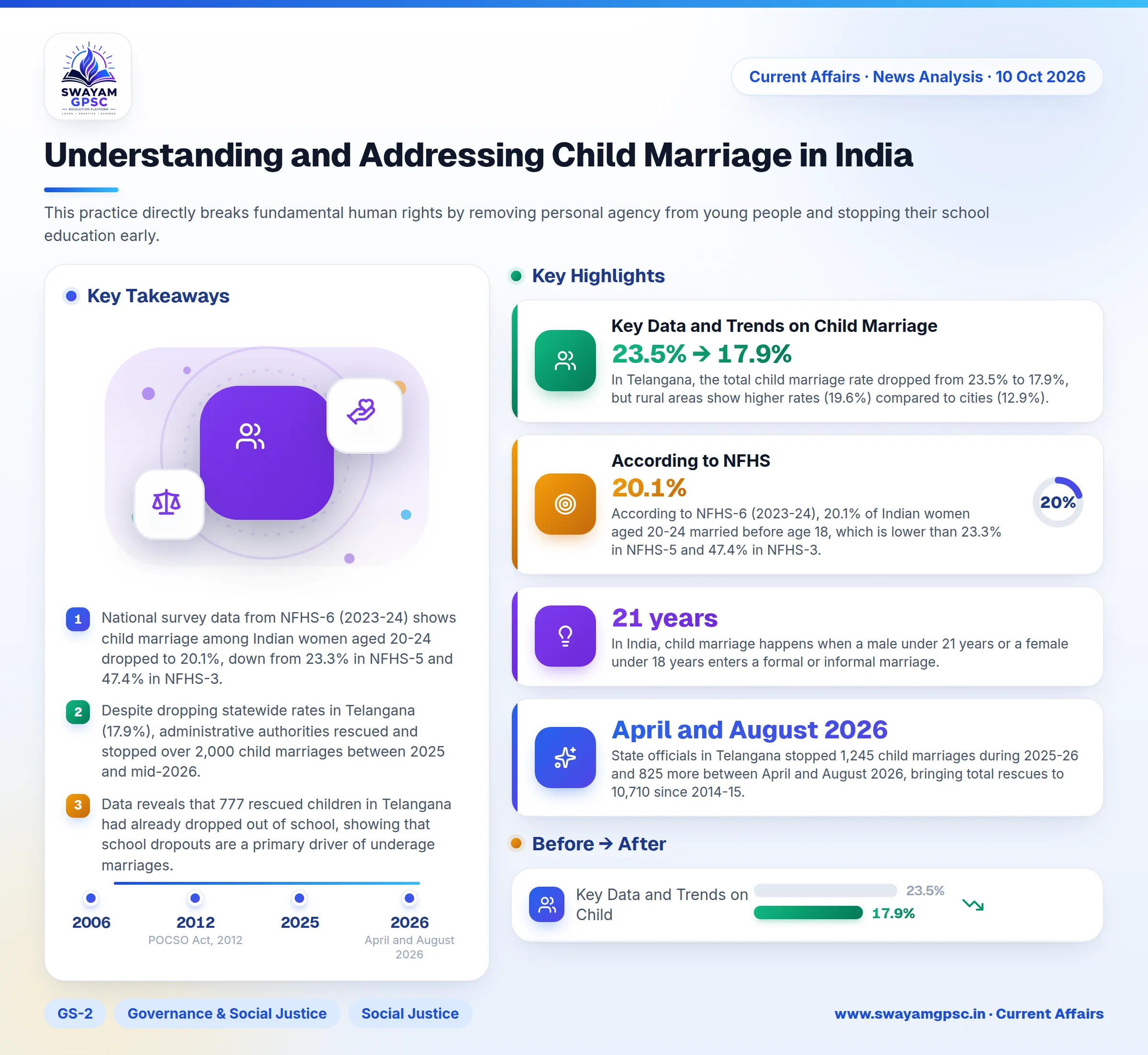
- National survey data from NFHS-6 (2023-24) shows child marriage among Indian women aged 20-24 dropped to 20.1%, down from 23.3% in NFHS-5 and 47.4% in NFHS-3.
- Despite dropping statewide rates in Telangana (17.9%), administrative authorities rescued and stopped over 2,000 child marriages between 2025 and mid-2026.
- Data reveals that 777 rescued children in Telangana had already dropped out of school, showing that school dropouts are a primary driver of underage marriages.
- Key legal protections include the Prohibition of Child Marriage Act (PCMA), 2006 and the POCSO Act, 2012, which removes marital exceptions for sexual contact with girls under 18 years.
- Sustainable solutions require conditional financial assistance for poor households, strict police prosecution of wedding organizers, and bridge classes through Kasturba Gandhi Balika Vidyalayas (KGBVs).
Why in News
- Official data from the National Family Health Survey (NFHS) shows a clear drop in child marriage rates across India.
- Despite this national drop, ground teams rescued and stopped more than 2,000 child marriages in Telangana between 2025 and mid-2026.
- Field inspections show that stopping a wedding ceremony alone does not fix basic problems like poverty, dropping out of school, or deep social pressure.
Understanding Child Marriage
- In India, child marriage happens when a male under 21 years or a female under 18 years enters a formal or informal marriage.
- This practice directly breaks fundamental human rights by removing personal agency from young people and stopping their school education early.
- It also forces young girls into underage pregnancies and domestic abuse long before they are physically or emotionally ready.
Key Data and Trends on Child Marriage
- According to NFHS-6 (2023-24), 20.1% of Indian women aged 20-24 married before age 18, which is lower than 23.3% in NFHS-5 and 47.4% in NFHS-3.
- In Telangana, the total child marriage rate dropped from 23.5% to 17.9%, but rural areas show higher rates (19.6%) compared to cities (12.9%).
- State officials in Telangana stopped 1,245 child marriages during 2025-26 and 825 more between April and August 2026, bringing total rescues to 10,710 since 2014-15.
- Among Telangana districts, Vikarabad reported the highest rescues with 878 cases, followed by Mahabubnagar with 759 and Sangareddy with 715, while Rajanna Sircilla recorded only 54 cases.
- Out of the children rescued in Telangana between 2025 and August 2026, 777 children had already dropped out of school, showing a strong link between leaving school and child marriage.
Causes of Child Marriage Persistence
- Extreme household poverty makes poor families treat daughters as financial costs, leading parents to marry them off early to reduce basic living expenses.
- For instance, a single mother earning daily wages in Nandigama arranged her 15-year-old daughter's marriage to an older shop owner due to severe money problems.
- Sudden family crises, such as a major illness or the death of a main wage earner, push young girls into farm labor and early marriage arrangements.
- For example, a Class VI tribal girl in Nizamabad faced early marriage after her father got tuberculosis and her mother developed disabling health issues.
- Deeply rooted patriarchal beliefs and worries about family social standing lead families to marry off girls right after they reach puberty.
- For instance, many rural families view a young girl's free movement as a threat to family honor and organize quiet alliance meetings to confirm early marriages.
- Local brokers, landlords, and moneylenders take advantage of poor debt-ridden families by setting up unequal marriage deals.
- For example, a rural landlord pressured an indebted tenant worker to marry her young daughter to a 40-year-old acquaintance.
- Unsupervised social media use among teenagers leads to early romantic relationships, which often end in runaway marriages to avoid family resistance.
Laws and Government Initiatives
- The Prohibition of Child Marriage Act (PCMA), 2006 makes marrying a child a serious, non-bailable crime, gives authority to Child Marriage Prohibition Officers (CMPOs), and allows courts to issue stay orders against underage weddings.
- The POCSO Act, 2012 classifies any sexual relation with a girl under 18 years as statutory rape, removing marital protection for adult husbands under criminal law.
- Round-the-clock emergency systems like the Child Helpline 1098 and Sakhi One Stop Centres offer immediate safety, personal counseling, and legal support.
- Grassroots health and care workers, including Anganwadi workers, ASHAs, and District Child Protection Units (DCPUs), track school dropouts to catch and report planned child marriages early.
- State governments run direct public campaigns, such as Telangana's Balya Vivaham - Bathuku Aagam drive, which uses local events like the Bathukamma festival to spread awareness.
Implications of Child Marriage
- A girl's body is not fully grown when puberty starts, so early pregnancy competes with her own growth and drains necessary bone density and nutrients.
- For example, an adolescent pregnancy forces the mother's body to share crucial nutrients with the growing fetus, causing long-term health depletion for the mother.
- Poorly nourished and anemic young mothers face difficult labor conditions, which creates serious health risks for their babies across generations.
- For instance, restricted growth inside the womb often leads to premature birth, low birth weight, stunting, and long-term metabolic health issues for the child.
- Early marriage forces young girls out of formal education, destroying their chance to learn basic skills or build future careers.
- For example, a girl who leaves school in Class VI loses basic reading and math skills, making it almost impossible to re-enter regular schooling later.
- Large age gaps between young brides and older husbands create an extreme power imbalance that often leads to domestic violence and forced unpaid work.
- For instance, a 15-year-old girl married to a 40-year-old man faces severe sexual violence and immediate forced household work.
- Depriving young women of education and job skills traps them in low-paying informal jobs, keeping their entire household in continuous poverty.
Way Forward
- Authorities must go beyond stopping wedding events by registering formal police complaints against everyone who helps organize the wedding, including religious priests, local brokers, and adult grooms.
- Governments should expand direct monthly financial support for poor single-mother families, tying cash payments to keeping daughters in school until age 18.
- Education departments must set up catch-up classes and job skill programs inside Kasturba Gandhi Balika Vidyalayas (KGBVs) to bring rescued girls back into formal learning.
- State health bodies need to give specialized training and extra monthly payments to Anganwadi workers and ASHAs so they can report missing school girls before weddings are arranged.
- Local village councils (Panchayats) and women's Self-Help Groups (SHGs) must lead community talks to challenge old social beliefs that treat physical puberty as readiness for marriage.
Conclusion
- Child marriage is a major human rights violation that hurts a girl's physical health, education, and career opportunities.
- Stopping a wedding ceremony only deals with the immediate event, while real progress needs deeper steps against rural poverty, school dropouts, and gender prejudice.
- Ensuring every young girl gets equal access to health services, continuous schooling, and personal freedom is essential for building a fair society.