DRDO Successfully Flight-Tests Indigenous High Altitude Platform System
#GS-3 #Science & Technology #Space #Defence #Current Events #National #Rapid Fire CA #Quick Facts For Prelims #Space Technology
Key takeaways
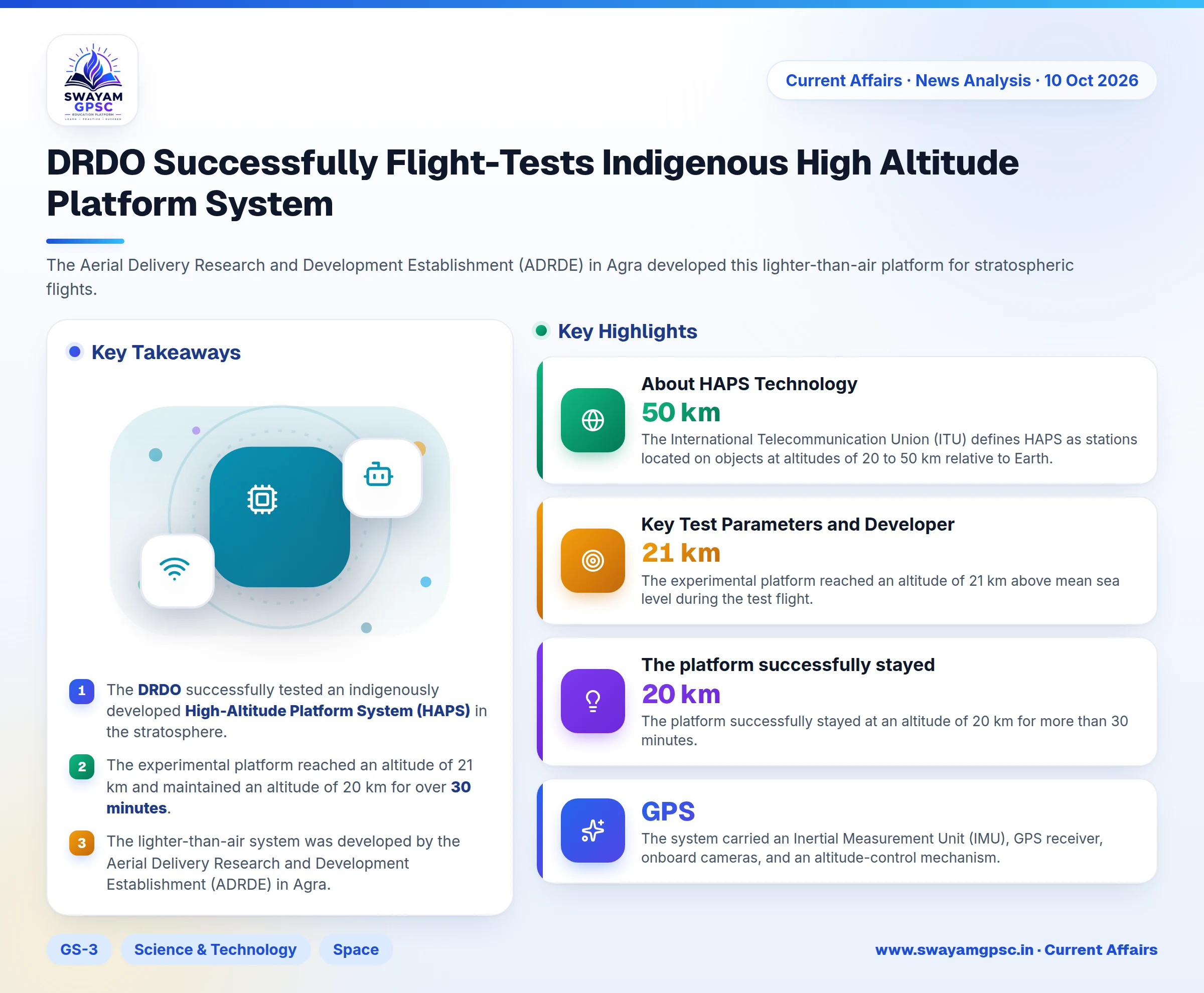
- The DRDO successfully tested an indigenously developed High-Altitude Platform System (HAPS) in the stratosphere.
- The experimental platform reached an altitude of 21 km and maintained an altitude of 20 km for over 30 minutes.
- The lighter-than-air system was developed by the Aerial Delivery Research and Development Establishment (ADRDE) in Agra.
- HAPS operates at altitudes of 20 to 50 km to bridge the operational gap between conventional aircraft and satellites.
Why in News
- The Defence Research and Development Organisation (DRDO) successfully flight-tested an indigenously developed High-Altitude Platform System (HAPS).
- This flight test marks major progress towards building a long-endurance stratospheric surveillance platform for India.
About HAPS Technology
- A High-Altitude Platform Station is carried by an aerial vehicle like an unmanned aircraft, airship, or balloon operating in the stratosphere.
- The International Telecommunication Union (ITU) defines HAPS as stations located on objects at altitudes of 20 to 50 km relative to Earth.
Key Test Parameters and Developer
- The experimental platform reached an altitude of 21 km above mean sea level during the test flight.
- The platform successfully stayed at an altitude of 20 km for more than 30 minutes.
- The Aerial Delivery Research and Development Establishment (ADRDE) in Agra developed this lighter-than-air platform for stratospheric flights.
- The system carried an Inertial Measurement Unit (IMU), GPS receiver, onboard cameras, and an altitude-control mechanism.
- Live video footage and flight parameters were continuously sent back to the Ground Control Station during the test.
- Operators commanded the platform to descend and successfully recovered it for detailed flight data analysis.
Institutional Coordination and Strategic Significance
- The test flight involved the Indian Air Force (IAF), CEMILAC, DGCA, Airports Authority of India (AAI), and civil authorities.
- This system bridges the operational gap between lower-altitude aircraft and higher-altitude space satellites.
- HAPS can provide continuous surveillance, intelligence gathering, Earth observation, communications, and disaster response.
- The ability to recover the platform for maintenance and upgrades supports India's Aatmanirbhar Bharat mission in aerospace technology.