Centenary of the Union Public Service Commission
#GS-2 #Indian Polity & Constitution #Constitutional Bodies #Governance & Social Justice #Civil Services #Current Events #National
Key takeaways
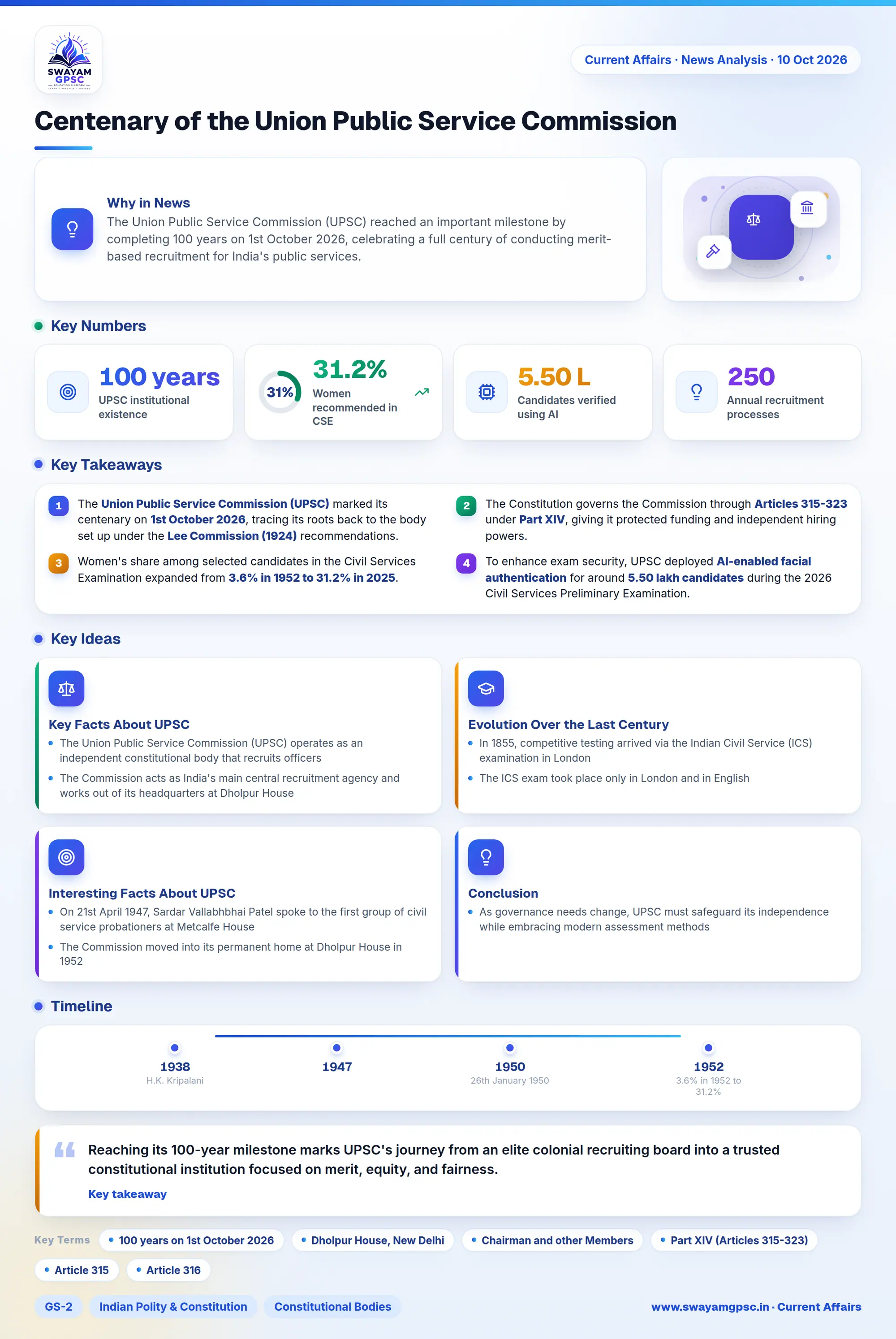
- The Union Public Service Commission (UPSC) marked its centenary on 1st October 2026, tracing its roots back to the body set up under the Lee Commission (1924) recommendations.
- The Constitution governs the Commission through Articles 315-323 under Part XIV, giving it protected funding and independent hiring powers.
- Women's share among selected candidates in the Civil Services Examination expanded from 3.6% in 1952 to 31.2% in 2025.
- To enhance exam security, UPSC deployed AI-enabled facial authentication for around 5.50 lakh candidates during the 2026 Civil Services Preliminary Examination.
Why in News
- The Union Public Service Commission (UPSC) reached an important milestone by completing 100 years on 1st October 2026, celebrating a full century of conducting merit-based recruitment for India's public services.
Key Facts About UPSC
- The Union Public Service Commission (UPSC) operates as an independent constitutional body that recruits officers for the All India Services and various Central Services, protecting merit, fair play, and equal opportunity in public appointments.
- The Commission acts as India's main central recruitment agency and works out of its headquarters at Dholpur House, New Delhi.
- The Commission features a Chairman and other Members, who are all appointed directly by the President of India.
- The Constitution grants UPSC its legal authority under Part XIV (Articles 315-323).
- Article 315 establishes Public Service Commissions for the Union and States, while also allowing a Joint Commission for two or more States.
- Article 316 gives the President the power to appoint the Chairman and Members of the Commission.
- Article 317 sets the legal path for the President to suspend or remove Members, requiring an inquiry by the Supreme Court.
- Article 318 allows the designated authority to frame regulations governing the conditions of service of Members and staff.
- Article 319 places strict restrictions on further employment once an individual completes their term as a Commission Member.
- Article 320 details the Commission's duties, which include conducting examinations and offering advice on recruitment, appointments, promotions and disciplinary matters.
- Article 321 gives Parliament or a State Legislature the authority to add more responsibilities to the Commission.
- Article 322 states that all expenses of the Commission are charged on the Consolidated Fund of the respective government, keeping its funding independent.
- Article 323 directs the Commission to send an annual report to the President or Governor, explaining any instances where the government rejected its advice.
- Under its examination mandate, UPSC organises major tests such as the Civil Services Examination (CSE), Indian Forest Service (IFoS), Engineering Services, Combined Medical Services, NDA & NA, CDS, and CAPF (Assistant Commandants).
- The Commission handles direct selection through specialised tests and interviews to fill expert posts across central ministries and departments.
- UPSC serves an advisory role by guiding the government on recruitment rules, appointments, promotions, disciplinary matters and induction into All India Services.
- Following the Supreme Court ruling in Prakash Singh v. Union of India (2006), the Commission selects senior IPS officers to serve as Director General of Police (DGP) or head of police forces in states.
- The Constitution protects UPSC's autonomy through guaranteed tenures, clear rules for removal, post-retirement job restrictions, and ring-fenced budgets.
- These solid legal safeguards prevent political interference, favouritism and nepotism during recruitment exercises.
- The Commission oversees 14-15 major examinations and manages over 250 recruitment processes each year.
- Women's share among selected CSE candidates rose dramatically from 3.6% in 1952 to 31.2% in 2025, showing greater female involvement in public administration.
- Women candidates gained entry into the NDA & NA Examination for the very first time in 2021.
Evolution Over the Last Century
- In 1855, competitive testing arrived via the Indian Civil Service (ICS) examination in London, ending the East India Company's practice of patronage appointments.
- The ICS exam took place only in London and in English, testing subjects like Greek and Latin that naturally locked out most Indian candidates.
- Satyendranath Tagore passed the competitive test in 1863 to become the first Indian ICS officer in 1864.
- By 1919, colonial policies kept Indian representation extremely low, with only 78 of 1,255 ICS officers being Indian.
- The Government of India Act, 1919, arising from the Montagu-Chelmsford Reforms, formally authorized the creation of a Public Service Commission.
- In 1922, colonial authorities held the ICS entrance examination on Indian soil for the first time in Allahabad, running it alongside the London test.
- The Lee Commission (1924), led by Arthur Hamilton Lee, strongly pushed for the quick creation of a statutory Public Service Commission with more Indian officers.
- India's first Public Service Commission began functioning on 1st October 1926 under the Public Service Commission (Functions) Rules, 1926, based on Sections 96B and 96C of the Government of India Act, 1919.
- Sir Ross Barker took charge as the first Chairman alongside four Members, starting operations at Metcalfe House, Delhi.
- Even though it began with limited advisory duties, this body created the foundation for permanent, structured civil service testing in India.
- The Government of India Act, 1935 expanded this framework by laying out rules for both Federal and Provincial Public Service Commissions.
- The central body was officially renamed the Federal Public Service Commission on 1st April 1937.
- Combined tests across multiple services started in 1938, and H.K. Kripalani became the first Indian Chairman of the Commission in 1947.
- On 26th January 1950, the body became the Union Public Service Commission, with R.N. Banerjee serving as its first Chairman under the new Republic.
- The newly adopted Constitution gave UPSC independent constitutional standing, ensuring future selections remained free from executive bias.
- In 1992, Rose Millian Bathew Kharbuli made history by becoming the first woman Chairperson of UPSC.
- The Commission allowed scribes for visually impaired aspirants in 1994, gradually introducing wider accommodations for candidates with disabilities.
- Modern digital updates arrived in 2025 with the Universal Registration Number, randomised interview panels, and the Pratibha Setu platform, followed by AI-enabled facial authentication for around 5.50 lakh candidates in the 2026 Preliminary exam.
Interesting Facts About UPSC
- On 21st April 1947, Sardar Vallabhbhai Patel spoke to the first group of civil service probationers at Metcalfe House, Delhi, calling the services the steel frame of India, a date now celebrated as Civil Services Day.
- The Commission moved into its permanent home at Dholpur House in 1952, a palace built in 1920 by Maharaja Rana Udaybhanu Singh of Dholpur.
- Dr. B.R. Ambedkar originally introduced the commission rules as Articles 284 and 285 in the Draft Constitution, which later turned into Articles 315-323.
- The Commission opened the UPSC Museum on 11th November 2016, allowing visitors to trace its institutional past through an interactive 360-degree virtual tour.
Conclusion
- Reaching its 100-year milestone marks UPSC's journey from an elite colonial recruiting board into a trusted constitutional institution focused on merit, equity, and fairness.
- As governance needs change, UPSC must safeguard its independence while embracing modern assessment methods, digital security, transparent evaluations, and student welfare to build a future-ready civil service.