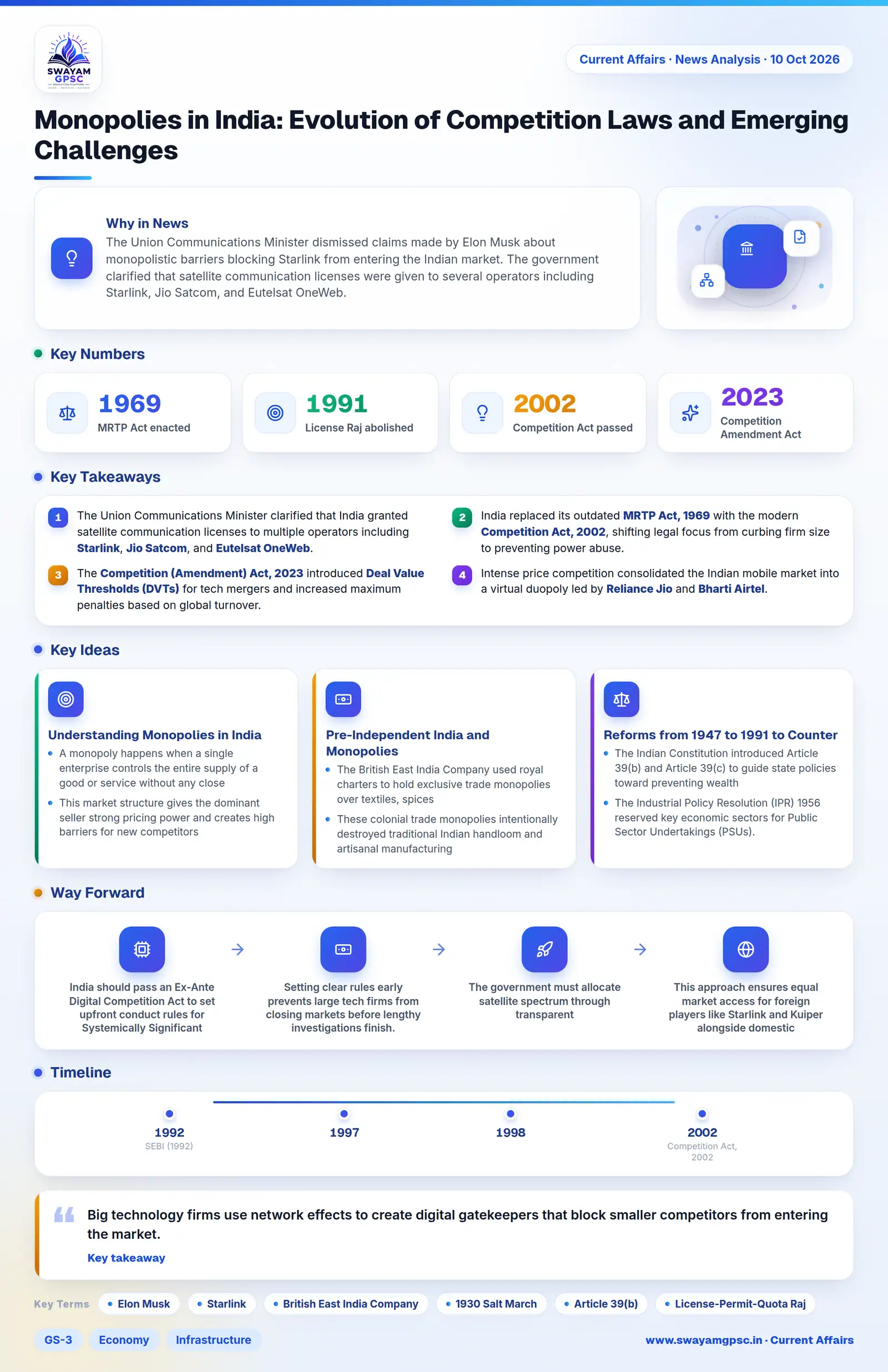
Monopolies in India: Evolution of Competition Laws and Emerging Challenges
#GS-3 #Economy #Infrastructure #Regulatory Bodies #Monopolies #Competition Law #Competition Commission of India #Big Tech
Key takeaways
- The Union Communications Minister clarified that India granted satellite communication licenses to multiple operators including Starlink, Jio Satcom, and Eutelsat OneWeb.
- India replaced its outdated MRTP Act, 1969 with the modern Competition Act, 2002, shifting legal focus from curbing firm size to preventing power abuse.
- The Competition (Amendment) Act, 2023 introduced Deal Value Thresholds (DVTs) for tech mergers and increased maximum penalties based on global turnover.
- Intense price competition consolidated the Indian mobile market into a virtual duopoly led by Reliance Jio and Bharti Airtel.
- Experts recommend enacting an Ex-Ante Digital Competition Act to regulate Systemically Significant Digital Enterprises (SSDEs) before market distortion occurs.
Why in News
- The Union Communications Minister dismissed claims made by Elon Musk about monopolistic barriers blocking Starlink from entering the Indian market.
- The government clarified that satellite communication licenses were given to several operators including Starlink, Jio Satcom, and Eutelsat OneWeb.
Understanding Monopolies in India
- A monopoly happens when a single enterprise controls the entire supply of a good or service without any close alternative.
- This market structure gives the dominant seller strong pricing power and creates high barriers for new competitors, which can lead to consumer exploitation.
- Modern competition laws do not punish a company simply for being large or successful in business.
- Instead, regulators take legal action when a firm abuses its market power through predatory pricing, blocking market access, or driving out fair competition.
Pre-Independent India and Monopolies
- The British East India Company used royal charters to hold exclusive trade monopolies over textiles, spices, and indigo.
- These colonial trade monopolies intentionally destroyed traditional Indian handloom and artisanal manufacturing industries.
- The colonial government established state monopolies on essential goods like salt and opium to maximize tax revenues.
- These revenue-driven state monopolies directly sparked major public resistance, including the historic 1930 Salt March led by Mahatma Gandhi.
- British-controlled managing agencies held total control over banking, shipping, jute, and coal industries across the country.
- This concentration of capital kept native Indian entrepreneurs out of main commercial sectors throughout the colonial era.
Reforms from 1947 to 1991 to Counter Monopolies
- The Indian Constitution introduced Article 39(b) and Article 39(c) to guide state policies toward preventing wealth concentration.
- The Industrial Policy Resolution (IPR) 1956 reserved key economic sectors for Public Sector Undertakings (PSUs).
- This policy aimed to stop private cartels from controlling strategic areas like steel, power, and heavy machinery.
- The Industries (Development and Regulation) Act (IDRA), 1951 set up the License-Permit-Quota Raj system.
- This law required government approval for expanding factory capacity to stop large corporate groups from cornering production quotas.
- Official panels like the Mahalanobis Committee and the Monopolies Inquiry Commission exposed deep corporate asset concentration in the 1960s.
- Their findings created the factual baseline needed to draft India's first anti-trust laws.
- The government passed the Monopolies and Restrictive Trade Practices (MRTP) Act, 1969 to limit corporate asset sizes.
- This law placed strict entry controls on large business houses to stop monopolistic, restrictive, and unfair trade practices.
LPG Reforms and the Post-1991 Era
- India dismantled the complex industrial licensing regime across most sectors during the 1991 economic reforms.
- Ending the License Raj made it far easier for domestic and foreign private investors to enter Indian markets.
- The government removed asset limits on business growth and eventually scrapped the MRTP Act.
- This reform changed regulator focus from limiting firm size to promoting healthy market competition.
- India created independent statutory regulators in newly opened, capital-intensive industries.
- Bodies like SEBI (1992), TRAI (1997), and CERC (1998) were established to guarantee transparent pricing and fair market access.
- The state introduced strategic disinvestment and removed public sector monopolies across key utilities.
- Opening fields like telecommunications, civil aviation, and insurance transformed closed sectors into competitive multi-player markets.
Laws and Organizations Countering Monopolies
- The Competition Act, 2002 replaced the older MRTP Act as India's main anti-trust law.
- This framework shifted enforcement from curbing market dominance itself to banning anti-competitive agreements, cartels, and power abuse.
- The Competition Commission of India (CCI) operates as a quasi-judicial body to remove unfair market practices.
- The CCI inspects corporate merger thresholds and works actively to protect overall consumer welfare.
- The National Company Law Appellate Tribunal (NCLAT) functions as the dedicated appellate court for anti-trust cases.
- It hears and decides all legal appeals filed against orders issued by the CCI.
- Parliament passed the Competition (Amendment) Act, 2023 to update regulatory powers for modern markets.
- This law added Deal Value Thresholds (DVTs) for tech acquisitions, introduced voluntary settlement options, and raised global turnover penalties.
Challenges Associated with Curbing Monopolies
- Big technology firms use network effects to create digital gatekeepers that block smaller competitors from entering the market.
- For example, the CCI fined Google for abusing its Android dominant position by forcing smartphone makers to pre-install its apps.
- High spectrum auction costs and heavy infrastructure requirements have turned major markets into tight oligopolies.
- For instance, the Indian telecom sector consolidated into a duopoly of Reliance Jio and Bharti Airtel after long price wars.
- Large domestic conglomerates use profits from core businesses to expand rapidly into nation-building infrastructure.
- This trend allows single corporate groups to dominate privatized national airports, seaports, and energy networks.
- Jurisdictional overlaps between the CCI and sector-specific regulators cause delays in anti-trust enforcement.
- For example, legal disputes between TRAI and the CCI over predatory data pricing stalled decision-making during telecom tariff battles.
Way Forward
- India should pass an Ex-Ante Digital Competition Act to set upfront conduct rules for Systemically Significant Digital Enterprises (SSDEs).
- Setting clear rules early prevents large tech firms from closing markets before lengthy investigations finish.
- The government must allocate satellite spectrum through transparent, non-discriminatory processes that balance national security with open access.
- This approach ensures equal market access for foreign players like Starlink and Kuiper alongside domestic firms like Jio and OneWeb.
- Authorities need to enforce strict open-access rules across critical infrastructure including ports, railways, transmission lines, and satcom stations.
- Mandating shared access stops single corporate operators from creating logistical bottlenecks across vital national assets.
- The government should build advanced technical capabilities within the CCI to handle complex modern markets.
- Equipping regulators with digital forensics, algorithm tracking tools, and forensic auditing helps uncover hidden cartels and data abuse.
Conclusion
- India moved away from colonial trade monopolies and post-independence licensing toward an open market governed by the Competition Act, 2002.
- Current regulations prevent single-firm monopolies, but emerging digital network effects and capital-heavy industries require continuous anti-trust monitoring.
- Maintaining open infrastructure access, transparent licensing, and pro-competitive laws remains essential for protecting consumer interests and economic stability.