West Nile Fever Outbreak Alert in Kerala
#GS-2 #Governance & Social Justice #Health #Current Events #National #West Nile Virus
Key takeaways
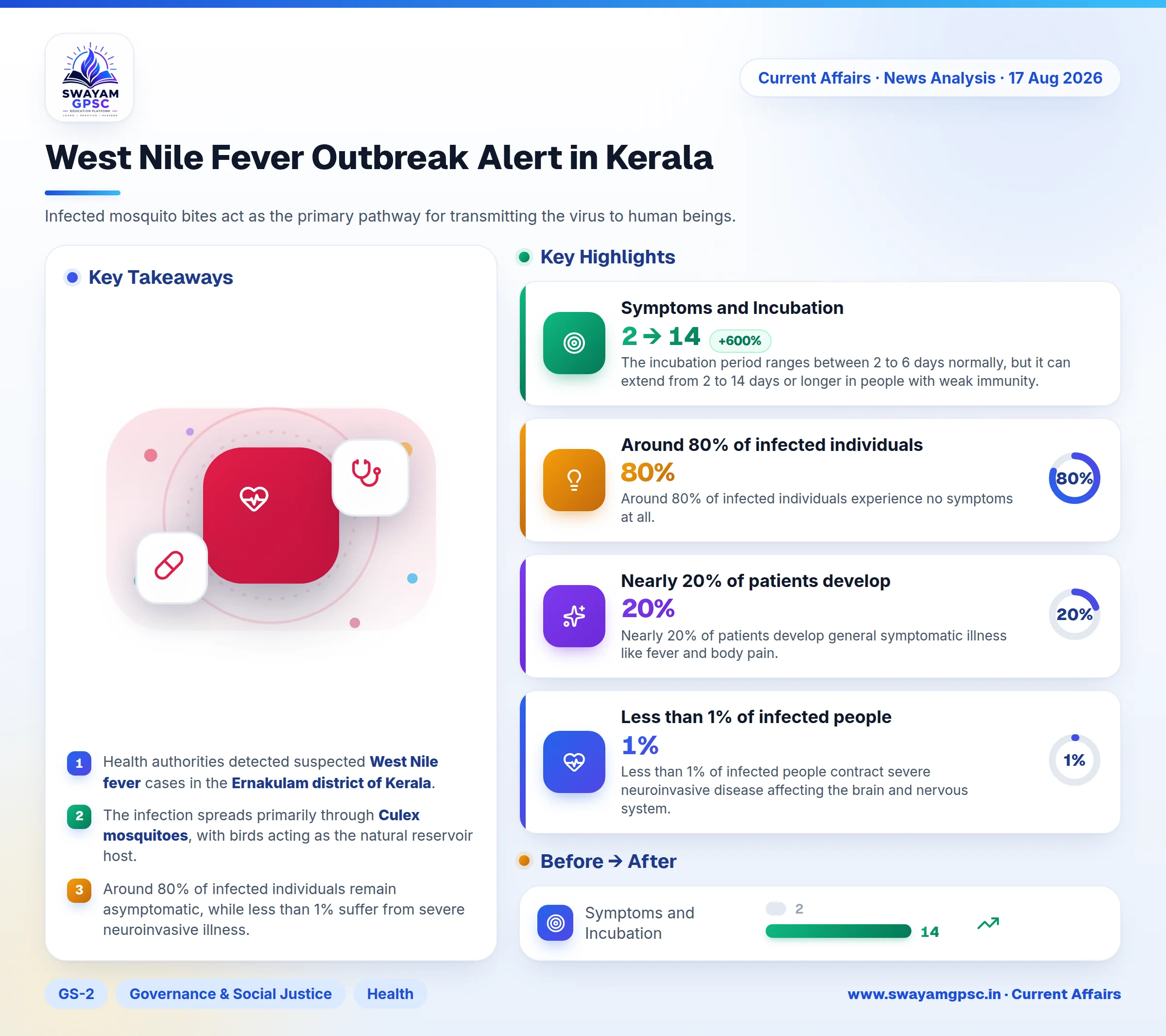
- Health authorities detected suspected West Nile fever cases in the Ernakulam district of Kerala.
- The infection spreads primarily through Culex mosquitoes, with birds acting as the natural reservoir host.
- Around 80% of infected individuals remain asymptomatic, while less than 1% suffer from severe neuroinvasive illness.
- First discovered in Uganda in 1937, the virus currently lacks any licensed human vaccine or targeted antiviral cure.
Why in News
- Health officials recently issued a warning after detecting suspected cases of West Nile fever in the Ernakulam district of Kerala.
About West Nile Virus
- The West Nile virus (WNV) causes this viral infection in humans and animals.
- It is a positive-sense single-stranded RNA virus from the Flaviviridae family and Orthoflavivirus genus.
Transmission and Spread
- Infected mosquito bites act as the primary pathway for transmitting the virus to human beings.
- Casual contact between humans does not spread the infection.
- Rare transmission occurs through blood transfusions, organ transplants, laboratory exposure, or from mother to child during pregnancy, delivery, or breastfeeding.
Vectors and Reservoir Hosts
- Wild birds serve as the principal natural reservoir hosts for the virus.
- Mosquitoes of the Culex species act as the main vector by breeding in stagnant or polluted water and biting mostly during nighttime.
Symptoms and Incubation
- Around 80% of infected individuals experience no symptoms at all.
- Nearly 20% of patients develop general symptomatic illness like fever and body pain.
- Less than 1% of infected people contract severe neuroinvasive disease affecting the brain and nervous system.
- The incubation period ranges between 2 to 6 days normally, but it can extend from 2 to 14 days or longer in people with weak immunity.
Geographical Distribution and History
- The virus stays active across Africa, Europe, the Middle East, North America, and West Asia.
- Researchers first isolated the virus in 1937 from a woman in the West Nile district of Uganda.
- Scientists later detected the virus among birds in the Nile Delta region in 1953.
Diagnosis and Treatment
- Doctors confirm the illness through laboratory blood tests, physical symptoms, and checking history of mosquito exposure.
- Medical science currently has no licensed human vaccine or specific antiviral medicine to treat this infection.
Prevention and Control
- Avoiding mosquito bites and eliminating stagnant water sources remain the most effective preventive steps.