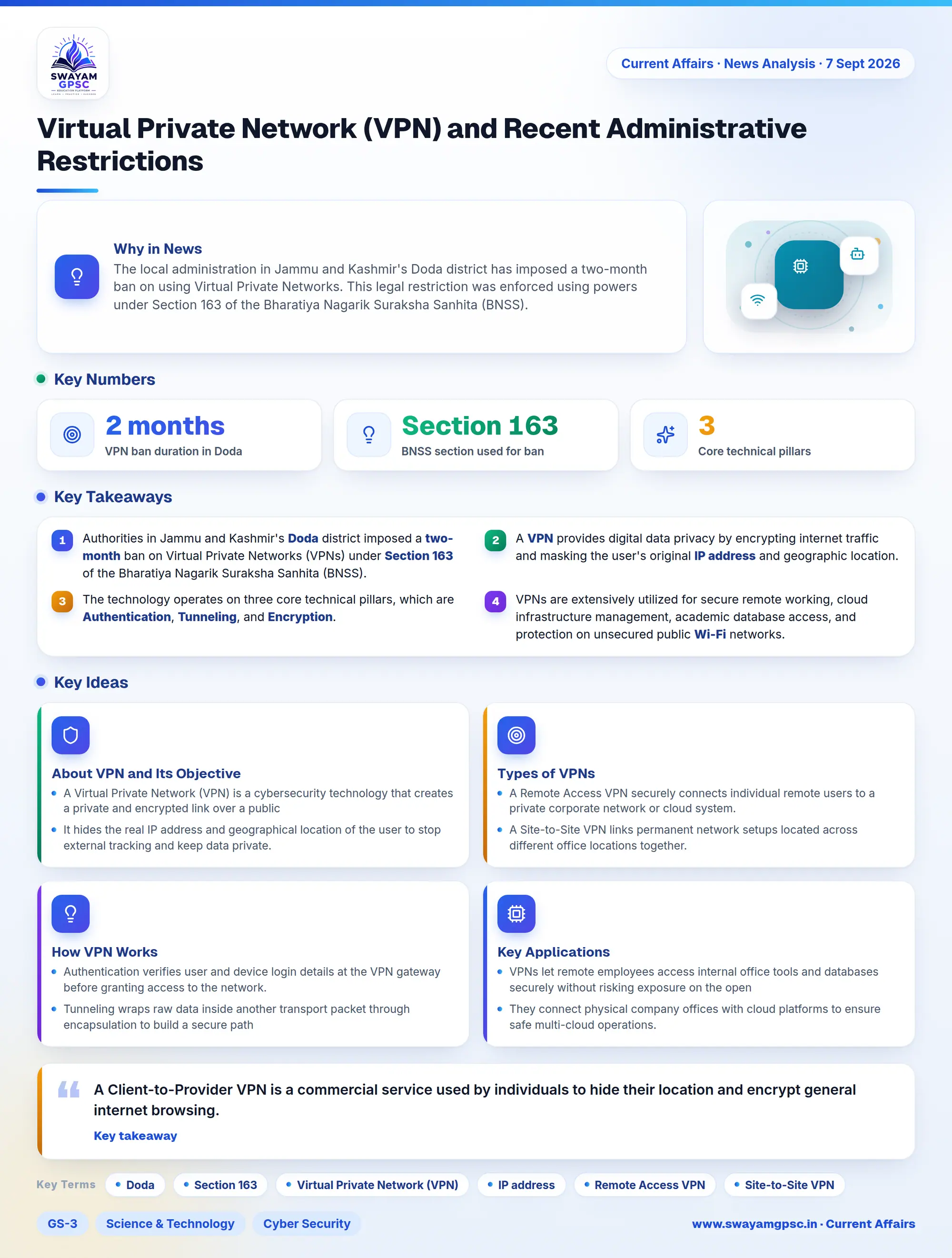
Virtual Private Network (VPN) and Recent Administrative Restrictions
#GS-3 #Science & Technology #Cyber Security #ICT #GS-2 #Current Events #National #Prelims #VPN #BNSS
Key takeaways
- Authorities in Jammu and Kashmir's Doda district imposed a two-month ban on Virtual Private Networks (VPNs) under Section 163 of the Bharatiya Nagarik Suraksha Sanhita (BNSS).
- A VPN provides digital data privacy by encrypting internet traffic and masking the user's original IP address and geographic location.
- The technology operates on three core technical pillars, which are Authentication, Tunneling, and Encryption.
- VPNs are extensively utilized for secure remote working, cloud infrastructure management, academic database access, and protection on unsecured public Wi-Fi networks.
Why in News
- The local administration in Jammu and Kashmir's Doda district has imposed a two-month ban on using Virtual Private Networks.
- This legal restriction was enforced using powers under Section 163 of the Bharatiya Nagarik Suraksha Sanhita (BNSS).
About VPN and Its Objective
- A Virtual Private Network (VPN) is a cybersecurity technology that creates a private and encrypted link over a public network like the internet.
- It hides the real IP address and geographical location of the user to stop external tracking and keep data private.
- The primary goal of a VPN is to secure sensitive data traffic from spying, illegal interception, and tampering while in transit.
Types of VPNs
- A Remote Access VPN securely connects individual remote users to a private corporate network or cloud system.
- A Site-to-Site VPN links permanent network setups located across different office locations together.
- A Client-to-Provider VPN is a commercial service used by individuals to hide their location and encrypt general internet browsing.
How VPN Works
- Authentication verifies user and device login details at the VPN gateway before granting access to the network.
- Tunneling wraps raw data inside another transport packet through encapsulation to build a secure path across the internet.
- Encryption turns normal readable text into coded secret text so that intercepted traffic cannot be read without a key.
Key Applications
- VPNs let remote employees access internal office tools and databases securely without risking exposure on the open internet.
- They connect physical company offices with cloud platforms to ensure safe multi-cloud operations.
- Students and researchers use VPNs to access private university libraries and campus research databases from home.
- They protect bank logins, personal passwords, and messages from cybercriminals on unsecured public Wi-Fi networks.