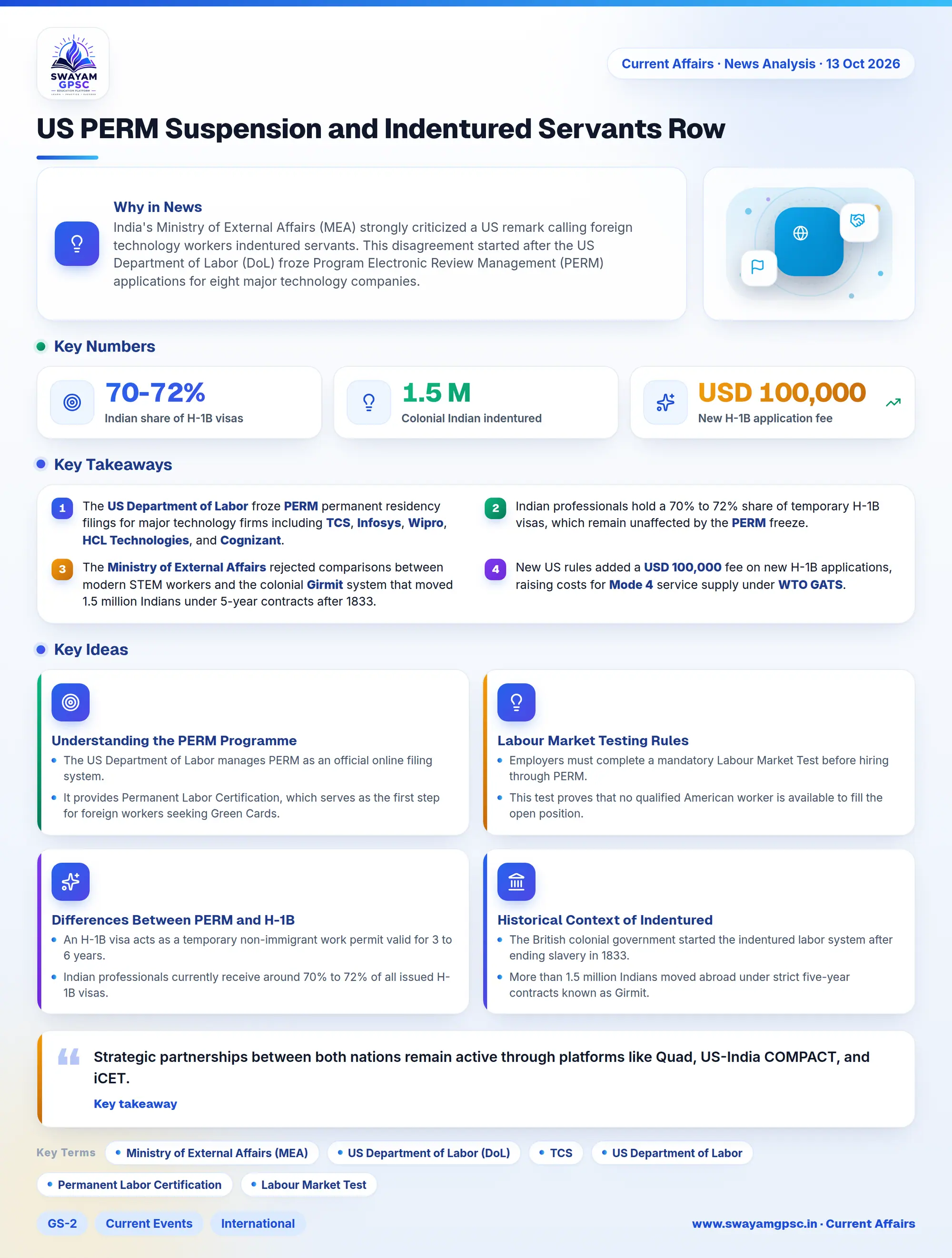
US PERM Suspension and Indentured Servants Row
#GS-2 #Current Events #International #Bilateral Groupings & Agreements #Effect of Policies & Politics of Countries on India's Interests #Indian Diaspora
Key takeaways
- The US Department of Labor froze PERM permanent residency filings for major technology firms including TCS, Infosys, Wipro, HCL Technologies, and Cognizant.
- Indian professionals hold a 70% to 72% share of temporary H-1B visas, which remain unaffected by the PERM freeze.
- The Ministry of External Affairs rejected comparisons between modern STEM workers and the colonial Girmit system that moved 1.5 million Indians under 5-year contracts after 1833.
- New US rules added a USD 100,000 fee on new H-1B applications, raising costs for Mode 4 service supply under WTO GATS.
Why in News
- India's Ministry of External Affairs (MEA) strongly criticized a US remark calling foreign technology workers indentured servants.
- This disagreement started after the US Department of Labor (DoL) froze Program Electronic Review Management (PERM) applications for eight major technology companies.
- The freeze affects five major Indian IT firms including TCS, Infosys, Wipro, HCL Technologies, and Cognizant.
Understanding the PERM Programme
- The US Department of Labor manages PERM as an official online filing system.
- It provides Permanent Labor Certification, which serves as the first step for foreign workers seeking Green Cards.
- This process applies to EB-2 visas for advanced degree holders and EB-3 visas for skilled workers.
Labour Market Testing Rules
- Employers must complete a mandatory Labour Market Test before hiring through PERM.
- This test proves that no qualified American worker is available to fill the open position.
- It also verifies that hiring a foreign worker will not lower local wage rates.
Differences Between PERM and H-1B Visas
- An H-1B visa acts as a temporary non-immigrant work permit valid for 3 to 6 years.
- Indian professionals currently receive around 70% to 72% of all issued H-1B visas.
- The current application freeze targets permanent residency through PERM without stopping temporary H-1B work permits.
Historical Context of Indentured Servitude
- The British colonial government started the indentured labor system after ending slavery in 1833.
- More than 1.5 million Indians moved abroad under strict five-year contracts known as Girmit.
- These workers moved to plantations in countries like Fiji, Mauritius, Trinidad & Tobago, Guyana, Suriname, South Africa, and Malaysia.
India's Rejection of Colonial Comparisons
- The Ministry of External Affairs rejected any comparison between colonial labor systems and modern Indian technology professionals.
- Indian STEM experts represent the highest-earning ethnic group inside the United States.
Impact on Broader India-US Strategic Ties
- Strategic partnerships between both nations remain active through platforms like Quad, US-India COMPACT, and iCET.
- Economic disputes and trade restrictions create fresh challenges for diplomatic relations.
Challenges in Cross-Border Service Movement
- American protectionist rules restrict how Indian professionals provide services abroad.
- These restrictions harm Mode 4 service supply under the WTO General Agreement on Trade in Services (GATS).
Financial Impact of High Visa Fees
- The US government added a new one-time payment of USD 100,000 for new H-1B visa filings.
- This fee increase significantly raises operational costs for companies sending Indian tech employees overseas.