US Midterm Elections 2026 and Strategic Implications for India
#GS-2 #Indian Polity & Constitution #Governance & Social Justice #Current Events #Parliament #Executive #International #National
Key takeaways
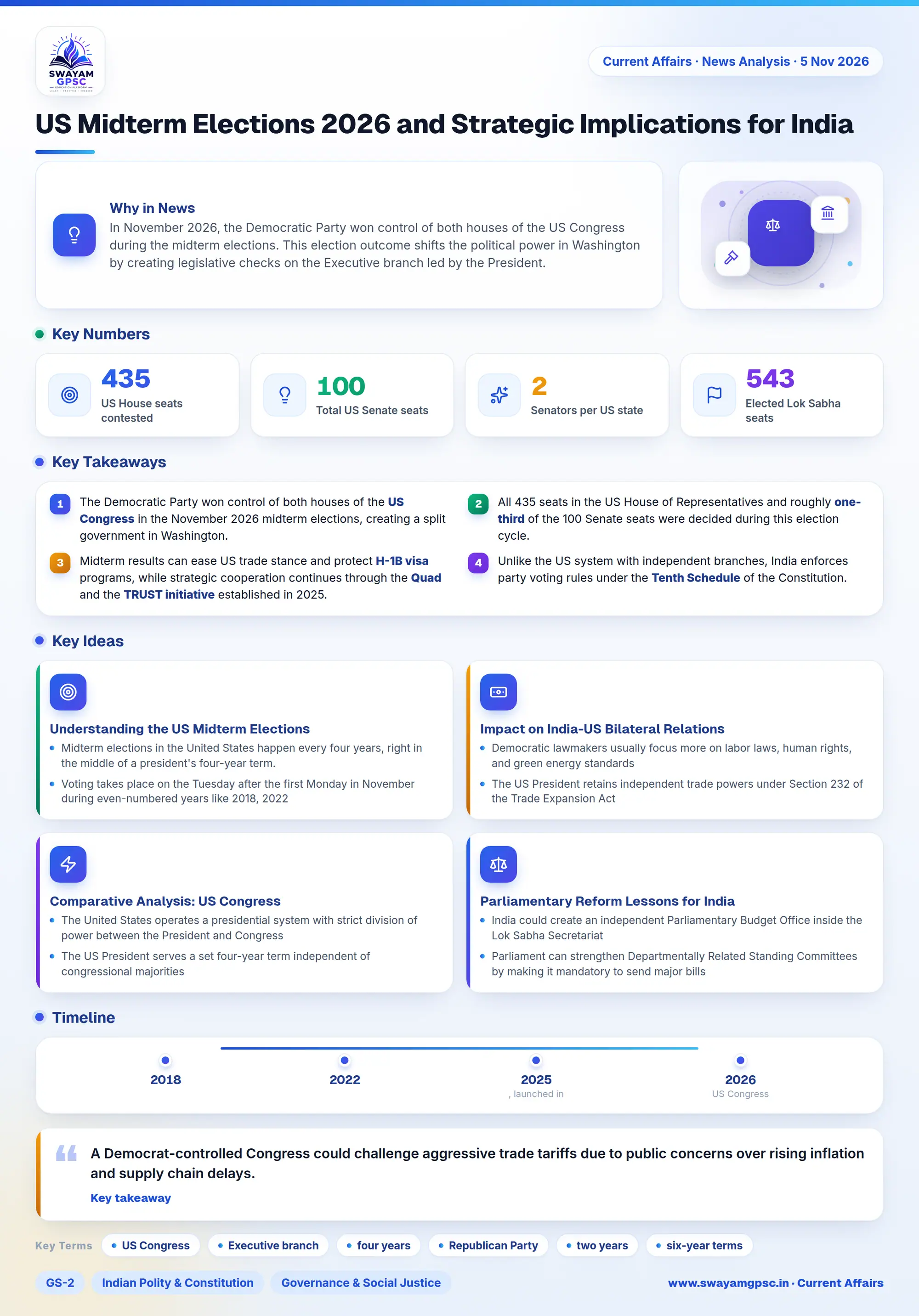
- The Democratic Party won control of both houses of the US Congress in the November 2026 midterm elections, creating a split government in Washington.
- All 435 seats in the US House of Representatives and roughly one-third of the 100 Senate seats were decided during this election cycle.
- Midterm results can ease US trade stance and protect H-1B visa programs, while strategic cooperation continues through the Quad and the TRUST initiative established in 2025.
- Unlike the US system with independent branches, India enforces party voting rules under the Tenth Schedule of the Constitution.
- Indian reforms could include building an independent Parliamentary Budget Office based on the American Congressional Budget Office (CBO).
Why in News
- In November 2026, the Democratic Party won control of both houses of the US Congress during the midterm elections.
- This election outcome shifts the political power in Washington by creating legislative checks on the Executive branch led by the President.
- The shift in legislative control brings new political dynamics that affect trade, foreign policy, and diplomatic strategies between India and the United States.
Understanding the US Midterm Elections
- Midterm elections in the United States happen every four years, right in the middle of a president's four-year term.
- Voting takes place on the Tuesday after the first Monday in November during even-numbered years like 2018, 2022, and 2026.
- The national legislative body of the United States is called the US Congress, which includes both the House of Representatives and the Senate.
- American politics operates as a two-party system, where the Republican Party and the Democratic Party hold almost all elected offices.
- All 435 voting seats in the House of Representatives face direct public elections every two years during both presidential and midterm election cycles.
- Like India's Lok Sabha, voters directly choose House members to represent specific population-based local districts.
- The Senate serves as the upper chamber where 100 total members hold staggered six-year terms as a continuous legislative body.
- Roughly one-third of all Senate seats, usually 33 to 35 seats, come up for election every two years during midterms.
- Unlike the population-based seat distribution in India's Rajya Sabha, every US state gets exactly two Senators who are elected directly by voters.
- The House of Representatives holds special constitutional powers to start revenue bills and vote to impeach federal officials.
- The Senate holds unique powers to approve presidential appointments, ratify foreign treaties, and conduct trial proceedings for impeachments.
- The President can use a presidential veto to stop bills passed by Congress, but both houses can override that veto with a two-thirds majority vote.
- Voters use midterm elections to express their opinions on the current president's job performance, economic management, and policy decisions.
- When the political party opposing the President wins a majority in either house of Congress, it creates a split government system.
- A split government allows opposition parties to block administration bills, control federal budget allocations, and run congressional inquiries into executive actions.
Impact on India-US Bilateral Relations
- A Democrat-controlled Congress could challenge aggressive trade tariffs due to public concerns over rising inflation and supply chain delays.
- Democratic lawmakers usually focus more on labor laws, human rights, and green energy standards, which could require Indian exporters to adjust compliance efforts.
- The US President retains independent trade powers under Section 232 of the Trade Expansion Act, 1962 and Section 301 of the Trade Act, 1974, keeping presidential trade authority active despite legislative oversight.
- Congressional leaders may push to finalize long-pending trade discussions, creating opportunities for a bilateral Free Trade Agreement ahead of upcoming summits in Manila and the G20 in Miami.
- Democratic oversight might limit executive actions that target H-1B visas, providing relief to Indian tech workers and the information technology sector.
- Strong support from both political parties ensures ongoing backing for India's role in the Indo-Pacific through the Quad alliance and defense agreements.
- Cooperation continues under the TRUST (Transforming the Relationship Utilizing Strategic Technology) initiative, launched in 2025 to advance work on artificial intelligence, semiconductors, and quantum computing.
- Policy gridlock in Washington can prompt global investors to shift capital into fast-growing economies, boosting Foreign Institutional Investment (FII) into Indian financial markets.
- Congressional scrutiny over military spending could encourage diplomatic resolution of conflicts in the Persian Gulf, helping stabilize shipping channels in the Strait of Hormuz to secure Indian crude oil, liquefied natural gas, and fertilizer shipments.
- Indian diplomats must continue engaging leaders from both political parties in Congress to maintain waivers against secondary sanctions on Russian oil under proposed laws like the Sanctioning Russia and Iran Act (SRIA).
Comparative Analysis: US Congress vs. Indian Parliament
- The United States operates a presidential system with strict division of power between the President and Congress, while India uses a parliamentary system where the executive council comes directly from Parliament.
- The US President serves a set four-year term independent of congressional majorities, whereas the Indian Prime Minister and Cabinet must maintain a majority in the Lok Sabha to remain in office.
- All 435 members of the US House face elections every two years, while all 543 Lok Sabha members serve five-year terms unless Parliament dissolves early.
- The US Senate rotates roughly one-third of its seats every two years through direct state elections, while India's Rajya Sabha replaces one-third of its members every two years through indirect votes by state assembly members.
- Every US state gets two Senators regardless of population size, while seats in the Rajya Sabha are divided among Indian states based on their population numbers.
- US lawmakers vote without an anti-defection law, allowing them to vote against their party, whereas India uses the Tenth Schedule to enforce strict party voting discipline.
- The US Congress retains full control over the federal budget process, while the Indian executive branch prepares the budget, using Money Bills in the Lok Sabha with limited parliamentary debate.
- Electoral management in the United States is decentralized across 50 individual states, whereas India relies on a centralized constitutional authority through the Election Commission of India (ECI) under Article 324.
Parliamentary Reform Lessons for India
- India could create an independent Parliamentary Budget Office inside the Lok Sabha Secretariat, modeled after the US Congressional Budget Office (CBO), to provide non-partisan financial analysis to lawmakers.
- Parliament can strengthen Departmentally Related Standing Committees by making it mandatory to send major bills for public technical hearings with subject matter experts.
- Following recommendations from the Law Commission of India (170th Report), India could update anti-defection rules under the Tenth Schedule to apply whips only during confidence votes, no-confidence motions, and Money Bills.