The Rise of Animal Products in Agricultural Trade
#GS-3 #Economy #Agriculture #Infrastructure #Current Events
Key takeaways
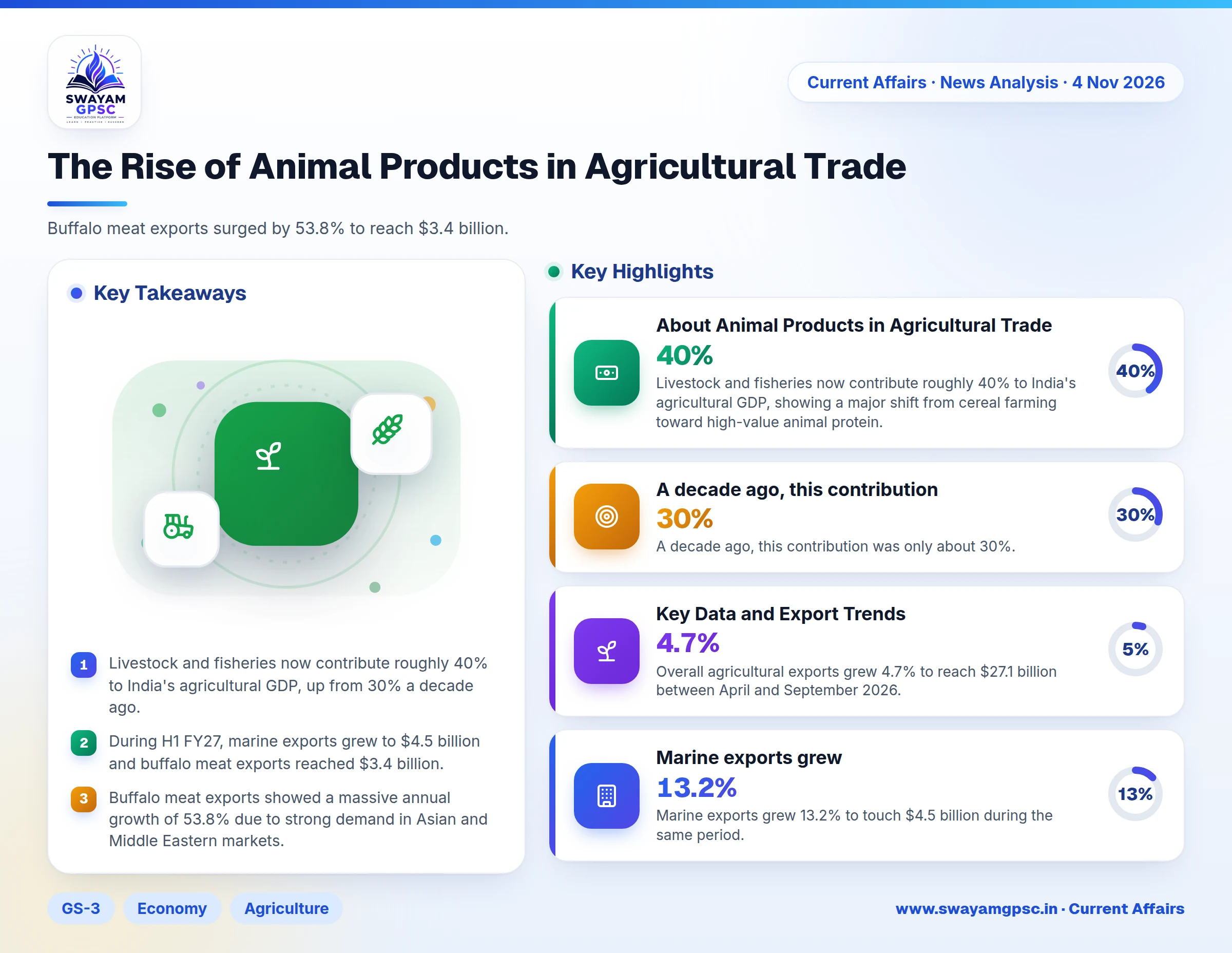
- Livestock and fisheries now contribute roughly 40% to India's agricultural GDP, up from 30% a decade ago.
- During H1 FY27, marine exports grew to $4.5 billion and buffalo meat exports reached $3.4 billion.
- Buffalo meat exports showed a massive annual growth of 53.8% due to strong demand in Asian and Middle Eastern markets.
- Stagnant domestic cotton yields turned India into a net cotton importer with shipments crossing $2 billion in FY27.
Context
- Department of Commerce data for H1 FY27 reveals that marine products and buffalo meat are becoming India's top agricultural exports.
- These animal-based products have now surpassed traditional crops, including basmati rice, in export value.
About Animal Products in Agricultural Trade
- Livestock and fisheries now contribute roughly 40% to India's agricultural GDP, showing a major shift from cereal farming toward high-value animal protein.
- A decade ago, this contribution was only about 30%.
- Better disease control, integrated cold-chain logistics, and modern abattoirs have helped animal products avoid the export bans and climate problems that affect traditional field crops.
Key Data and Export Trends
- Overall agricultural exports grew 4.7% to reach $27.1 billion between April and September 2026.
- Marine exports grew 13.2% to touch $4.5 billion during the same period.
- Buffalo meat exports surged by 53.8% to reach $3.4 billion.
- Seafood exports reached a record $8.4 billion in FY26, driven by strong demand from the US and growing markets in Asia and Russia.
Key Drivers Behind Animal Product Exports
- Exporters have successfully expanded into West Asian, Southeast Asian, and Central Asian markets instead of relying on a single buyer.
- Major shipments of buffalo meat go to countries like Vietnam, Egypt, Malaysia, Indonesia, and Saudi Arabia.
- Strict sanitary rules have changed global views of Indian carabeef, turning it into a lean, halal-certified premium meat rather than a low-grade beef substitute.
- Mandatory export registration is now required only for modern integrated abattoirs that meet international sanitary standards.
- Commercial shrimp farming has grown rapidly in Andhra Pradesh, Odisha, and Gujarat with the help of pathogen-free hatcheries.
- Unlike wheat and sugar, buffalo meat and seafood exports rarely face sudden government bans or minimum export price restrictions.
Reversal of Traditional Agri Trade Trends
- Stagnant domestic cotton yields and bollworm resistance have turned India into a net cotton importer, with shipments crossing $2 billion in FY27.
- The government cut import duties on palm, soybean, and sunflower oil to control food inflation after El Nino dry spells.
- Lower water levels in reservoirs reduced sugarcane crushing, leading to an export ban and duty-free imports of 10 lakh tonnes of raw sugar.
- The uneven 2026 monsoon showed how vulnerable rain-fed field crops are to climate shocks, unlike steady livestock and aquaculture.
Challenges Associated with Animal Product Exports
- Advanced destination markets often impose strict anti-microbial residue limits and mandatory health certificates.
- Trace antibiotic residues have led to the rejection of some Indian seafood consignments in the US and EU.
- Persistent animal diseases like Foot-and-Mouth Disease prevent Indian meat from entering high-value Western markets.
- Intensive shrimp farming and slaughterhouses generate waste that creates friction with local coastal ecosystems and groundwater.
Way Ahead
- The government should fast-track the National Animal Disease Control Programme to establish disease-free zones and open European markets.
- Exporters must move beyond frozen shrimp into ready-to-eat products and seaweed farming under the Pradhan Mantri Matsya Sampada Yojana.
- Upgrading cold-storage corridors and testing labs will help eliminate residue rejections at ports.
- Scaling blockchain-backed digital origin tracking will guarantee food safety compliance for global buyers.
Conclusion
- The rise of marine products and buffalo meat marks a structural shift in India's agricultural trade.
- Livestock and fisheries are now the main drivers of farm exports while traditional crops face domestic supply and climate pressures.
- Sustaining this growth requires better biosecurity standards, modern processing infrastructure, and official disease-free status.