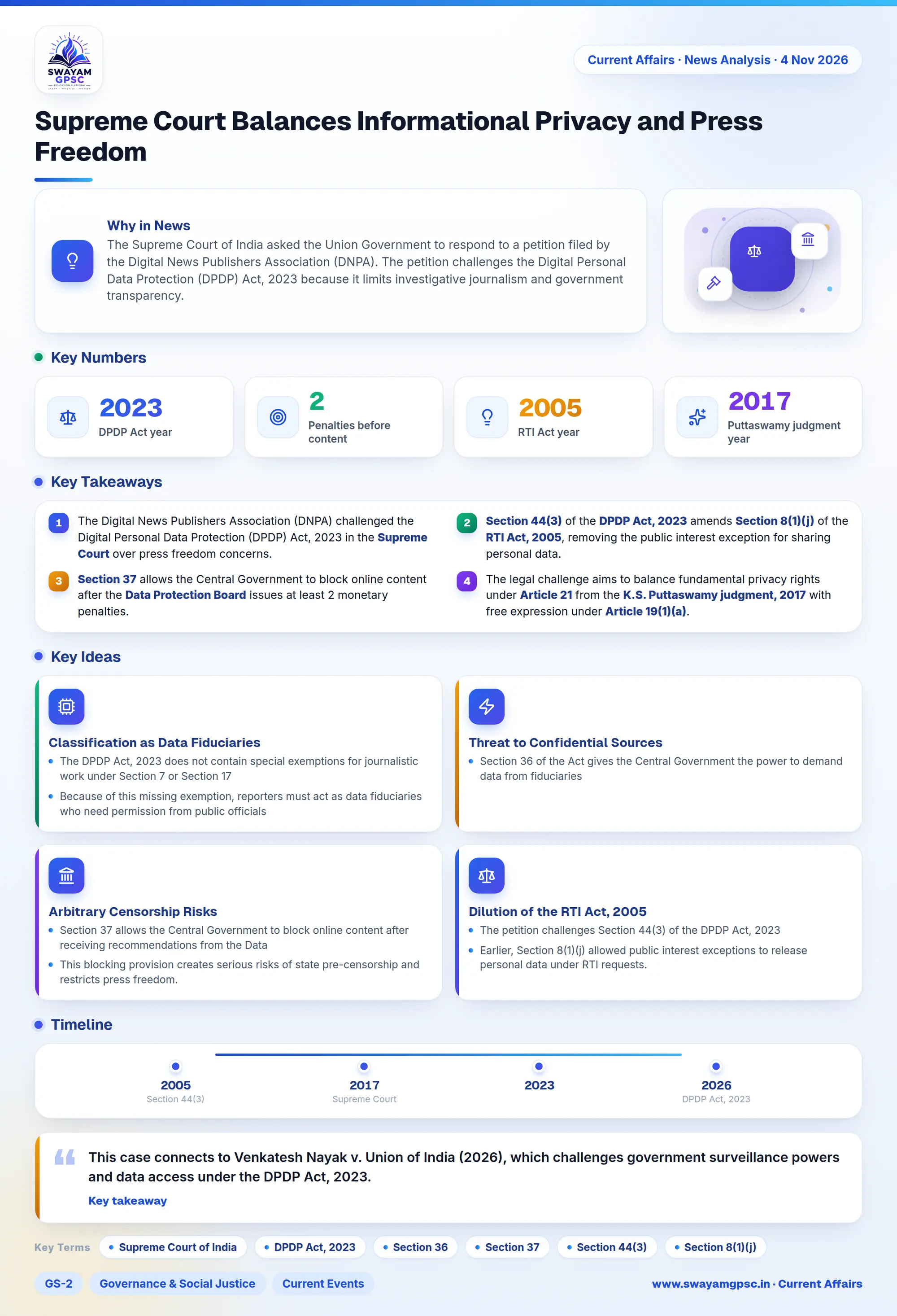
Supreme Court Balances Informational Privacy and Press Freedom
#GS-2 #Governance & Social Justice #Current Events #Constitution #Judiciary #E-Governance #National #Rapid Fire CA #Quick Facts For Prelims #Government Policies & Interventions
Key takeaways
- The Digital News Publishers Association (DNPA) challenged the Digital Personal Data Protection (DPDP) Act, 2023 in the Supreme Court over press freedom concerns.
- Section 44(3) of the DPDP Act, 2023 amends Section 8(1)(j) of the RTI Act, 2005, removing the public interest exception for sharing personal data.
- Section 37 allows the Central Government to block online content after the Data Protection Board issues at least 2 monetary penalties.
- The legal challenge aims to balance fundamental privacy rights under Article 21 from the K.S. Puttaswamy judgment, 2017 with free expression under Article 19(1)(a).
Why in News
- The Supreme Court of India asked the Union Government to respond to a petition filed by the Digital News Publishers Association (DNPA).
- The petition challenges the Digital Personal Data Protection (DPDP) Act, 2023 because it limits investigative journalism and government transparency.
Classification as Data Fiduciaries
- The DPDP Act, 2023 does not contain special exemptions for journalistic work under Section 7 or Section 17, which raises serious concerns about public interest reporting.
- Because of this missing exemption, reporters must act as data fiduciaries who need permission from public officials before investigating them.
- Under this law, a Data Fiduciary is any entity that determines why and how personal data gets processed.
Threat to Confidential Sources
- Section 36 of the Act gives the Central Government the power to demand data from fiduciaries, which can expose confidential sources and scare whistleblowers.
Arbitrary Censorship Risks
- Section 37 allows the Central Government to block online content after receiving recommendations from the Data Protection Board following at least 2 monetary penalties.
- This blocking provision creates serious risks of state pre-censorship and restricts press freedom.
Dilution of the RTI Act, 2005
- The petition challenges Section 44(3) of the DPDP Act, 2023, which changes Section 8(1)(j) of the Right to Information (RTI) Act, 2005.
- Earlier, Section 8(1)(j) allowed public interest exceptions to release personal data under RTI requests.
- The new law removes this public interest exception and creates a blanket exemption for all personal information.
- This change prevents journalists from accessing asset disclosures or public tender records, making it harder to expose corruption.
Right to Privacy vs. Freedom of Press
- The Supreme Court stated that courts must balance the right to privacy under Article 21 and the K.S. Puttaswamy judgment, 2017 with free speech under Article 19(1)(a).
Broader Constitutional Challenge
- This case connects to Venkatesh Nayak v. Union of India (2026), which challenges government surveillance powers and data access under the DPDP Act, 2023.
Regulatory Complexities
- The Central Government explained that defining who qualifies as a journalist is difficult today because many young citizens get news from social media creators.