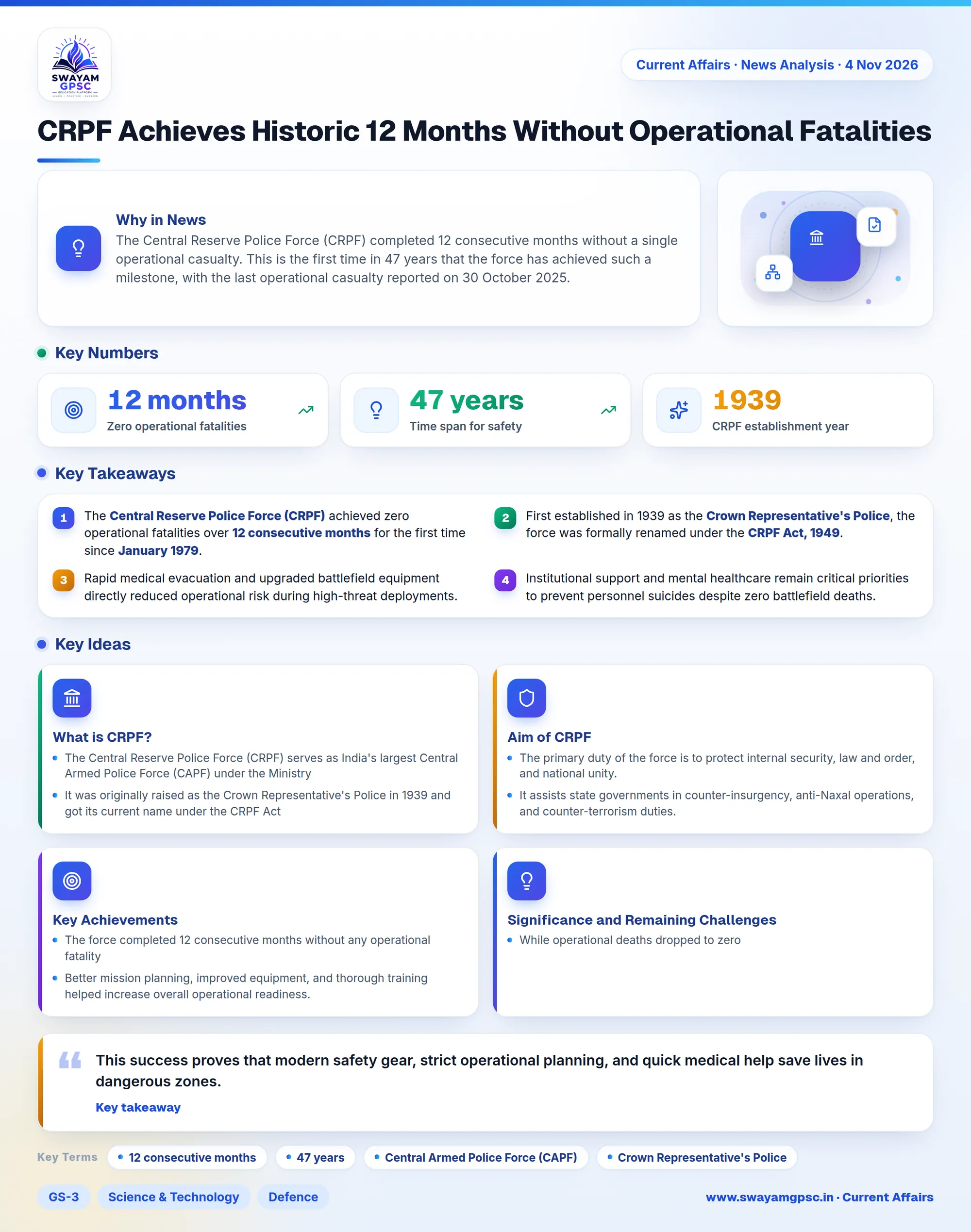
CRPF Achieves Historic 12 Months Without Operational Fatalities
#GS-3 #Science & Technology #Defence #Current Events #National #GS-2 #Governance & Social Justice #Regulatory Bodies #Ethics #CRPF #Internal Security #MHA
Key takeaways
- The Central Reserve Police Force (CRPF) achieved zero operational fatalities over 12 consecutive months for the first time since January 1979.
- First established in 1939 as the Crown Representative's Police, the force was formally renamed under the CRPF Act, 1949.
- Rapid medical evacuation and upgraded battlefield equipment directly reduced operational risk during high-threat deployments.
- Institutional support and mental healthcare remain critical priorities to prevent personnel suicides despite zero battlefield deaths.
Why in News
- The Central Reserve Police Force (CRPF) completed 12 consecutive months without a single operational casualty.
- This is the first time in 47 years that the force has achieved such a milestone, with the last operational casualty reported on 30 October 2025.
What is CRPF?
- The Central Reserve Police Force (CRPF) serves as India's largest Central Armed Police Force (CAPF) under the Ministry of Home Affairs (MHA).
- It was originally raised as the Crown Representative's Police in 1939 and got its current name under the CRPF Act, 1949.
Aim of CRPF
- The primary duty of the force is to protect internal security, law and order, and national unity.
- It assists state governments in counter-insurgency, anti-Naxal operations, and counter-terrorism duties.
Key Achievements
- The force completed 12 consecutive months without any operational fatality, marking a unique safety record since January 1979.
- Better mission planning, improved equipment, and thorough training helped increase overall operational readiness.
- Quick medical evacuation and fast access to advanced hospitals significantly reduced risk for injured personnel.
- The force continued heavy deployments in high-risk zones while securing major tactical successes without losing personnel.
Significance and Remaining Challenges
- This success proves that modern safety gear, strict operational planning, and quick medical help save lives in dangerous zones.
- While operational deaths dropped to zero, ongoing instances of personnel suicide show that mental health support and stress management are still urgently needed.