Biosphere Reserves in India: Conservation and Sustainable Development
#GS-3 #Environment #Conservation #Climate Change #Biodiversity #Current Events #National
Key takeaways
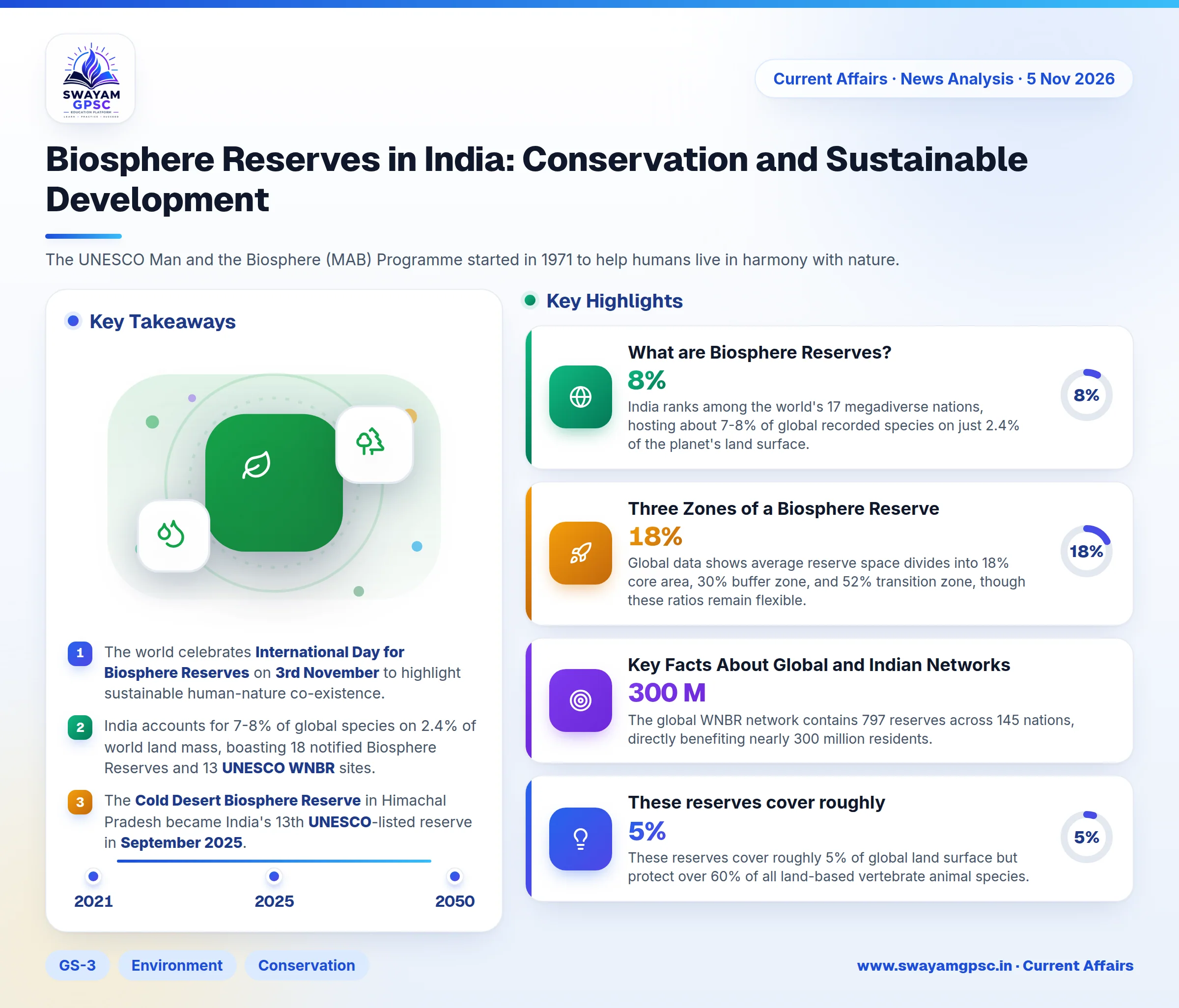
- The world celebrates International Day for Biosphere Reserves on 3rd November to highlight sustainable human-nature co-existence.
- India accounts for 7-8% of global species on 2.4% of world land mass, boasting 18 notified Biosphere Reserves and 13 UNESCO WNBR sites.
- The Cold Desert Biosphere Reserve in Himachal Pradesh became India's 13th UNESCO-listed reserve in September 2025.
- The MoEFCC funds biosphere reserve development through a 60:40 ratio for general states and 90:10 for Himalayan and North-Eastern states.
- Invasive Lantana camara weeds cover 3 lakh sq. km of Indian forests, which Nilgiri tribes creatively recycle into elephant statues and furniture.
Why in News
- The world marks the International Day for Biosphere Reserves every year on 3rd November.
- This special day emphasizes how these unique ecosystems balance wildlife protection with local community growth.
What are Biosphere Reserves?
- Individual countries establish these designated areas to protect wildlife, natural habitats, and genetic diversity while supporting local livelihoods.
- The UNESCO Man and the Biosphere (MAB) Programme started in 1971 to help humans live in harmony with nature.
- Member countries recommend their own national sites to be added to the UNESCO World Network of Biosphere Reserves (WNBR).
- Every 10 years, UNESCO conducts a formal review of listed sites to check how well they protect biodiversity.
- National designation remains completely separate from UNESCO status, meaning not all national reserves automatically join the global network.
- These places act as real-world laboratories where scientists test sustainable resource management, forest restoration, and community conservation practices.
- India ranks among the world's 17 megadiverse nations, hosting about 7-8% of global recorded species on just 2.4% of the planet's land surface.
- Unlike National Parks or Wildlife Sanctuaries that focus strictly on protecting animals, these reserves actively combine nature conservation with scientific study and local economic growth.
- Declaring a site as a Biosphere Reserve does not give statutory legal protection to the entire region under the Wildlife (Protection) Act, 1972.
- Only the core zones hold legal status as National Parks or Sanctuaries, whereas outer buffer and transition zones permit eco-friendly human work.
Functions of Biosphere Reserves
- They protect natural ecosystems, native species, unique gene pools, and traditional cultural heritage across the landscape.
- They encourage eco-friendly economic activities that provide jobs to local residents while staying within ecological limits.
- They offer logisitcal and scientific support for field research, environmental training, species monitoring, and global knowledge sharing.
Three Zones of a Biosphere Reserve
- The Core Zone receives strict legal protection where human disturbance remains forbidden, permitting only non-destructive research and monitoring.
- The Buffer Zone surrounds the core and allows controlled activities like environmental training, scientific study, and managed ecotourism.
- The Transition Zone forms the outermost band where local populations practise eco-friendly farming, forestry, and sustainable economic activities.
- Global data shows average reserve space divides into 18% core area, 30% buffer zone, and 52% transition zone, though these ratios remain flexible.
Key Facts About Global and Indian Networks
- The global WNBR network contains 797 reserves across 145 nations, directly benefiting nearly 300 million residents.
- These reserves cover roughly 5% of global land surface but protect over 60% of all land-based vertebrate animal species.
- The Map of the World Network of Biosphere Reserves 2025-26 reports that 40% of reserves face extreme weather by 2050, with over 50% holding double conservation tags.
- India maintains 18 notified Biosphere Reserves, and 13 of them belong to the prestigious UNESCO WNBR list.
- India set up its first reserve, the Nilgiri Biosphere Reserve, back in 1986.
- The Cold Desert region became India's 13th reserve to join the global UNESCO network in September 2025.
Important Biosphere Reserves in India
- The Nilgiri Biosphere Reserve covers 5,520 sq. km across Western Ghats regions in Tamil Nadu, Kerala, and Karnataka.
- This reserve protects diverse forests including tropical evergreen tracts, high-altitude montane shola forests, and natural grasslands.
- It safeguards rare animals like the lion-tailed macaque and Nilgiri tahr, along with wild tigers, Asian elephants, and 550 bird species.
- The Cold Desert Biosphere Reserve spans 7,770 sq. km in Himachal Pradesh at high altitudes between 3,300 and 6,600 metres.
- It supports 732 vascular plant species, including 30 endemic plants, alongside rare fauna like snow leopards, Himalayan ibex, and blue sheep.
- Local communities in this cold region follow traditional ways of living like seasonal animal herding, farming, and herbal medicine gathering.
- The Gulf of Mannar Biosphere Reserve covers 10,500 sq. km off the southeastern shoreline of Tamil Nadu.
- Its marine waters house rich coral reefs, underwater seagrass beds, and mangroves that shelter 4,223 animal and plant species.
- Local coastal communities rely heavily on this rich marine ecosystem for sustainable fishing and coastal trade livelihoods.
Government Initiatives for Conservation
- The MoEFCC runs the Biodiversity Conservation Scheme under its larger Conservation of Natural Resources and Ecosystems umbrella project.
- This scheme hands out financial grants to state governments to execute official Management Plans for MAB recognized reserves.
- The central government shares funding on a 60:40 ratio with general states, while providing 90:10 funding to North-Eastern and Himalayan states.
- State Forest Departments manage on-ground work according to officially approved Management Plans.
- Since 2022-23, the ministry has piloted five-year Integrated Management Plans for Nanda Devi, Pachmarhi, Dehang-Dibang, and Agasthyamalai.
- These plans bring forest officers, scientific institutions, and villagers together to focus on habitat restoration, species counts, and sustainable livelihoods.
Community-Based Conservation
- Native tribes in the Nilgiri Biosphere Reserve harvest invasive Lantana camara bushes to build elephant statues, home furniture, and craft goods.
- This creative project removes aggressive weeds, creates steady local jobs, and teaches people how to live safely alongside wild animals.
- This project earned global praise when 125 life-sized Lantana elephant statues were shown in London in 2021, with others placed at Bengaluru Airport and Rashtrapati Bhavan.
- The invasive Lantana camara weed has invaded around 3 lakh sq. km of Indian forests, choking native plants and worsening forest fire risks.
Conclusion
- Biosphere reserves prove that environmental conservation and local community development can thrive side-by-side.
- Strengthening community involvement, ecosystem repair, and climate management will help India protect its natural heritage for future generations.