All India Conference of Public Accounts Committees 2026
#GS-2 #Indian Polity & Constitution #Parliament #Governance & Social Justice #Good Governance #Current Events #National #Quick Facts For Prelims
Key takeaways
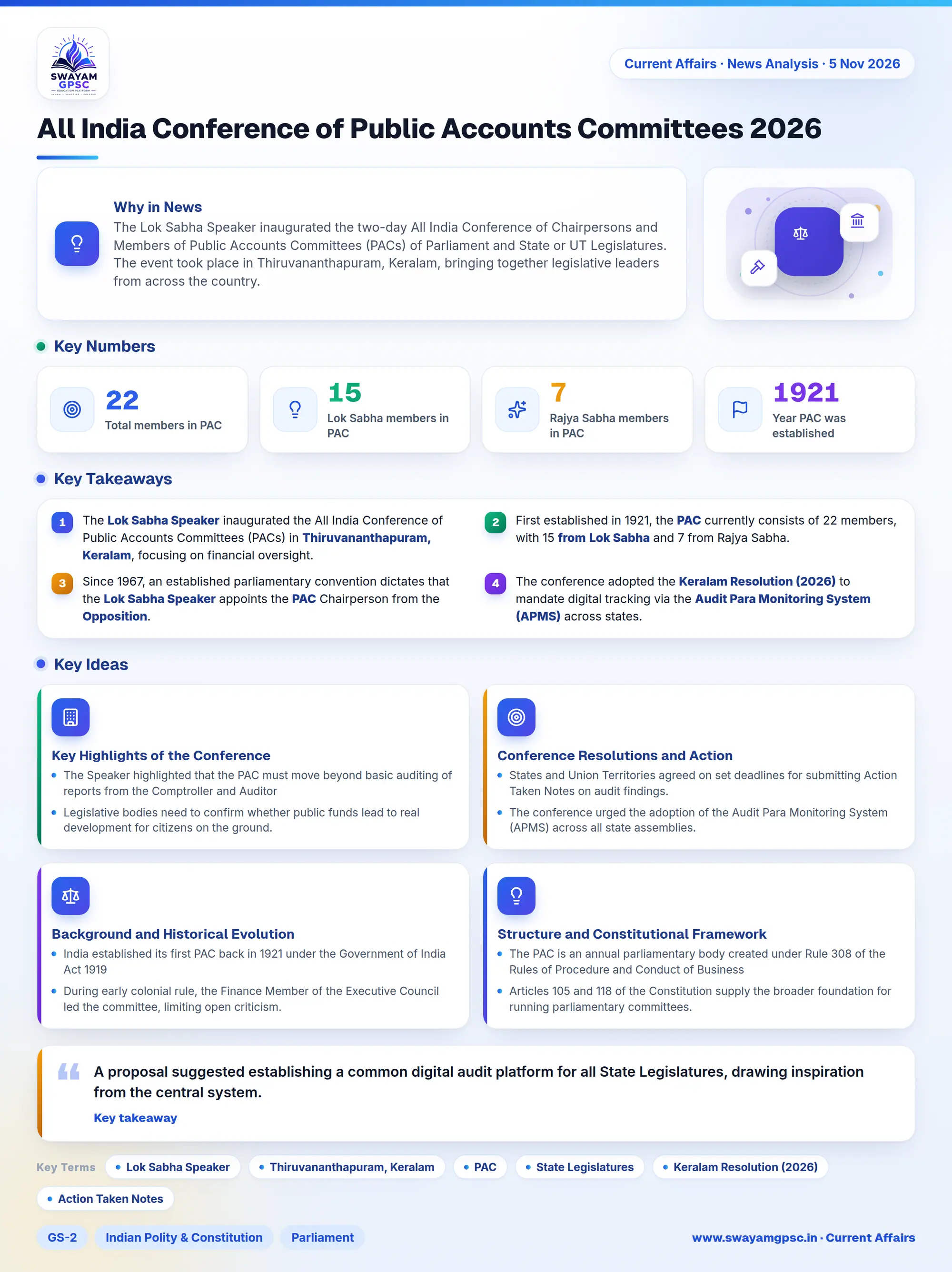
- The Lok Sabha Speaker inaugurated the All India Conference of Public Accounts Committees (PACs) in Thiruvananthapuram, Keralam, focusing on financial oversight.
- First established in 1921, the PAC currently consists of 22 members, with 15 from Lok Sabha and 7 from Rajya Sabha.
- Since 1967, an established parliamentary convention dictates that the Lok Sabha Speaker appoints the PAC Chairperson from the Opposition.
- The conference adopted the Keralam Resolution (2026) to mandate digital tracking via the Audit Para Monitoring System (APMS) across states.
- Unapproved government spending beyond sanctioned limits requires review by the PAC for regularization by Parliament under Article 115.
Why in News
- The Lok Sabha Speaker inaugurated the two-day All India Conference of Chairpersons and Members of Public Accounts Committees (PACs) of Parliament and State or UT Legislatures.
- The event took place in Thiruvananthapuram, Keralam, bringing together legislative leaders from across the country.
- The primary focus of the 2026 conference revolved around the theme “Audit, Accountability and Good Governance: The Evolving Role of PAC”.
Key Highlights of the Conference
- The Speaker highlighted that the PAC must move beyond basic auditing of reports from the Comptroller and Auditor General (CAG).
- Legislative bodies need to confirm whether public funds lead to real development for citizens on the ground.
- Maintain absolute fiscal discipline, making sure every rupee spent aligns with its original approval.
- A proposal suggested establishing a common digital audit platform for all State Legislatures, drawing inspiration from the central system.
- Delegates passed the Keralam Resolution (2026) to build stronger cooperation among various legislative financial committees.
Conference Resolutions and Action Items
- States and Union Territories agreed on set deadlines for submitting Action Taken Notes on audit findings.
- The conference urged the adoption of the Audit Para Monitoring System (APMS) across all state assemblies.
- Committees plan to use advanced forensic tools, artificial intelligence, and data analytics alongside the CAG.
- Members recommended holding at least three PAC sittings each month and setting up sub-committees to resolve old audit issues.
- A joint online portal will help union and state committees share financial oversight knowledge and training materials.
Background and Historical Evolution
- India established its first PAC back in 1921 under the Government of India Act 1919, also known as the Montague-Chelmsford Reforms.
- During early colonial rule, the Finance Member of the Executive Council led the committee, limiting open criticism.
- After adopting the Constitution in 1950, the committee came under the direct control of the Lok Sabha Speaker, while excluding ministers.
- A new convention started in 1967, under which an Opposition member leads the committee.
Structure and Constitutional Framework
- The PAC is an annual parliamentary body created under Rule 308 of the Rules of Procedure and Conduct of Business in Lok Sabha.
- Articles 105 and 118 of the Constitution supply the broader foundation for running parliamentary committees.
- The total membership stands at 22, including 15 members from Lok Sabha and 7 members from Rajya Sabha.
- Members enter the committee through an annual election using proportional representation by means of a single transferable vote.
- No Minister can join the committee, and any sitting member becoming a minister loses their position immediately.
- The tenure of elected members lasts for one year.
Core Functions and Oversight Scope
- The committee scrutinizes Appropriation Accounts and Annual Finance Accounts to track government money flows.
- It relies heavily on audit documents from the CAG, who acts as a trusted advisor to the committee.
- Members check whether spending complied with legal rules and remained within authorized limits.
- The committee reviews financial statements from state corporations, public commercial projects, and autonomous bodies.
- It monitors cases involving financial waste, losses, and improper spending practices.
- When spending exceeds parliamentary approvals, the committee examines the excess so Parliament can regularize it under Article 115.
- Under Rule 276, members can pick specific spending topics for study even without a CAG paragraph.
- Ministries must respond to committee recommendations within six months, and online portals handle audit replies within four months.
- The committee conducts post-expenditure reviews only, meaning its findings remain advisory and cannot alter government policy.