US Executive Order to Rename Lake Ontario
#GS-3 #Geography #Physical Geography #GS-2 #Current Events #International #Lake Ontario #United States #Canada
Key takeaways
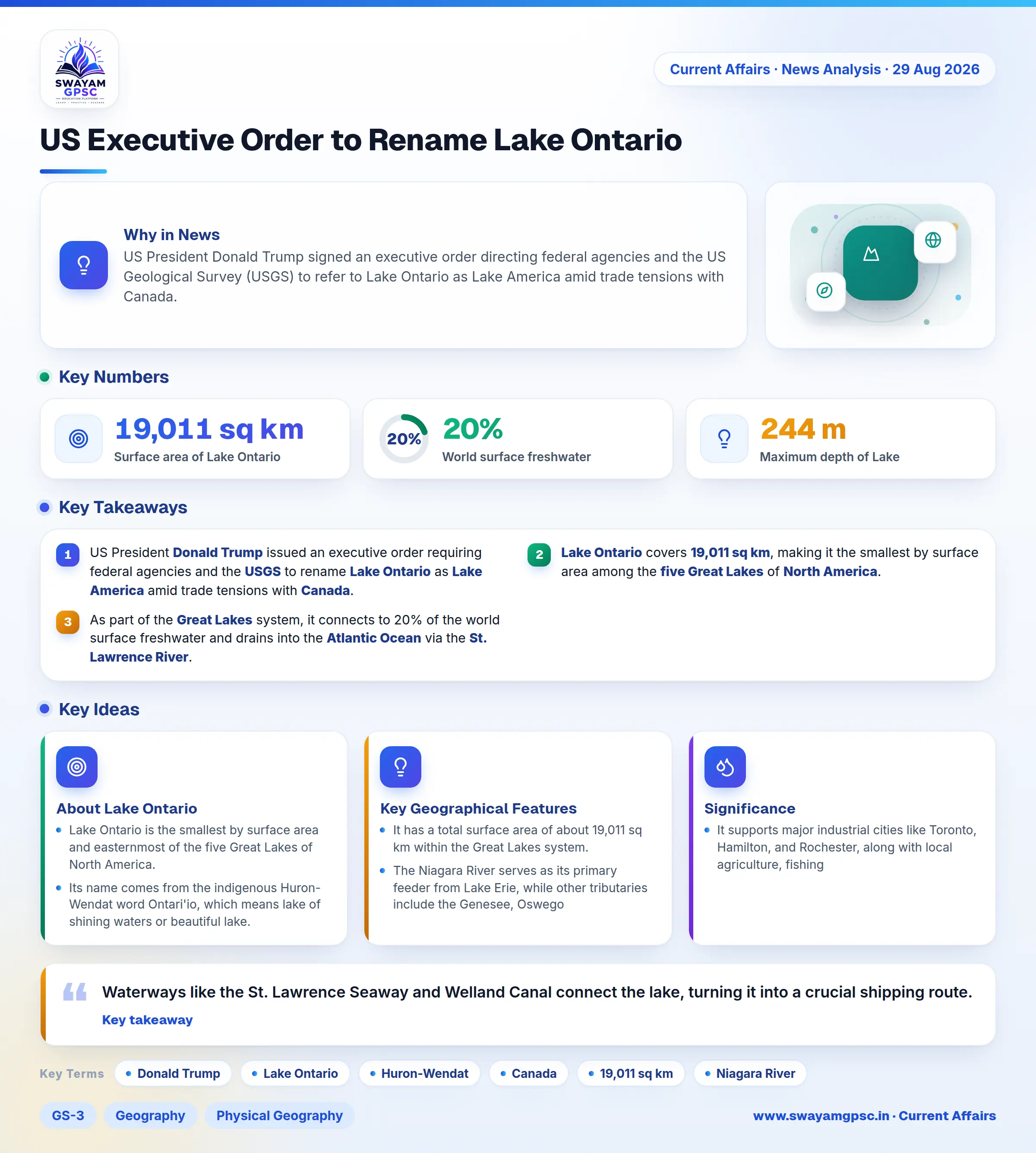
- US President Donald Trump issued an executive order requiring federal agencies and the USGS to rename Lake Ontario as Lake America amid trade tensions with Canada.
- Lake Ontario covers 19,011 sq km, making it the smallest by surface area among the five Great Lakes of North America.
- As part of the Great Lakes system, it connects to 20% of the world surface freshwater and drains into the Atlantic Ocean via the St. Lawrence River.
Why in News
- US President Donald Trump signed an executive order directing federal agencies and the US Geological Survey (USGS) to refer to Lake Ontario as Lake America amid trade tensions with Canada.
About Lake Ontario
- Lake Ontario is the smallest by surface area and easternmost of the five Great Lakes of North America.
- Its name comes from the indigenous Huron-Wendat word Ontari'io, which means lake of shining waters or beautiful lake.
- The lake forms a natural international boundary between Canada and the United States in North America.
Key Geographical Features
- It has a total surface area of about 19,011 sq km within the Great Lakes system.
- The Niagara River serves as its primary feeder from Lake Erie, while other tributaries include the Genesee, Oswego, Black, and Trent rivers.
- It drains eastward into the St. Lawrence River, which eventually flows into the Atlantic Ocean.
- Glaciers from the Pleistocene epoch shaped its basin, creating a mean depth of 86 m and a maximum depth of 244 m.
- The Great Lakes system holds around 20% of the world surface freshwater and provides drinking water to millions of people.
Significance
- Waterways like the St. Lawrence Seaway and Welland Canal connect the lake, turning it into a crucial shipping route.
- It supports major industrial cities like Toronto, Hamilton, and Rochester, along with local agriculture, fishing, and tourism.