US Completes Military Withdrawal from Iraq
#GS-2 #Current Events #International #GS-3 #Geography #Resources
Key takeaways
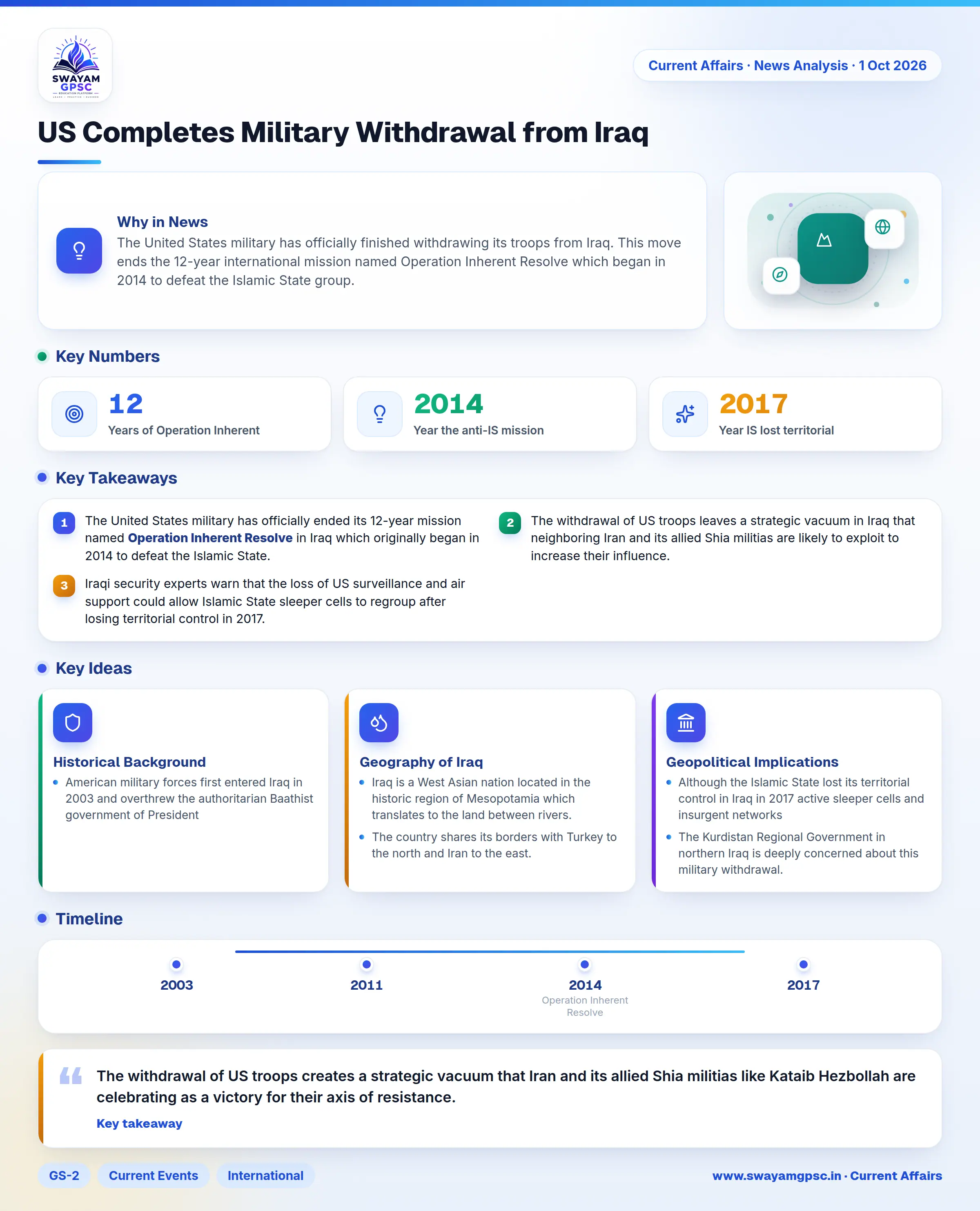
- The United States military has officially ended its 12-year mission named Operation Inherent Resolve in Iraq which originally began in 2014 to defeat the Islamic State.
- The withdrawal of US troops leaves a strategic vacuum in Iraq that neighboring Iran and its allied Shia militias are likely to exploit to increase their influence.
- Iraqi security experts warn that the loss of US surveillance and air support could allow Islamic State sleeper cells to regroup after losing territorial control in 2017.
Why in News
- The United States military has officially finished withdrawing its troops from Iraq. This move ends the 12-year international mission named Operation Inherent Resolve which began in 2014 to defeat the Islamic State group. This complete withdrawal represents a major shift in the security and geopolitical landscape of West Asia.
Historical Background
- American military forces first entered Iraq in 2003 and overthrew the authoritarian Baathist government of President Saddam Hussein. Although US forces withdrew in 2011 the Iraqi government invited them back in 2014 to fight the rapid expansion of the Islamic State which had taken control of nearly one third of the country's territory.
Geography of Iraq
- Iraq is a West Asian nation located in the historic region of Mesopotamia which translates to the land between rivers.
- The country shares its borders with Turkey to the north and Iran to the east. It also borders Kuwait and the Persian Gulf to the southeast, Saudi Arabia to the south, Jordan to the southwest, and Syria to the west.
- The Tigris and Euphrates rivers define the geography and agriculture of Iraq. These two rivers flow southeast across the nation and merge to form the Shatt al-Arab before emptying into the Persian Gulf.
- The landscape of the country consists of the Syrian Desert in the west and the fertile Mesopotamian alluvial plain in the center. It also features the rugged Zagros Mountains in the northeast Kurdish region.
Geopolitical Implications
- The withdrawal of US troops creates a strategic vacuum that Iran and its allied Shia militias like Kataib Hezbollah are celebrating as a victory for their axis of resistance. Iran is highly likely to use this opening to deepen its political and military influence over the central government of Iraq.
- Although the Islamic State lost its territorial control in Iraq in 2017 active sleeper cells and insurgent networks still remain. Iraqi security experts warn that the loss of US airpower, surveillance, and logistics could give these extremist groups the space they need to regroup.
- The Kurdistan Regional Government in northern Iraq is deeply concerned about this military withdrawal. This region has faced frequent drone and ballistic missile attacks from groups backed by Iran, and the removal of US air defense systems from Erbil leaves them highly vulnerable to future strikes.