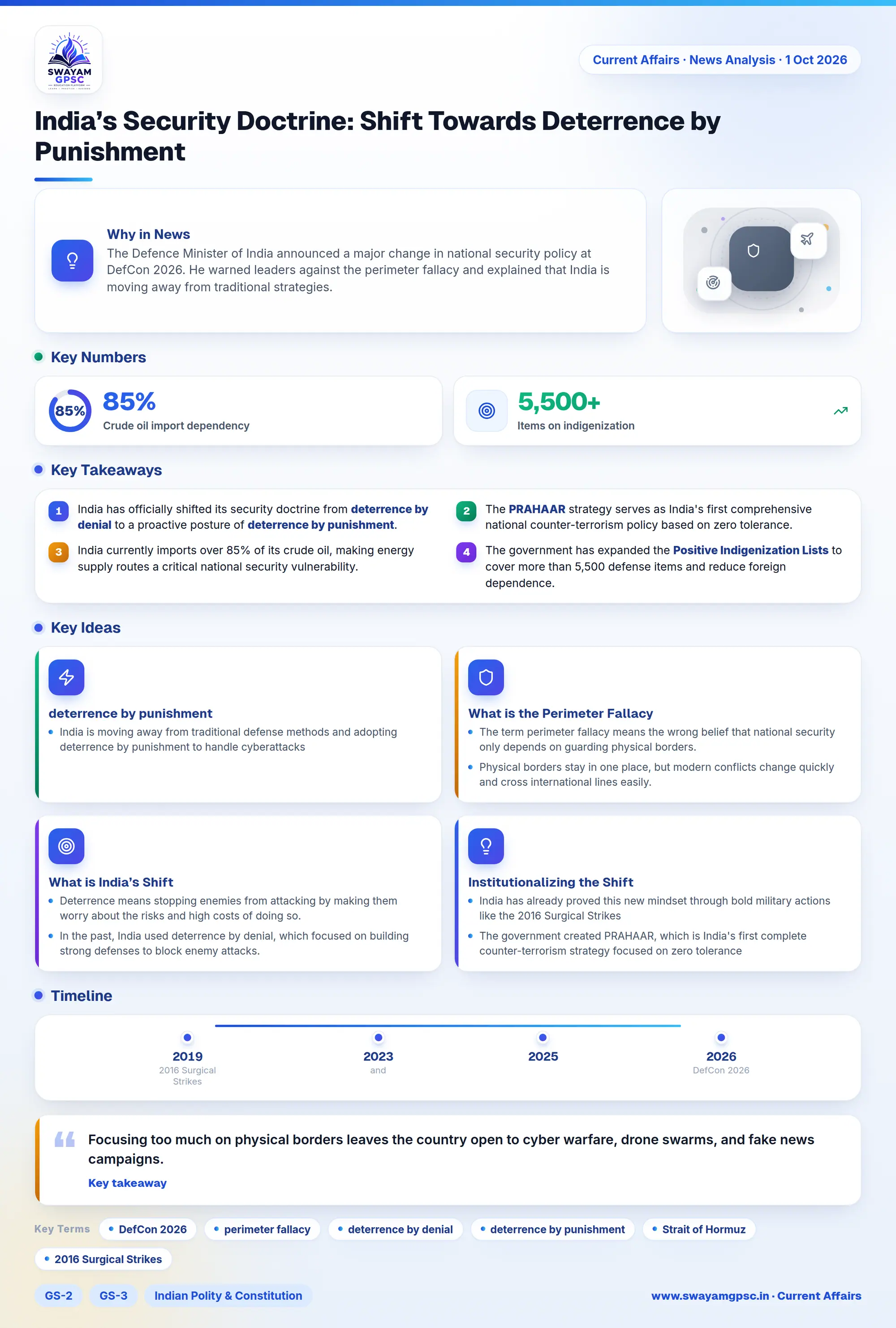
India’s Security Doctrine: Shift Towards Deterrence by Punishment
#GS-2 #GS-3 #Indian Polity & Constitution #National #Economy #Infrastructure #Science & Technology #Cyber Security #Terrorism in Hinterland & Border Areas #Security Challenges & their Management in Border Areas #Challenges to Internal Security Through Communication Networks
Key takeaways
- India has officially shifted its security doctrine from deterrence by denial to a proactive posture of deterrence by punishment.
- The PRAHAAR strategy serves as India's first comprehensive national counter-terrorism policy based on zero tolerance.
- India currently imports over 85% of its crude oil, making energy supply routes a critical national security vulnerability.
- The government has expanded the Positive Indigenization Lists to cover more than 5,500 defense items and reduce foreign dependence.
Why in News
- The Defence Minister of India announced a major change in national security policy at DefCon 2026.
- He warned leaders against the perimeter fallacy and explained that India is moving away from traditional strategies.
- The country has officially shifted from strategic containment and deterrence by denial toward a proactive approach called deterrence by punishment.
Summary
- India is moving away from traditional defense methods and adopting deterrence by punishment to handle cyberattacks, drones, gray-zone warfare, and energy risks.
- Building strong national security needs domestic defense manufacturing, joint military commands, smart intelligence work, and cooperation across all government departments.
What is the Perimeter Fallacy
- The term perimeter fallacy means the wrong belief that national security only depends on guarding physical borders.
- Physical borders stay in one place, but modern conflicts change quickly and cross international lines easily.
- Relying only on border walls and soldiers is not enough to stop modern threats like drone attacks, cyber hacks, fake news, and hidden attacks.
- Security now includes the economy and energy supplies because enemies can bypass borders to disrupt supply chains.
- For example, India buys most of its crude oil from abroad, making vital sea routes like the Strait of Hormuz a major national security risk.
What is India’s Shift Towards Deterrence by Punishment
- Deterrence means stopping enemies from attacking by making them worry about the risks and high costs of doing so.
- In the past, India used deterrence by denial, which focused on building strong defenses to block enemy attacks.
- The new deterrence by punishment strategy focuses on making attackers pay heavy and painful consequences after they cross the line.
- This new approach works only when India has strong retaliatory power, sends clear warnings, and stays fully prepared for military action.
Institutionalizing the Shift Towards Deterrence by Punishment
- India has already proved this new mindset through bold military actions like the 2016 Surgical Strikes, the 2019 Balakot air strikes, and Operation Sindoor (2025).
- The government created PRAHAAR, which is India's first complete counter-terrorism strategy focused on zero tolerance and smart intelligence.
- India now uses diplomatic pressure and trade actions, such as using the Financial Action Task Force (FATF) to isolate hostile neighbors globally.
- Other strong steps include keeping the Indus Waters Treaty (1960) suspended, halting bilateral trade, closing the Attari-Wagah Integrated Check Post, and building military strength.
Challenges to India's Security Architecture
- Focusing too much on physical borders leaves the country open to cyber warfare, drone swarms, and fake news campaigns.
- The November 2025 Red Fort car bombing proved that terrorists mix physical attacks with encrypted messaging to beat normal border security.
- India imports over 85% of its crude oil, leaving the economy exposed when shipping routes like the Strait of Hormuz and Red Sea/Gulf of Aden face trouble from groups like the Houthis.
- Relying on foreign countries for semiconductors, advanced electronics, Active Pharmaceutical Ingredients (APIs), and rare earth elements puts India's defense industry at risk.
- China and Pakistan work together using gray-zone tactics, which are hostile actions that stay just below the level of open war.
- While national agencies like the National Critical Information Infrastructure Protection Centre (NCIIPC) and Indian Cyber Crime Coordination Centre (I4C) are advanced, local police struggle with digital evidence under the Bharatiya Sakshya Adhiniyam (BSA), 2023.
Measures Needed to Build a Resilient Security Architecture
- India must quickly set up integrated theater commands under the Chief of Defence Staff (CDS) to improve joint planning and resource sharing.
- The government should expand the Positive Indigenization Lists, which already cover over 5,500 items, to stop importing key defense equipment.
- India must grow the iDEX (Innovations for Defence Excellence) program and ensure that 25% of the defense research budget goes to private companies and universities.
- Critical computer networks in banking, utilities, and telecom must share data in real-time with CERT-In to prevent massive cyber collapses.
- India needs to build up its Strategic Petroleum Reserves (SPRs) beyond the current 9.5-day supply and use trade routes like the India-Middle East-Europe Economic Corridor (IMEC).
- Local police and national intelligence networks like NATGRID and the Samanvaya platform must work together seamlessly to stop terror financing and cyber crimes.
Conclusion
- India's shift from passive border defense to active deterrence by punishment shows how the country is adapting to modern warfare.
- By combining strong military power, energy security, and strategies like PRAHAAR, India is building a reliable shield against complex threats.