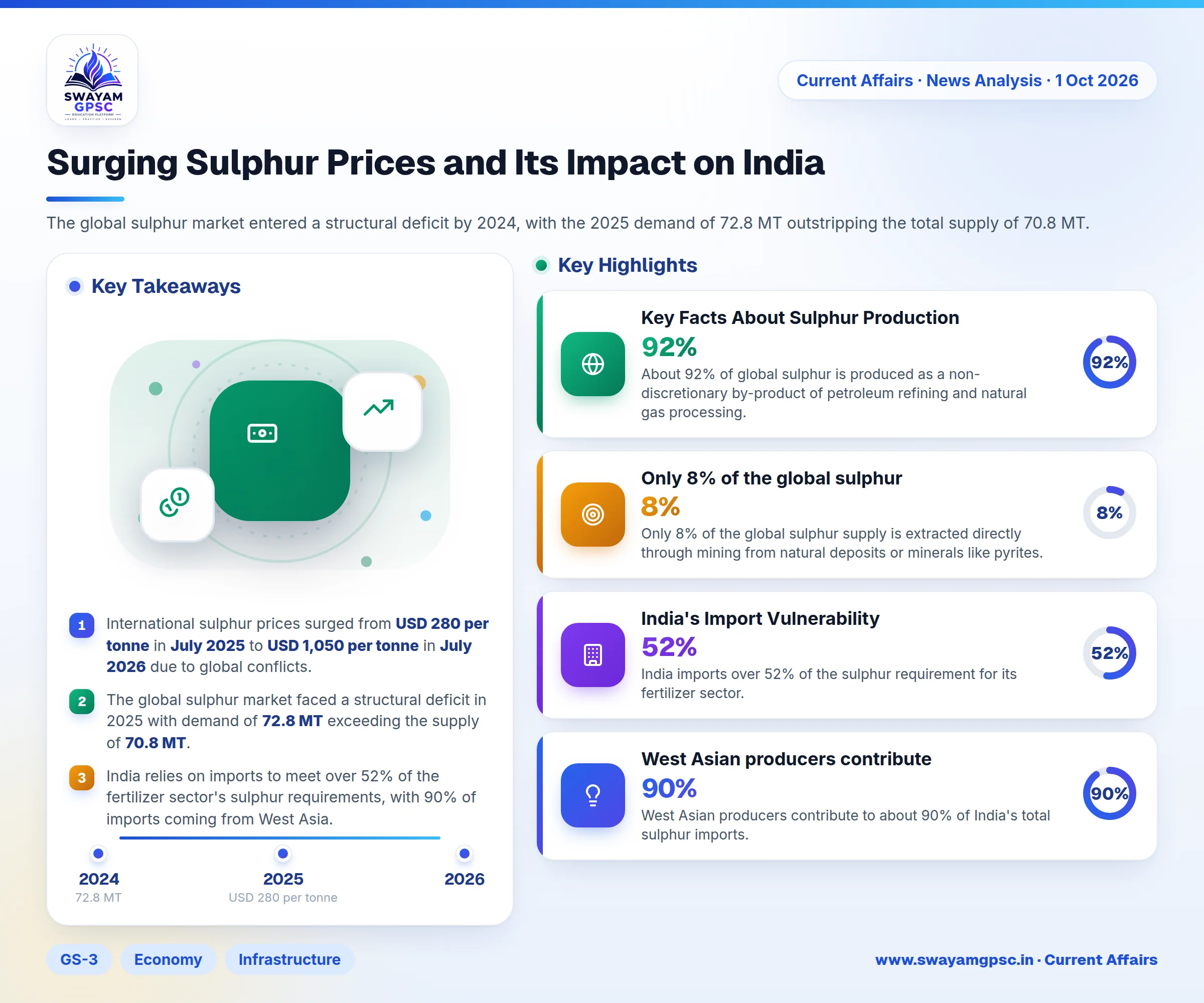
Surging Sulphur Prices and Its Impact on India
#GS-3 #Economy #Infrastructure #Environment #Resources #Current Events #International
Key takeaways
- International sulphur prices surged from USD 280 per tonne in July 2025 to USD 1,050 per tonne in July 2026 due to global conflicts.
- The global sulphur market faced a structural deficit in 2025 with demand of 72.8 MT exceeding the supply of 70.8 MT.
- India relies on imports to meet over 52% of the fertilizer sector's sulphur requirements, with 90% of imports coming from West Asia.
- Russia has restricted its industrial sulphur exports until 31st December 2026 following drone strikes on its Astrakhan plant.
Why in News
- International sulphur prices surged from USD 280 per tonne in July 2025 to USD 1,050 per tonne in July 2026 because of the Russia-Ukraine war and West Asian conflicts.
- This price hike has increased India's import burden and threatened supply chains in both the agriculture and metal processing sectors.
Key Facts About Sulphur Production
- About 92% of global sulphur is produced as a non-discretionary by-product of petroleum refining and natural gas processing.
- Only 8% of the global sulphur supply is extracted directly through mining from natural deposits or minerals like pyrites.
- China is the world's largest producer of sulphur, followed by the US, Russia, Saudi Arabia, and the UAE.
Market Deficit and EV Battery Connection
- The global sulphur market entered a structural deficit by 2024, with the 2025 demand of 72.8 MT outstripping the total supply of 70.8 MT.
- The metal processing industry is a major new driver of sulphur demand because sulphuric acid is crucial for High-Pressure Acid Leach (HPAL) plants.
- These HPAL plants use sulphuric acid to extract nickel from laterite ores, which is an indispensable component for manufacturing EV batteries in countries like Indonesia.
Russia Ukraine Supply Shock
- Repeated Ukrainian drone strikes on Russia's Astrakhan gas processing plant severely damaged its sulphur recovery infrastructure.
- As a result, Russia restricted its industrial sulphur exports until 31st December 2026 to manage its own domestic demand.
India's Import Vulnerability
- India is among the top ten producers of sulphur with 3.7 MT but still relies heavily on imports to meet its domestic demand.
- India imports over 52% of the sulphur requirement for its fertilizer sector.
- West Asian producers contribute to about 90% of India's total sulphur imports.
- In 2025, India imported 2.25 MT of sulphur, with 2.02 MT coming from West Asia and 0.15 MT or 6.5% coming from Russia.
Economic Impact on India
- Geopolitical uncertainties are likely to continue, forcing India to face a much higher import bill.
- This price surge will also increase the government's agricultural fertilizer subsidy burden, which could hurt food security and increase inflation.