Rising Indian Household Debt and Its Macroeconomic Risks
#GS-3 #Economy #Banking #Growth #GS-2 #Governance & Social Justice #Poverty #Current Events #National #Household Debt #Consumer Credit #Financial Savings #Reserve Bank of India
Key takeaways
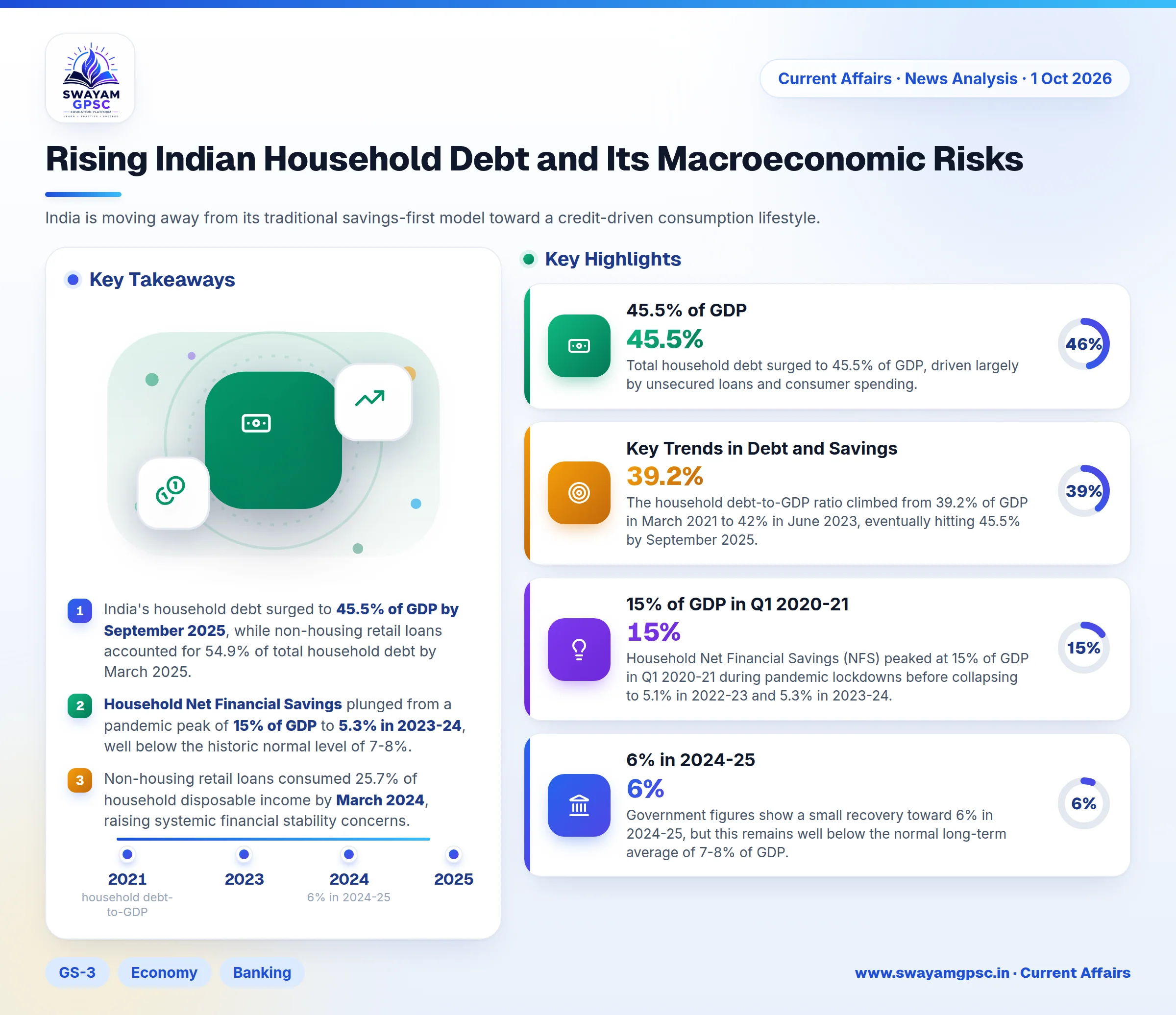
- India's household debt surged to 45.5% of GDP by September 2025, while non-housing retail loans accounted for 54.9% of total household debt by March 2025.
- Household Net Financial Savings plunged from a pandemic peak of 15% of GDP to 5.3% in 2023-24, well below the historic normal level of 7-8%.
- Non-housing retail loans consumed 25.7% of household disposable income by March 2024, raising systemic financial stability concerns.
- In response to surging unsecured digital lending, the Reserve Bank of India (RBI) raised risk weights on consumer credit in November 2023 to curb over-leveraging.
Why in News
- India is recording a sharp surge in household debt across the country.
- At the same time, household net financial savings have fallen sharply from their pandemic peak.
- This shift raises big questions about how long credit-led spending can last as families borrow heavily against future earnings.
Overview
- India is moving away from its traditional savings-first model toward a credit-driven consumption lifestyle.
- Total household debt surged to 45.5% of GDP, driven largely by unsecured loans and consumer spending.
- While access to loans can aid growth, excessive borrowing weakens financial safety nets, deepens inequality, and risks broader banking stability.
- To fix this, the country needs real wage growth, cautious lending norms, and stronger social safety systems.
Key Trends in Debt and Savings
- The household debt-to-GDP ratio climbed from 39.2% of GDP in March 2021 to 42% in June 2023, eventually hitting 45.5% by September 2025.
- Household Net Financial Savings (NFS) peaked at 15% of GDP in Q1 2020-21 during pandemic lockdowns before collapsing to 5.1% in 2022-23 and 5.3% in 2023-24.
- Government figures show a small recovery toward 6% in 2024-25, but this remains well below the normal long-term average of 7-8% of GDP.
- Gross financial liabilities jumped from 3.9% of GDP in 2020-21 to 6.4% in 2023-24, showing a growing willingness to take on debt.
- Borrowing has shifted away from asset-building housing loans toward consumption, with non-housing loans making up 54.9% of total household debt as of March 2025.
- Unsecured personal loans, credit card balances, and Buy-Now-Pay-Later (BNPL) schemes are growing much faster than traditional home or business credit.
- By March 2024, servicing these non-housing loans consumed 25.7% of total household disposable income.
- Household allocations to Mutual Funds (MFs) rose from 2.1% of financial flows in 2020-21 to 7% in 2023-24, showing a shift from fixed bank deposits to market-linked assets.
Drivers of Rising Household Debt
- Fintech apps and instant credit options have removed friction from borrowing, confusing actual buying power with debt limits.
- Flat real wage growth in the unorganized and informal sectors forces workers to use loans for everyday living expenses.
- Rising out-of-pocket costs for healthcare, education, and house rent push families into debt because public safety nets remain weak.
- Changing lifestyle norms and strong post-pandemic optimism have made it common to fund discretionary upgrades with borrowed money.
Challenges and Macroeconomic Risks
- Lower household savings shrink the pool of domestic capital available for Gross Capital Formation, hurting long-term industrial investment.
- Rising debt-servicing burdens eat into future spending, pushing average borrower debt up by 23% between 2023 and 2025 through fresh loans taken to pay old debts.
- A K-shaped divide is worsening as poorer households borrow for basic survival while affluent families build wealth through financial markets.
- A surge in unsecured consumer credit raises the threat of sudden Non-Performing Asset (NPA) spikes for banks and lending institutions.
- A drop in domestic savings forces higher reliance on foreign capital, raising Current Account Deficit (CAD) risks, especially after foreign investors pulled a record Rs 1.66 lakh crore from India in 2025.
- The RBI Annual Report 2024-25 notes that informal workers face unstable earnings, making it dangerous for them to service unsecured debt.
- Credit access gives an illusion of rising prosperity while merely delaying income problems, which led the RBI to raise risk weights on consumer loans in November 2023.
- High household leverage makes consumer spending overly sensitive to interest rate hikes set by the central bank.
- Higher gold prices create an illusion of wealth by letting families borrow more against jewellery without improving their actual monthly income.
Way Forward
- The Reserve Bank of India (RBI) should implement strict debt-to-income caps and restrict aggressive algorithmic lending on digital platforms.
- Regulations should promote asset-creating loans like housing and education while keeping higher risk weights on consumption credit like BNPL.
- Policymakers must encourage steady manufacturing jobs through initiatives like Production Linked Incentive (PLI) schemes to lift real wages.
- Retail investors should get low-cost financial guidance toward disciplined wealth-building tools like Equity-Linked Savings Schemes (ELSS) and Systematic Investment Plans (SIPs).
- Expanding public healthcare and basic social security will directly prevent households from taking high-cost distress loans.
Conclusion
- Rising debt becomes dangerous when loans replace basic income rather than building productive, wealth-generating assets.
- India needs an income-led economic model backed by solid social security and disciplined lending so citizens build their future safely.