Green Energy Corridor Phase-III Scheme
#GS-3 #Economy #Infrastructure #Energy #Environment #Sustainable Development #Government Policies & Interventions #Renewable Energy #Growth & Development
Key takeaways
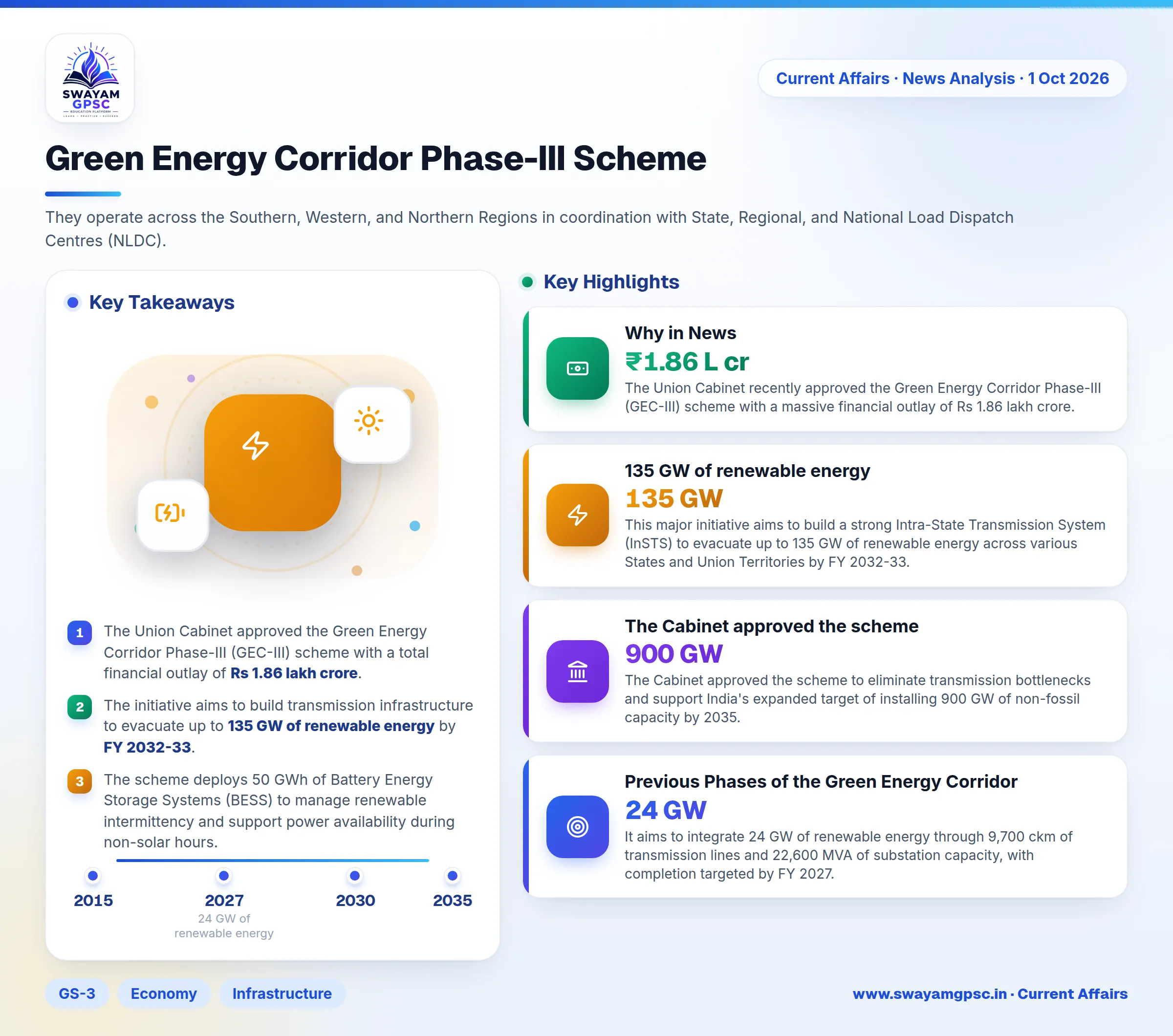
- The Union Cabinet approved the Green Energy Corridor Phase-III (GEC-III) scheme with a total financial outlay of Rs 1.86 lakh crore.
- The initiative aims to build transmission infrastructure to evacuate up to 135 GW of renewable energy by FY 2032-33.
- The scheme deploys 50 GWh of Battery Energy Storage Systems (BESS) to manage renewable intermittency and support power availability during non-solar hours.
- Central financial assistance under the scheme amounts to Rs 54,082 crore to help reduce transmission and power costs for end users.
- The project supports India's expanded target of installing 900 GW of non-fossil capacity by 2035 and achieving Net Zero by 2070.
Why in News
- The Union Cabinet recently approved the Green Energy Corridor Phase-III (GEC-III) scheme with a massive financial outlay of Rs 1.86 lakh crore.
- This major initiative aims to build a strong Intra-State Transmission System (InSTS) to evacuate up to 135 GW of renewable energy across various States and Union Territories by FY 2032-33.
- The Cabinet approved the scheme to eliminate transmission bottlenecks and support India's expanded target of installing 900 GW of non-fossil capacity by 2035.
Key Features of the Green Energy Corridor
- The GEC is a critical national infrastructure initiative implemented by the Ministry of New and Renewable Energy (MNRE) to efficiently integrate renewable electricity with conventional power stations, ensure grid stability, and help India meet its climate change commitments.
- Stemming from a 2012 Power Grid Corporation of India Limited (PGCIL) study, the project was launched in 2015 to upgrade existing power grids that were incapable of handling the erratic and geographically dispersed nature of large-scale renewable generation.
- The Inter-State Transmission System (ISTS) develops high-voltage transmission lines to evacuate power across state boundaries from renewable energy-rich states to high-demand regions via the central grid.
- Central Financial Assistance (CFA) will offset intra-state transmission charges, helping reduce power costs for end users and DISCOMs.
- The Intra-State Transmission System (InSTS) focuses on strengthening local transmission networks to distribute renewable energy efficiently within different districts of the same state.
- Renewable Energy Management Centres (REMCs) utilize real-time data and forecasting tools to balance the irregular generation patterns of solar and wind power.
- They operate across the Southern, Western, and Northern Regions in coordination with State, Regional, and National Load Dispatch Centres (NLDC).
- Grid stability mechanisms deploy Reactive Power Compensation (RPC) to correct voltage fluctuations and Energy Storage Systems (ESS) like grid-scale batteries to store excess power for dispatch during peak demand or low generation periods.
Previous Phases of the Green Energy Corridor
- GEC Phase-I is being implemented across eight renewable-rich states including Tamil Nadu, Rajasthan, Karnataka, Andhra Pradesh, Maharashtra, Gujarat, Himachal Pradesh, and Madhya Pradesh.
- It aims to integrate 24 GW of renewable energy through 9,700 ckm of transmission lines and 22,600 MVA of substation capacity, with completion targeted by FY 2027.
- GEC Phase-II envisages 10,750 ckm of transmission lines and 27,500 MVA of substation capacity to evacuate around 20 GW of renewable energy across 7 States including Gujarat, Himachal Pradesh, Karnataka, Kerala, Rajasthan, Tamil Nadu, and Uttar Pradesh.
- It was implemented during 2021-22 to 2025-26 with CFA to reduce transmission charges and keep electricity costs lower.
- The earlier phases support India's energy security, reduce carbon emissions, generate employment, and align with the target of integrating over 500 GW of non-fossil fuel-based capacity by 2030.
Green Energy Corridor Phase-III Details
- The scheme provides Rs 1.36 lakh crore for transmission infrastructure and Rs 50,000 crore for storage, supported by Rs 54,082 crore in Central Financial Assistance.
- It aims to evacuate up to 135 Gigawatt (GW) of renewable energy across various States and Union Territories by FY 2032-33.
- The project focuses exclusively on strengthening and expanding the InSTS to connect renewable-rich zones directly with regional load centers.
- It integrates 50 GWh of Battery Energy Storage Systems (BESS) at generator terminals and critical nodes to address renewable intermittency, prevent peak-hour curtailment, manage grid congestion, and provide round-the-clock power during non-solar hours.
- Greenfield projects are executed through Tariff Based Competitive Bidding (TBCB) under a Build-Own-Operate-Maintain (BOOM) framework.
- Brownfield projects and network upgrades are undertaken on a Cost Plus Basis (CPB).
- State Transmission Utilities (STUs) serve as the principal implementing bodies in coordination with private and public Transmission Service Providers (TSPs).
- The project serves as a critical infrastructure backbone to help India achieve its expanded target of 900 GW of installed non-fossil fuel capacity by 2035 while driving domestic battery manufacturing and grid management capabilities.
- By strengthening domestic transmission and storage capability, GEC-III reduces dependence on fossil-fuel-based balancing generation and improves the system's ability to absorb variable solar and wind power, thereby supporting long-term energy security.
Significance and Benefits
- Central financial assistance reduces transmission and wheeling costs for distribution companies.
- Improved infrastructure enables greater utilization of renewable power across different regions of the country.
- Combining intra-state transmission with grid-scale storage enables greater integration of round-the-clock renewable power.
- The initiative supports India's Net Zero 2070 pathway by lowering carbon emissions.
- It boosts domestic production of battery cells, high-voltage transformers, and digital grid equipment while generating skilled employment in the power sector.