The UPSC EWS Quota Investigation
#GS-2 #Economy #Governance & Social Justice #Poverty #Constitution
Key takeaways
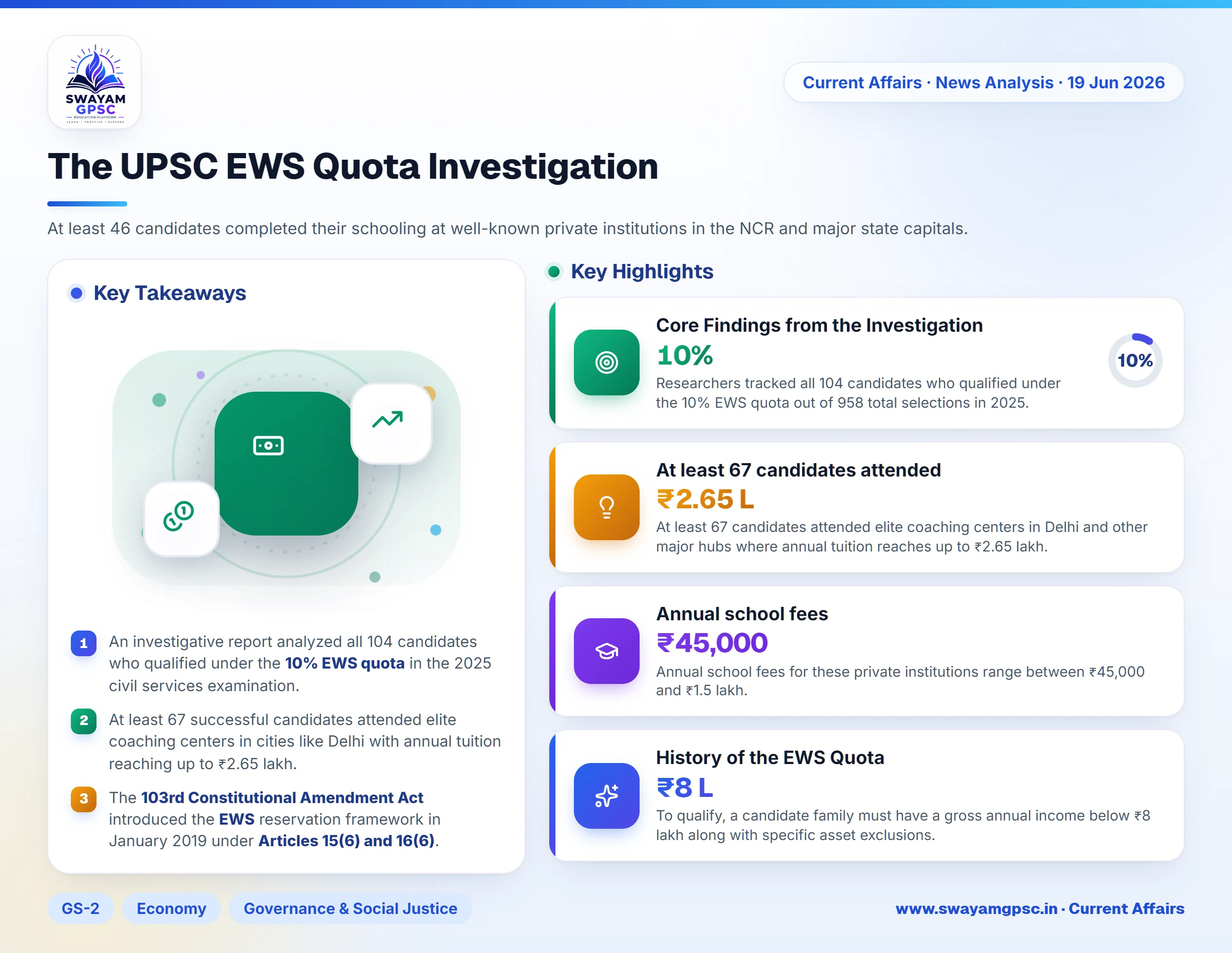
- An investigative report analyzed all 104 candidates who qualified under the 10% EWS quota in the 2025 civil services examination.
- At least 67 successful candidates attended elite coaching centers in cities like Delhi with annual tuition reaching up to ₹2.65 lakh.
- The 103rd Constitutional Amendment Act introduced the EWS reservation framework in January 2019 under Articles 15(6) and 16(6).
- To qualify for the EWS reservation, a candidate family must maintain a gross annual income below ₹8 lakh.
Why in News
- An investigative report by The Indian Express recently revealed a wide gap between welfare goals and candidate profiles.
- The report analyzed candidates who cleared the Civil Services Examination (CSE) 2025 under the EWS quota.
Core Findings from the Investigation
- Researchers tracked all 104 candidates who qualified under the 10% EWS quota out of 958 total selections in 2025.
- At least 67 candidates attended elite coaching centers in Delhi and other major hubs where annual tuition reaches up to ₹2.65 lakh.
- A total of 84 out of 104 successful candidates relied on formal private coaching networks.
- At least 46 candidates completed their schooling at well-known private institutions in the NCR and major state capitals.
- Annual school fees for these private institutions range between ₹45,000 and ₹1.5 lakh.
- The parents of at least 28 candidates own active commercial businesses across the NCR, state capitals, and district headquarters.
- At least 10 candidates worked in the private sector at multinational corporations or large firms before their civil services preparation.
- Successful candidates include 14 graduates or postgraduates from the IITs, 3 from NITs, 27 from Delhi University, and 3 from JNU.
- Successful EWS candidates primarily hail from Uttar Pradesh (25), Bihar (17), Madhya Pradesh (14), Haryana (9), and Rajasthan (8).
History of the EWS Quota
- The Government of India introduced the EWS reservation framework in January 2019.
- The framework was established through the 103rd Constitutional Amendment Act.
- This amendment inserted Articles 15(6) and 16(6) into the Constitution of India.
- It enables the state to provide up to 10% reservation in educational institutions and initial public employment.
- To qualify, a candidate family must have a gross annual income below ₹8 lakh along with specific asset exclusions.
The Structural Need for the EWS Quota
- The quota creates a legal safety net for economically disadvantaged individuals belonging to the general category.
- It introduces economic status as a valid marker for affirmative action alongside traditional caste-based policies.
- The policy helps reduce educational and employment disparities for low-income families.
- It offers a vital path toward upward social mobility for the children of small-scale farmers and laborers.
- The measure helps institutionalize the constitutional promise of inclusive growth across all communities.
Challenges Associated with the EWS Framework
- Setting the gross family income ceiling at ₹8 lakh per year makes the criteria too wide.
- Local certificate-issuing authorities frequently rely on basic self-declarations without thorough asset audits.
- Affluent general-category individuals who can afford private schooling often crowd out truly underprivileged candidates.
- Sustaining multi-year preparation in expensive hubs like New Delhi indicates a high level of underlying financial stability.
- Revenue departments lack a unified digital registry to verify cross-border property holdings and informal business revenues.
Way Forward
- Authorities should re-evaluate and reduce the annual family income criteria below the current ₹8 lakh baseline.
- Local revenue departments must move past simple self-declarations and run deep field verifications of family assets.
- The government should link EWS applications directly with the Income Tax Department and EPFO registries.
- Building a unified digital property tracking network across states can help identify hidden urban real estate holdings.
- The Department of Personnel and Training should form an expert panel to audit EWS selection profiles annually.