Political Funding in India: The RUPP Conundrum
#GS-2 #Indian Polity & Constitution #Governance & Social Justice #Current Events #Representation of the People Act #Electoral Reforms #Election Commission of India #Political Funding
Key takeaways
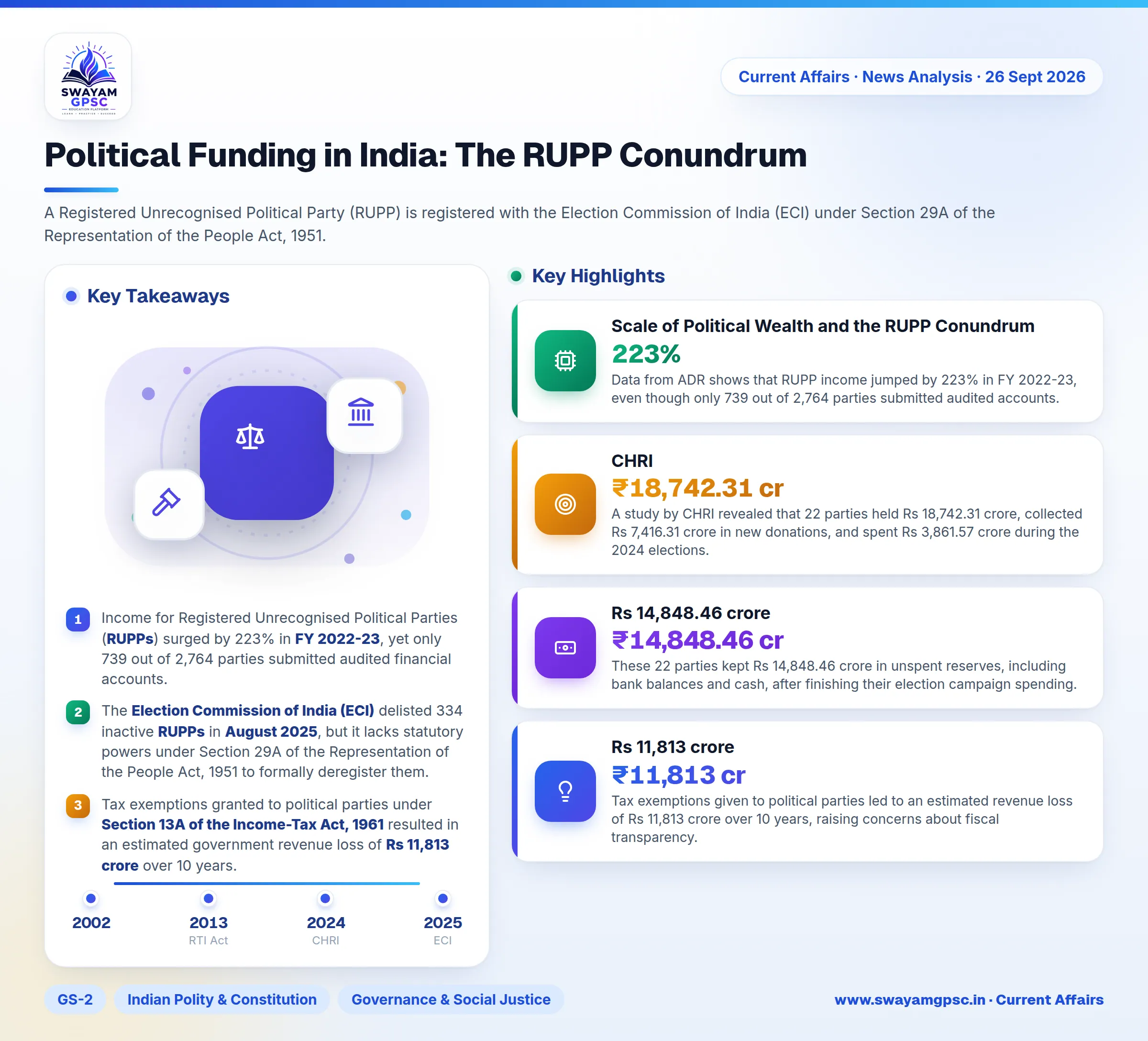
- Income for Registered Unrecognised Political Parties (RUPPs) surged by 223% in FY 2022-23, yet only 739 out of 2,764 parties submitted audited financial accounts.
- The Election Commission of India (ECI) delisted 334 inactive RUPPs in August 2025, but it lacks statutory powers under Section 29A of the Representation of the People Act, 1951 to formally deregister them.
- Tax exemptions granted to political parties under Section 13A of the Income-Tax Act, 1961 resulted in an estimated government revenue loss of Rs 11,813 crore over 10 years.
- During the 2024 elections, 22 major political parties retained Rs 14,848.46 crore in unspent reserves after spending Rs 3,861.57 crore on campaigns.
- Experts recommend amending Section 29A to empower the ECI to deregister shell parties and mandating independent financial audits by CAG-empanelled auditors.
Why in News
- Former Election Commissioner Ashok Lavasa highlighted serious issues with unaccounted political funding in India.
- A BBC investigation revealed suspicious donations made to several unrecognised political parties.
- He urged the government to take strong action against shell parties, require independent financial audits, and reform tax-exemption rules.
What is an RUPP?
- A Registered Unrecognised Political Party (RUPP) is registered with the Election Commission of India (ECI) under Section 29A of the Representation of the People Act, 1951.
- These parties have not satisfied the minimum performance requirements in elections to become a recognized national or state party.
Constitutional and Legal Framework
- The Constitution of India does not fully define political parties, but the Tenth Schedule acknowledges them regarding anti-defection rules.
- Citizens have the fundamental right to form political parties under Article 19(1)(c) of the Constitution.
- Party registration follows Section 29A of the Representation of the People Act, 1951, and a 2002 Supreme Court ruling restricts deregistration to rare cases like fraud.
- The ECI can delist parties that do not contest elections for 6 straight years, which removes them from operational lists without formal statutory deregistration.
- Under Section 13A of the Income-Tax Act, 1961, parties get tax exemptions only if they maintain audited accounts, report contributions, and file tax returns on time.
Scale of Political Wealth and the RUPP Conundrum
- Data from ADR shows that RUPP income jumped by 223% in FY 2022-23, even though only 739 out of 2,764 parties submitted audited accounts.
- The ECI delisted 334 out of 2,854 RUPPs in August 2025 because of long electoral inactivity and failure to follow rules.
- A study by CHRI revealed that 22 parties held Rs 18,742.31 crore, collected Rs 7,416.31 crore in new donations, and spent Rs 3,861.57 crore during the 2024 elections.
- These 22 parties kept Rs 14,848.46 crore in unspent reserves, including bank balances and cash, after finishing their election campaign spending.
- Tax exemptions given to political parties led to an estimated revenue loss of Rs 11,813 crore over 10 years, raising concerns about fiscal transparency.
- In FY 2022-23, individuals and HUFs claimed Rs 2,275.85 crore in tax deductions, while companies claimed Rs 514.4 crore and firms claimed Rs 115.71 crore.
- Out of Rs 28,287 crore in political donations over 9 years, only 41.76% involved tax-deduction claims, leaving the rest to be examined.
Challenges
- Inactive RUPPs that do not fight elections or disclose finances create loopholes for misusing donations and reporting fake expenses.
- The Supreme Court struck down the Electoral Bond Scheme in 2024, but concerns about donor anonymity and corporate influence remain unresolved.
- Political parties continue to resist the Central Information Commission (CIC) ruling of 2013 that labeled major national parties as public authorities under the RTI Act.
- Individual candidates have legal spending limits during elections, but political parties face no overall spending caps, leading to massive campaign expenditures.
Way Forward
- Establish independent financial audits of political parties through CAG-empanelled auditors backed by clear legislation that defines ECI oversight.
- Parliament should amend Section 29A of the Representation of the People Act, 1951 to grant explicit powers to deregister inactive, non-compliant, or fraudulent parties.
- Set statutory spending ceilings for political party campaigns along with stricter rules for receiving tax exemptions.
- Launch a unified digital portal where all registered parties must publish their audited financial statements, donor lists, and expenses in a standardized public format.
- Conduct independent investigations into suspicious donations and financial irregularities using judicial oversight and fair legal procedures.
Conclusion
- The vast number of inactive RUPPs shows that the electoral registry is being abused for tax evasion due to a lack of deregistration powers.
- Protecting election integrity requires amending the Representation of the People Act, 1951, making party accounts public, and tying tax exemptions directly to genuine democratic participation.